
Here’s what to expect in the first Democratic presidential debate
Better late than never.
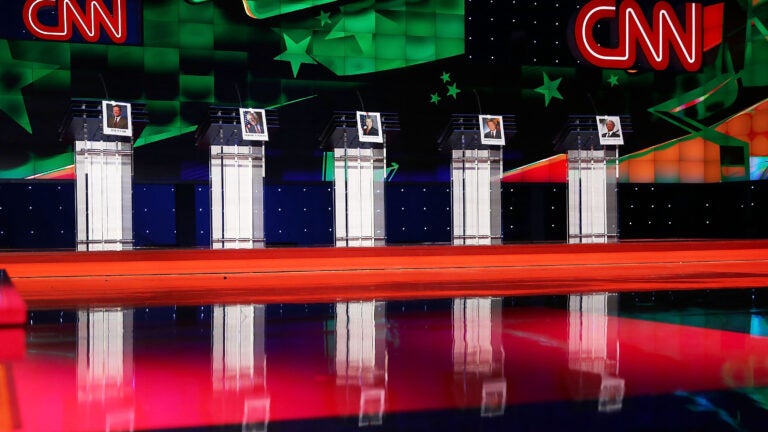
More than two months after the Republicans held their first presidential primary debate, the Democratic candidates will step behind their respective podiums Tuesday in Las Vegas for the first of six debates.
With a strong lead in national polls, Hillary Clinton will take center stage inside the Wynn hotel-casino. Vermont Sen. Bernie Sanders, riding a wave of populist enthusiasm, is expected to attempt to draw a contrast, standing literally and ideologically to Clinton’s left.
Former Maryland Gov. Martin O’Malley will try to introduce himself on the national stage. While former Virginia Sen. Jim Webb and former Rhode Island senator and governor Lincoln Chafee will take their places on the ends of the stage.
Vice President Joe Biden will watch this debate, at least, from the figurative sidelines.
The much-anticipated event brings together candidates who have thus far been reluctant to go on the offensive, particularly compared to their Republican counterparts. But there have been signals that the close confines of the debate stage may stir a change in campaign tactics.
Here’s what to expect from each of the candidates.
Hillary Clinton
The former secretary of state is no stranger to debating — she’s literally been at it since before O’Malley had his second birthday. But pre-debate signs show that Clinton’s focus will be less on O’Malley and more on Sanders.
The New York Timesreported Clinton’s debate preparations have focused on just exactly how Sanders, a democratic socialist, would implement his extensive progressive proposals — which includes single-payer healthcare, tuition-free public colleges, a $15 dollar minimum wage, and a $1 trillion transportation infrastructure bill.
Meanwhile, Clinton, has rolled out a number of detailed policy papers on things from college affordability to Wall Street reform. On many policies, however, Clinton’s campaign has tacked to the left — incidentally boxing out Sanders — particularly within recent weeks.
After a long silence, Clinton announced September 22 that she opposed the proposed Keystone XL pipeline. Last Wednesday in a PBS interview, Clinton also came out against the Trans-Pacific Partnership, a trade deal she previously supported.
But there is one issue that Clinton will certainly emphasize a difference of opinion on: gun control. The Times reported that her debate sessions have included the issue as one where she and Sanders are “at odds.’’ The rural-state senator has a well-documented mixed record when it comes to firearms.
Bernie Sanders
Sanders is nothing if not consistent, and that could be a strength for winning over voters who distrust Clinton, as well as those who still don’t know him (37 percent of Democratic voters, according to a recent CBS News poll).
The independent senator thinks that consistency is an asset. On Meet the Press, he told NBC’s Chuck Todd on Sunday that voters will have to “contrast my consistency and my willingness to stand up to Wall Street and corporations, big corporations, with the secretary,’’ referring to Clinton. Sanders highlighted his long-held opposition to the TPP and Keystone XL pipeline, which he reemphasized on Twitter.
[fragment number=0]
Sanders has also not shied away from stating the differences of opinion he has with Clinton, though neither candidate has directly gone negative against each other.
In an interview with MSNBC’s Chris Hayes, he listed breaking up large banks, the Glass-Steagall Act, and how much to raise the minimum wage as issues that separate himself with Clinton. One other thing the two candidates have historically differed on is the Iraq War, which now-President Barack Obama also used as a focal point in 2008.
“I would point out to you that in perhaps the most significant public policy issue of our time, the war in Iraq, I cast the correct vote,’’ Sanders told CNN in an interview earlier this year. “On the other hand, Secretary Clinton voted for that war. Her judgment was not right. It is an issue we have got to talk more about.’’
The Sanders campaign followed up over the weekend, with a press release detailing his foreign policy experience and the transcript of Sanders’ 2002 speech opposing the war.
Martin O’Malley
While the spotlight will be on Clinton and Sanders, the candidate feeling the most pressure to perform could be the former Maryland governor.
After vocally calling for more than six debates and accusing the Democratic National Committee of having “rigged’’ the schedule to help Clinton, O’Malley acknowledged the debate stage could be “make or break’’ for his campaign. That could spell an aggressive strategy Tuesday night.
O’Malley has already called out Sanders on gun control, as well as Clinton for her “reversal’’ on the TPP deal.
“I didn’t have one opinion 8 months ago and switch that opinion on the eve of debates,’’ O’Malley said in a statement to multiplemediaoutlets, referring to Clinton.
He also told CNN that Clinton was always “quick for the military intervention.’’
However, O’Malley also needs to introduce himself to a national audience, which has some advising a more positive tone that focuses on his own record. In multiple interviews, the former governor has emphasized his executive experience passing laws.
“Whether it’s marriage equality, the DREAM act or tough gun safety reform, Governor O’Malley doesn’t just talk about holding these principles, he delivered on them, and that’s what he can be counted to do as President,’’ O’Malley press secretary Haley Morris told Boston.com.
“Tomorrow night will be the first time Democrats will hear ideas from the whole field so we feel like this is a fight that’s just getting started,’’ she added.
Lincoln Chafee
Positioned on the margins of the debate — on stage and on the campaign trail — Chafee and Webb have nothing to lose.
Chafee’s spokesperson told MSNBC we can “absolutely’’ expect the former Rhode Island Republican senator and independent-turned-Democratic governor to go on the offense in the debate.
Chafee, who has used his campaign to stake out strong positions on odd-ballissues, has not refrained from going after Clinton for her Iraq War vote. Chafee was the only Republican in the senate to vote against the war.
Jim Webb
A former Democratic primary opponent of Webb’s described the former Virginia senator — who also opposed the Iraq War — as an energetic debater.
“Don’t underestimate him, he’s a very smart guy, he’s a very aggressive guy. You can’t treat him like you could a Jim Gilmore,’’ Harvey Miller, who lost to Webb in 2006, told MSNBC. “I would say be careful about raising your boiling point level to his boiling point level, because he can get very energized and say things that sound like the almighty has provided him with some kind of inside information.’’
Larry Lessig
The Harvard law professor and single-issue election reform candidate was not invited to Tuesday’s CNN debate. According to campaign spokesman Brandon Hersh, Lessig will be on MSNBC’s Last Word with Lawrence O’Donnell from 8 to 9 p.m.
Coverage of the debate begins at 8:30 on CNN. Anderson Cooper will be moderating the event, with anchor Don Lemon, political correspondent Dana Bash, and CNN Español anchor Juan Carlos Lopez asking questions.


To comment, please create a screen name in your profile
To comment, please verify your email address
Conversation
This discussion has ended. Please join elsewhere on Boston.com