
Trump, Biden, Bernie: Why Democrats and Republicans are boosting each others’ candidates
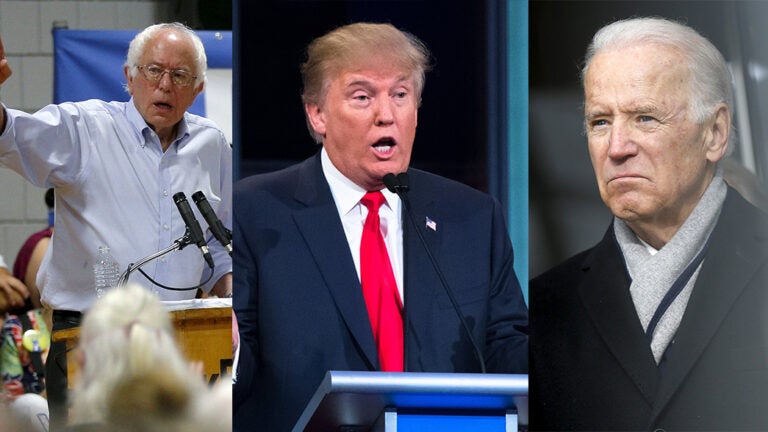
Some of Joe Biden, Bernie Sanders, and Donald Trump’s most avid supporters won’t vote for them.
With anti-establishment candidates leading insurgent primary campaigns, both sides have taken to trumpeting the underdogs in the opposing party, whether it’s Republicans tweeting the hashtag #FeelTheBern or Democrats welcoming Donald Trump’s presidential announcement.
“The explanation is pretty simple: They’re trying to boost people they don’t think can win the general election,’’ said Kyle Kondik, managing editor of the election analysis website Sabato’s Crystal Ball at the University of Virginia Center for Politics.
The practice spans from social media to newspapers.
The conservative magazine National Reviewposted an article Sunday touting the notion of Vice President Joe Biden as a one-term presidential candidate with Sen. Elizabeth Warren as his running mate.
“If Biden made her his vice-presidential choice, as Yale’s Professor [Paul] Kahn and others have suggested, she might be a virtual lock for the [2020] Democratic nomination,’’ wrote John Fund.
On Monday, Republican commentator Charles Krauthammer echoed on Fox News that Biden would be “perfect alternative’’ to Clinton, adding that if he added Warren as his running mate, “the liberals have a vision of a 12-year rule, it would work perfectly for them.’’
The Boston Herald followed suit Wednesday.
[fragment number=0]
“A Biden-Warren ticket would surely give the flawed Clinton a competitive race,’’ wrote the paper’s conservative-leaning editorial staff, in one of three Biden-Warren articles.
(It’s worth mentioning that Warren and Biden don’t always see eye-to-eye, that vice presidents are traditionally not picked until after the primary stage, and that neither Biden or Warren have said they are running.)
In a recent Podcast for America episode, former 2012 Mitt Romney strategist Stuart Stevens drew a comparison with the 1968 Democratic primary, in which Sen. Eugene McCarthy challenged incumbent President Lyndon B. Johnson in the Democratic primary, ultimately leading Johnson to drop out and (eventual nominee) Vice President Hubert Humphrey to jump into the race.
“I think that’s very likely to happen that Hillary Clinton won’t be the nominee and that someone will be the nominee that’s not in the race,’’ Stevens said. “It could be Joe Biden. It could be Elizabeth Warren.’’
On Twitter, the Senate majority whip, Texas Republican Sen. John Cornyn, has spent the past few days linking to articles about Biden possibly running.
[fragment number=1]
Spoiler alert: Cornyn is not going to vote for Biden.
According to New England College political science professor Wayne Lesperance, anything a party can do to make their presumed opponent in the general election spend resources and energy on other things is a positive.
“They have this idea that they can make hay with the other party,’’ Lesperance told Boston.com.
Boosting the other party’s underdog candidates undermines leading threats, Republican National Committee spokesman Michael Short told Politico.
“A Biden candidacy will divide the White House and could fracture the Democrat establishment,’’ he said, “especially if Clinton can’t turn things around or stumbles even further.’’
But Republicans haven’t exclusively reserved their love just for Biden.
Conservative research political action committee America Rising has posted multiple videos hyping the size of crowds at Bernie Sanders rallies. One article is self-explanatorily titled “#FeelTheBern UPDATE: 27,000 Turn Out For Sanders In Los Angeles, Morning Shows Discuss ‘Amazing,’ ‘Incredible’ Crowds.’’ Another video created by the group edited together Sanders crowd footage with chants from the Dark Knight Rises.
Through August, the Twitter feed of America Rising’s executive director, Colin Reed, is practicallyfilledwithas muchpositive press about Sanders as negative press about Clinton.
Perhaps Republicans are just borrowing a strategy from Bill Clinton.
The Washington Postreported that Clinton called Trump in late-May to offer “his own views of the political landscape’’ and encourage the real estate mogul to “play a larger role in the Republican Party.’’
Trump denies Clinton talked him into running, but announced his candidacy for the Republican nomination June 16. After his announcement, the Democratic National Committee released this statement:
Today, Donald Trump became the second major Republican candidate to announce for president in two days. He adds some much-needed seriousness that has previously been lacking from the GOP field, and we look forward to hearing more about his ideas for the nation.
And they haven’t stopped celebrating the havoc Trump has wreaked on the Republican primary, as strategist Paul Begala told the Post.
“I am a person of faith — and the Donald’s entry into this race can only be attributed to the fact that the good Lord is a Democrat with a sense of humor,’’ said Begala, who is an advisor for the pro-Hillary Clinton super PAC Priorities USA Action.
Lesperance said that ultimately, trolling from both sides ultimately has very little effect, especially this early in the campaign.
“Both sides do it,’’ he said. “Most people recognize it for the gamesmanship that it is.’’
Kondik said it reminded him a little bit of the 2008 Democratic primary, after it became clear Barack Obama was nominee.
“A lot of Republicans started saying nice things about Hillary Clinton, which is surreal because Republicans hate the Clintons,’’ Kondik said.
“She has inspired generations of American women to believe that they can reach the highest office in this nation, and I respect her campaign, and I respect her,’’ Republican nominee John McCain said of Clinton in June 2008.
However, that instance may have been more of an effort to poach Clinton supporters to the McCain side. As Wiredpointed out, the RNC registered the domain name “ClintonsForMcCain.com’’ a month before the Arizona senator’s praise.
“Right now it’s just comments on Twitter and comments in the press; I don’t think it’s at all meaningful,’’ said Kondik.
Noting that Republicans would rather run against anyone but Clinton and Democrats would rather run against Trump, Kondik said it would be more interesting if groups affiliated with the parties began directly spending in the opposing primary.
“There is a recent precedent for that, but it was in a Senate race,’’ he said. Missouri Democratic Sen. Claire McCaskill spent $1.7 million on “dog whistle ads’’ during the state GOP primary to boost the candidacy of a Republican who she thought would be easier to beat in the general election.
“There’s enough money in the system now that maybe you would see something like that,’’ Kondik said. “An example I could imagine is if Democrats want to run against Ted Cruz, they would spend money on an ad in Alabama or Mississippi that highlight aspects the Democratic voters would find offensive, but which many Alabama and Mississippi voters would be fine with.’’
But Kondik did concede there always is a chance for intervention in another party’s primary to backfire.
“Back in 1980, a lot of Democrats wanted to run against Ronald Reagan, because they thought he would be too conservative to win,’’ said Kondik.
His message to Republicans tweeting #FeelTheBern and Democrats boosting Trump:
“Be careful what you wish for.’’
[bdc-gallery id=”140212″]





To comment, please create a screen name in your profile
To comment, please verify your email address
Conversation
This discussion has ended. Please join elsewhere on Boston.com