
Barney vs. Bernie
Frank writes that the Sanders campaign can’t win. Is he right?
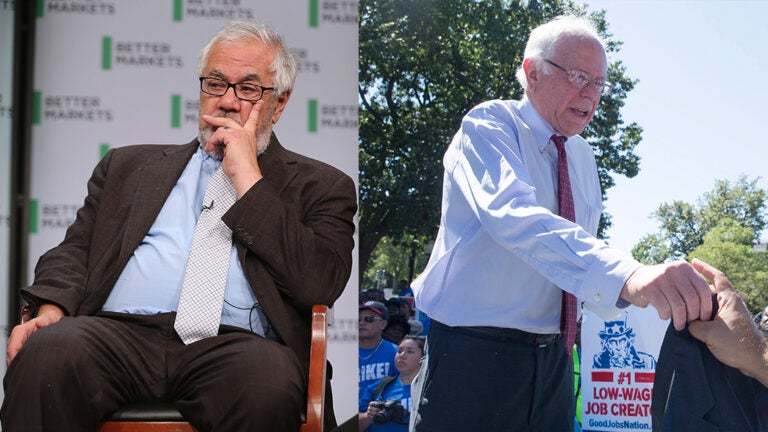
Barney Frank’s message to progressives: Don’t support Bernie Sanders.
The former Massachusetts representative wrote Wednesday for Politico that, despite sharing “most of Sanders’ policy views,’’ he thinks voting for the Vermont senator in the Democratic primary would give Republicans ammunition against Hillary Clinton in the general election.
Rather than debate the merits of specific policies to diminish inequality, [Republicans] will argue that she has let a proud, self-identified socialist shape her approach…A strong vote for Sanders in the primaries and caucuses guarantees that the argument will be made with renewed force and more plausibility in November.
Frank said that Democrats supporting a lifelong independent and democratic socialist is not “effective political action,’’ because there is “no chance — perhaps regrettably — for Sanders to win a national election.’’
His very unwillingness to be confined by existing voter attitudes, as part of a long-term strategy to change them, is both a very valuable contribution to the democratic dialogue and an obvious bar to winning support from the majority of these very voters in the near term.
Asked about Frank’s column, Sanders spokesman Michael Briggs told Boston.com, “It’s a great country; everyone is entitled to their opinion.’’
Frank isn’t the first Democrat to opine Sanders is unelectable. In an MSNBC interview, Missouri Sen. Claire McCaskill, who endorsed Clinton for president in 2013, said Sanders’s message was too “extreme.’’
“I think Bernie is too liberal to gather enough votes in this country to become president,’’ McCaskill said in June, “and I think Hillary Clinton is going to be a fantastic president.’’
However, a Quinnipiac University Poll released Wednesday found that Sanders performed better than Clinton when matched up against Republicans in some swing states.
“In several matchups in Iowa and Colorado, another Democratic contender, U.S. Sen. Bernie Sanders of Vermont, runs as well as, or better than Clinton against [Marco] Rubio, [Jeb] Bush and [Scott] Walker,’’ said the poll’s press release.
Both Sanders and Clinton trailed Rubio, Bush, and Walker in surveys in Colorado, Iowa, and Virginia. Sanders performed virtually the same as Clinton in nearly all of the matchups — within the 2.8 percentage point margin of error.

However, Sanders may have more room for growth than Clinton.
In both states, the Vermont senator was still unknown to 39 percent of voters, whereas Clinton was unknown to less than 10 percent of voters in those states.
Peter A. Brown, assistant director of the Quinnipiac University Poll, told Boston.com that Sanders is currently disadvantaged by low name recognition because he represents a small state in the Northeast.
“Hopefully, everybody should see their name recognition rise as the campaign goes on,’’ he said.
In Colorado, 56 percent of respondents said they had an unfavorable view of Clinton, while just 35 percent said they had a favorable view. And in Iowa, the former secretary of state was viewed 56 percent unfavorably to 33 percent favorably.
Meanwhile, Sanders was viewed 31 percent unfavorably to 29 percent favorably in Colorado, and 32 percent favorably to 28 percent unfavorably in Iowa.
Brown told Boston.com the results were “not good news’’ for either Sanders or Clinton, but emphasized that the survey only represented a “snapshot’’ in time.
“The large drop in Secretary Clinton’s favorability in Iowa,’’ he said in a press release, “from a split 45 – 47 percent in Quinnipiac University’s April 9 survey to a big negative 33 – 56 percent today, has to be worrisome for her.’’
2016 presidential candidates
[bdc-gallery id=”140212″]






To comment, please create a screen name in your profile
To comment, please verify your email address
Conversation
This discussion has ended. Please join elsewhere on Boston.com