
Sign up for the Today newsletter
Get everything you need to know to start your day, delivered right to your inbox every morning.
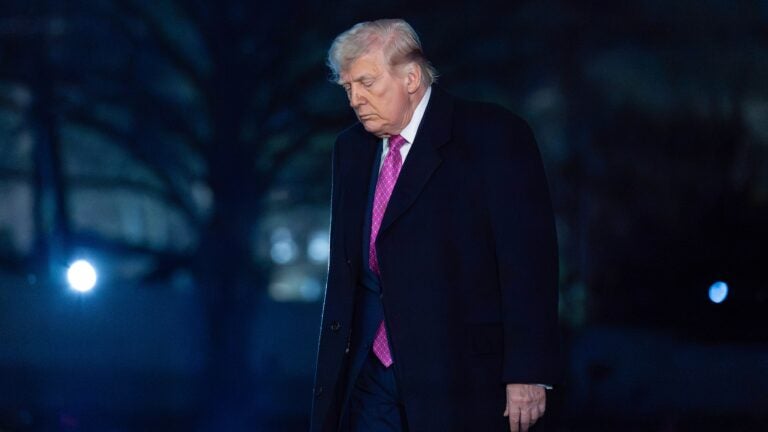
A new national University of Massachusetts Amherst poll found President Donald Trump’s approval rating has fallen to 33%, marking its lowest point of his second term as the 2026 midterm elections approach.
The survey, conducted March 20-25 among 1,000 respondents and released Monday, determined that 62% of Americans somewhat or strongly disapprove of Trump’s job performance.
Trump’s approval rating has dropped five points since July 2025 and 11 points since April of last year, UMass pollsters said in a statement.
Tatishe Nteta, director of the poll and a provost professor of political science at UMass Amherst, said in the statement that it was “no shock” to see the drop in Trump’s approval ratings, citing economic concerns, ongoing conflict in the Middle East, a recent government shutdown, and nationwide protests.
“What is surprising, and of likely grave concern to the White House, are the dips in support from the very groups that helped Trump take back the presidency in 2024,” Nteta said.
Approval among men, working-class Americans, and Black voters has dropped by nearly 20 points since April 2025, according to the poll.
Support has also declined among moderates, dropping 18 points, and independents, dropping 13 points — both key constituencies in the upcoming midterm election, Nteta said.
“These latest poll numbers on public approval of President Trump are brutal,” said Jesse Rhodes, co-director of the poll.
Pollsters pointed to the economy as a primary driver of Trump’s declining approval.
Some 71% of respondents said Trump is not handling inflation well, while 61% disapprove of his handling of jobs, according to Rhodes, who is also a professor of political science at UMass Amherst.
Tariffs — once “one of Trump’s signature issues” — are now viewed negatively by about two-thirds of Americans, Rhodes said.
“When it comes to public opinion, economic concerns usually dominate,” Rhodes said. “Americans’ harshly negative views of Trump’s economic leadership are a major cause of his declining poll numbers.”
The poll also found widespread disapproval of Trump’s handling of foreign policy, particularly the conflict involving Iran.
According to Raymond La Raja, professor of political science at UMass Amherst and co-director of the poll, 63% of Americans believe Trump is handling the situation poorly, including more than half who said “not well at all.”
“This appears to create a weak foundation for Trump to attempt to escalate the war,” said La Raja.
While support remains strong among Republicans — especially self-identified “Make America Great Again” voters — the data suggests divisions within Trump’s broader coalition, La Raja said.
“Strong MAGA voters appear to rally behind the president, while more conditional supporters are far more skeptical, suggesting potential cracks beneath the surface,” he said.
Few Americans support a deeper military engagement.
“There’s a striking gap between what Americans want and what they expect,” La Raja said. “Very few support a ground war with Iran, but many think it’s inevitable.”
Less than one in 10 Americans back sending ground troops, though about 40% believe the move is likely to happen anyway, according to the poll.
Pollsters also found opposition to other foreign conflicts: 52% of Americans opposed overthrowing the government of Cuba, 59% opposed making Greenland part of the U.S., and 69% opposed annexing Canada, Rhodes said.
“During his 2024 presidential campaign, Trump promised that he would ‘put America first’ and keep the U.S. out of foreign conflicts,” Rhodes said. “As president, however, Trump has embraced an aggressive foreign policy, overthrowing the government of Venezuela, attacking Iran, and we find that his bellicose approach to foreign affairs is broadly unpopular.”
Immigration was once Trump’s greatest strength, Nteta said, but now it has become a growing vulnerability, the poll suggests.
Six in 10 Americans said Trump is not handling immigration well — a reversal from April 2025, when about half of respondents viewed his approach positively, according to Nteta.
Pollsters also found majority disapproval of Trump’s handling of voting rights, as debates continue over election laws and access to the ballot.
Trump called voting a “privilege” rather than a “right,” and Congress is considering legislation that dramatically increases the paperwork required to register, which would likely make it more difficult for certain Americans to vote.
“Trump has been demanding legislation that would address the alleged problem of voter fraud, even though there is no evidence of systematic fraudulent voting in the United States,” Rhodes said. “The unpopularity of the issue — and the public’s negative evaluation of Trump’s handling of voting rights — probably helps explain why his favored legislation is stalled in the Senate.”
The poll indicates ongoing public skepticism around issues tied to child sex offender Jeffrey Epstein.
A majority of respondents said they believe the government has not been fully transparent, and about two-thirds disapprove of how the administration has handled related disclosures.
“Trump and his supporters may have hoped that public concerns about Trump’s relationship with disgraced sex trafficker Jeffrey Epstein would fade with the Justice Department’s release of millions of pages of documents relating to Epstein, but this hope has gone unfulfilled,” Rhodes said.
La Raja said one of the most notable findings is agreement on accountability: 82% of Americans, including 78% of Republicans, believe Epstein’s associates should be prosecuted.
But views diverge on transparency. Just 22% of Republicans believe information is being withheld, while 46% said the Epstein issue is “old news,” according to the poll.
Among Trump’s base, attitudes also vary, the poll shows. Self-identified MAGA supporters largely reject the idea of a cover-up, with only 14% saying they believe one exists. Other Trump voters, including those less closely aligned with the MAGA movement, are more open to the possibility.
“There’s strong support among Republicans for pursuing wrongdoing, but many downplay the importance of the Epstein scandal,” La Raja said.
While most Trump supporters said they do not regret their 2024 vote, there are signs of softening support.
The share of Trump voters who said they feel “very confident” in their vote has declined to 62%, down from 74% last year, according to Alexander Theodoridis, associate professor of political science at UMass Amherst and co-director of the poll. Five percent of Americans indicated they regretted their vote — an increase from last year’s 1%.
“This is hardly the mass exodus anecdotal media accounts of Trump voters might imply, but it is a meaningful indication of weakening support given the narrowness of Trump’s 2024 margin of victory,” Theodoridis said. “And, it is certainly not an encouraging sign for Republican fortunes as we head into the 2026 Midterm elections.”
Get everything you need to know to start your day, delivered right to your inbox every morning.




Be civil. Be kind.
Read our full community guidelines.To comment, please create a screen name in your profile
To comment, please verify your email address