
States love jokes on road safety signs, but the feds aren’t laughing
For years, federal transportation officials have been trying to rein in usage of the signs, arguing there's no evidence humor improves safety - and might create risks of its own by distracting or confusing drivers.
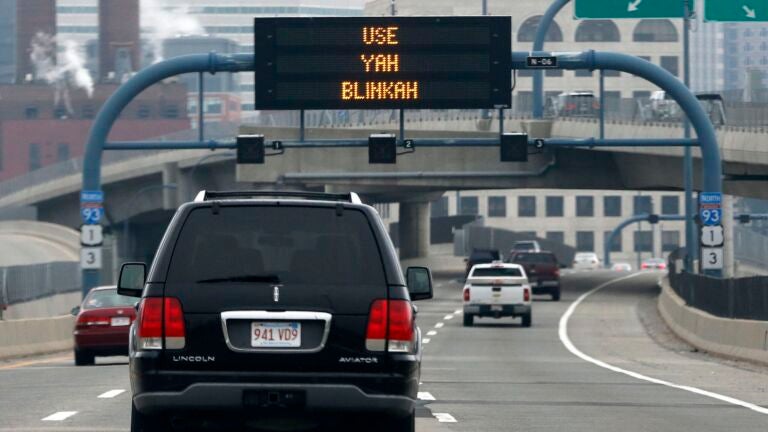
New Jersey had a message for drivers who might be thinking of hitting the road while under the influence of marijuana: “We’ll be blunt/Don’t drive high.” Another tried to protect woodlands: “Hold on to your Butts/Help prevent Forest Fires.”
The state was engaging in what is all but tradition for transportation agencies looking to spice up their roadside safety messages with jokes and pop culture references. One researcher gathered more than 350 examples of the messages from 12 states in 2020. But late last year, the Federal Highway Administration responded to New Jersey’s efforts at humor with a leaden warning, asking that it “cease and desist.”
Robert J. Clark, head of the federal agency’s New Jersey division, listed reasons the state should knock it off. In a letter to state highway officials, he wrote that using highways signs for such messages does not “promote the safe and efficient use of the roadway, does not serve a highway purpose, is inconsistent with both law and regulations, and increases the liability risk to the owner of the roadway facility.”
For years, federal transportation officials have been trying to rein in usage of the signs, arguing there’s no evidence humor improves safety – and might create risks of its own by distracting or confusing drivers. State transportation officials, who are trying to encourage drivers to adopt better habits at a time when crash deaths have surged, have largely been undeterred while trying to sprinkle a little wit into calls for drivers to put down phones, buckle seat belts and ease off the gas.
Or as New Jersey put it: “Slow down. This aint Thunder Road.”

Neither side has gained an upper hand with an outcome that has been a patchwork of responses and seemingly conflicting directives from Washington. As the debate has played out, researchers have been dragged into the fray. The National Academy of Sciences assembled a review team that published a book on the messages last year, while one study used brain scans to monitor responses to the signs.
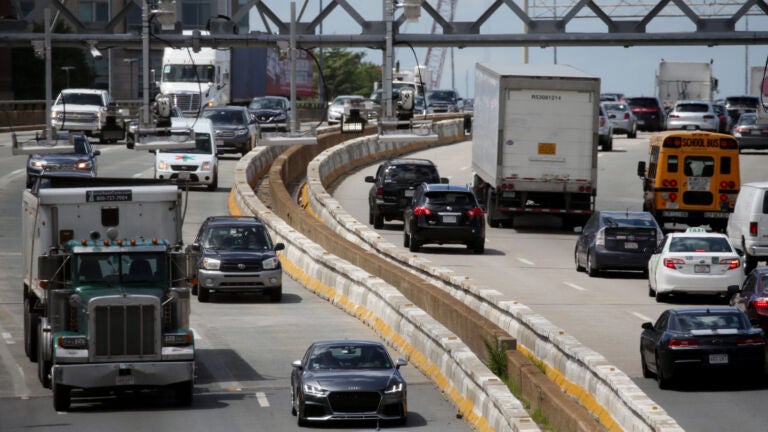
The signs at issue are those with digital displays that hang over highways or stand alongside them, generally showing messages in yellow text on a black background. Officially, they are known as changeable message signs, or CMS, with a primary use of displaying messages or information about road conditions.
The signs often aren’t needed for that purpose, so Russ Martin, senior director of policy and government relations at the Governors Highway Safety Association, said states should be free to use them for general safety bulletins.
“We need to have ways to refresh messages and change and innovate to reach new audiences,” said Martin, whose organization represents state traffic safety agencies.
Transportation
To get states to adopt more straightforward safety messages, the Federal Highway Administration has pointed to an 864-page book of rules called the Manual of Uniform Traffic Control Devices. The manual sets standards for road signs and other highway infrastructure. Federal officials ruled in 2021 that some of the racier messages displayed – referring to them as “unconventional syntax” – were inconsistent with standards in the manual and could present a safety risk.
The current edition of the manual dates to 2009, but Congress told the highway administration to issue an update this year as part of the infrastructure law. The draft of the revised version includes guidance that comes down firmly against such messages.
“Messages with obscure or secondary meanings, such as those with popular culture references, unconventional sign legend syntax, or that are intended to be humorous, should not be used,” the draft says.
Some states and safety advocacy groups have pushed back, calling for that language to be struck from the manual. Martin said such a provision could leave federal highway officials in the position of judging just how funny is too funny.
“You start getting into having to make subjective value judgments about things,” he said.
In New Jersey, state Department of Transportation spokesman Stephen Schapiro said the agency heeded Clark’s cease-and-desist letter. But in a subsequent letter a few weeks later, Clark appeared to soften his stance, saying his staff was ready to collaborate.
“We share your concern with the rise in roadway fatalities and understand that states often use cultural references and social expressions to relay operational and traffic safety messages,” he wrote.
Yet Clark’s initial, tougher stance was not the first time federal officials had clashed with a state, according to comments Martin’s group filed on the draft update to the traffic control manual.
“Some divisions within FHWA have responded with threats to States exploring innovative messages,” the state safety group wrote. “One State was warned that they may face the loss of federal funds.”

The 2021 federal ruling by FHWA prompted Tennessee officials to rethink their approach to the messages, which in the past had warned drivers, “Ain’t nobody got time for a wreck, slow it down.” That year, it adopted a new policy, saying messages should avoid “witticisms, colloquialisms, popular cultural or slang references.”
In other states, transportation officials say they have worked with federal officials to get lighthearted signs approved. In Pennsylvania, the state transportation department began experimenting with more creative messages over the holidays, including a reminder that “Only Rudolph should drive lit/Plan a sober ride.”
Jennifer Kuntch, a spokeswoman for the department, said it created a committee to vet proposed messages and that federal officials gave guidance on how to craft them.
Virginia has taken a similar approach. Marshall Herman, a spokeswoman for the state’s transportation department, said puns and references are vetted to make sure they can be understood even if drivers don’t completely get the joke.
The influence of the signs is difficult to measure, but Paul Katool, a spokesman for the Mississippi Department of Transportation, said he has heard from drivers who changed their behavior after seeing the messages. The department recently had a bit of a hit with a Taylor Swift-themed message: “Texting and driving? Say it: I’m the problem it’s me.”
“We’ve got a tremendous response and want to continue to do this,” Katool said.
Some transportation researchers have tried to gauge the effectiveness of the messages, developing evidence backing their use.
Tripp Shealy, a civil and environmental engineering professor at Virginia Tech, has studied how the public responds to such messages. He concluded that drivers generally found them to be effective and rarely had concerns about their appropriateness.
Determining whether the signs alter behavior in the moment is more difficult, Shealy said. His research team hooked 300 people to brain wave monitors to see how they responded when shown messages like “Texting while driving? Oh cell no,” and “Don’t let your tailgate end with a cell mate.” The results indicated that messages using humor or wordplay triggered more brain activity among participants.
“I think that’s why DOTs are using them, because they command more attention and drivers notice them,” Shealy said.
But other researchers have come down against the signs. A panel assembled by the National Academy of Sciences’ Transportation Research Board wrote a book on the best uses of highway signs. The panel measured the attention and response of 120 people as they read a mix of safety messages using a computerized test.
Its conclusion: Signs should be simple and “not include humor, wit, or pop culture references.”



To comment, please create a screen name in your profile
To comment, please verify your email address
Conversation
This discussion has ended. Please join elsewhere on Boston.com