
Child labor remains a problem in the United States
U.S. Labor Secretary Marty Walsh, former mayor of Boston, has repeatedly condemned child labor internationally, but not made any mention of the American domestic child labor situation.
In September, Human Rights Watch (HRW) assigned a letter grade to each U.S. state offering an assessment of children’s rights. It measured these based on the U.N. Convention on the Rights of the Child, the 1989 international concordat that the United States is the only member nation not to ratify. No state received an “A” or “B.” Only New Jersey, Ohio, Iowa and Minnesota received “Cs.” Twenty received an ‘F.’ In addition to juvenile justice standards, corporal punishment and child marriage, many states’ scores suffered because of the prevalence of child labor.
U.S. Labor Secretary Marty Walsh has repeatedly condemned child labor internationally, saying it is “a denial of fundamental human labor rights and it’s unacceptable.” In June 2022, the State Department issued a statement supporting the “World Day against Child Labor.” Neither the Department of Labor nor State made any mention of the American domestic child labor situation, which is one reason nongovernmental organizations like HRW are monitoring the practice and pointing to U.S. hypocrisy on the issue. But child labor has persisted in the United States as a result of the debate and Depression-era compromises that produced the regulatory framework for managing children at work.
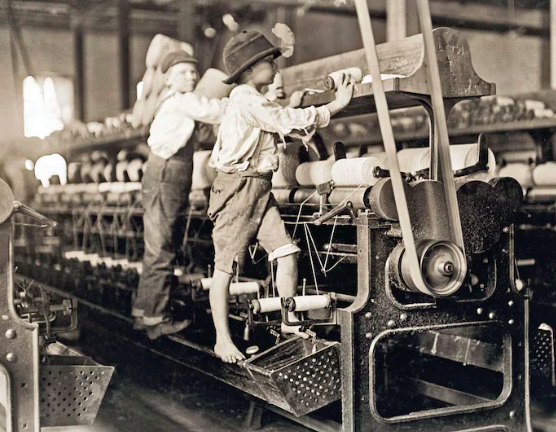
Children between the ages of 10 and 15 made up as much as 40 percent of the workforce according to the 1880 census. But by the start of the 20th century, public opinion began to turn against child labor. Sociologist Lewis Hine’s photographs provided provocative images of young children laboring in harsh conditions.
Defenders of the practice long claimed labor was good for children. But Hine disagreed, arguing that “the object of employing children is not to train them, but to get high profits from their work.” Following the formation of the National Child Labor Committee (NCLC) in 1904, the first federal child labor bills were introduced in Congress in 1906. Sen. Albert Beveridge (R-Ind.) and Rep. Herbert Parsons (R-N.Y.) introduced identical bills to “prevent the employment of children in factories and mines.” The same day, Sen. Henry Cabot Lodge (R-Mass.) introduced a bill to prohibit the interstate commerce of goods produced by children. The bills went to committee, but no further action was taken once it was clear they did not have President Theodore Roosevelt’s support.
After pressure from the NCLC and from women reformers like Florence Kelly at the National Consumers League – who created a “white label campaign,” identifying products produced in poor labor conditions, including through the use of child labor – Congress passed the Keating-Owen Act in 1916. The new legislation emulated Lodge’s original bill, banning interstate commerce of child-produced goods. President Woodrow Wilson had largely ignored the issue but facing a rejuvenated GOP challenge he considered it a good way to woo the growing constituency of women voters and signed the bill into law. But in Hammer v. Dagenhart (1918), the Supreme Court declared Keating-Owen unconstitutional following a challenge by North Carolina mill owner Ronald Dagenhart. Congress reacted by implementing a 10 percent tax on businesses that used child labor, but the court struck that down too, deeming it a “penalty in disguise” in Bailey v. Drexel Furniture Co. (1922).
Another hindrance for child labor abolitionists was that some children wanted to keep their jobs. For example, newsboys who unionized to demand better pay and conditions wanted to continue supplementing their working-class parents’ wages. Parental poverty provided a practical argument against regulation, but reformers remained focused on the moral issue. They supported mandatory school laws at the state level to restrict child labor by stealth; it was easier to mandate children do something else rather than directly prohibit their employment.
Compromises were insufficient for radical working-class children whose bold critiques of child labor emerge from the archive. For example, in 1923, 11-year-old Leo Granoff appeared at Manhattan Children’s Court charged with child delinquency because of his membership in a communist organization, the Junior Section of the Young Workers League. He asked the judge, “Why don’t you care about the children in factories who have to work all night?” Granoff asserted that the courts did not “look out for the kids,” as he said they should.
Congress had moved to restrict child labor twice and twice the unelected court had rebuffed them at the behest of big business challenges – a dynamic that made communism more attractive to some youth. In 1925, 14-year-old Morris Spector, the New York City organizer for the communist children’s group Young Pioneers of America, addressed a meeting at Madison Square Garden. He explained that he hoped for a revolution to see “a time when the blood and bones of little children shall no longer be coined into yellow gold to feed the greedy.”
Responding to setbacks from the court, Congress passed a constitutional amendment to regulate child labor in June 1924, but only five states ratified it during the 1920s. President Franklin D. Roosevelt supported the amendment and his election reinvigorated the cause. In his first year in office in 1933, 14 more states ratified the amendment. That year Congress passed the National Industrial Recovery Act, part of which allowed industries to set codes restricting child labor, but the Supreme Court ruled it an “unconstitutional delegation of legislative power” in Schechter Poultry Corp. v. United States (1935).
In his 1936 reelection campaign, Roosevelt pledged to “reduce hours over-long, to increase wages that spell starvation, to end the labor of children.” With 12 more states needed to amend the constitution, in January 1937 he wrote to the governors and governors-elect of the 19 remaining states arguing child labor should be “permanently abolished.” The next month he confirmed via telegraph to New York Mayor Fiorello La Guardia that he remained committed to changing the Constitution to “protect the rights of childhood.” Meanwhile piecemeal reforms were successful: the 1936 Walsh-Healy Act prohibited the federal government from purchasing child-made goods and the 1937 Sugar Act prevented farmers from receiving benefits if they did not meet minimum age requirements.
With limited progress on the constitutional amendment, child labor restrictions were rolled into wider contested New Deal labor changes and stalled in Congress. The Fair Labor Standards Act (FLSA) that emerged in 1938 from a Congress divided on the issue, allowing the secretary of labor to impose a minimum wage and age-based maximum hours, but it exempted agriculture, transportation and local retail. As a result, when the FLSA was signed into law, it restricted predominantly White child labor in Northeastern industry but left predominantly non-White agricultural child labor in the West and South unchecked. This compromise reflected the power of senior Southern legislators in Congress – who had disproportionate influence due to seniority thanks to the one-party nature of the South.
The exemptions made in the FLSA still apply today so child labor remains the status quo in agriculture where children as young as 10 can work part-time and children aged 12 can work full-time. The children come from predominantly immigrant and non-White backgrounds – and their work remains exempt from a federal ban on children working in “hazardous” occupations. Child agricultural workers are exposed to dangerous machines, extreme heat and pesticides; when the EPA determines the safety of substances, it does not consider the presence of children and the lower tolerances of smaller bodies. One hundred thousand child farmworkers are estimated to be injured on the job each year and children represent 20 percent of farming fatalities: a child dies every three days in U.S. agriculture, according to the National Children’s Center for Rural and Agricultural Health and Safety.
Around a quarter of U.S. domestic produce is picked by an army of child workers who numbered an estimated 500,000 in 2021. As young Morris Spector said in 1925, “the blood and bones of little children” are still coined into profit as modern agribusiness exploits a 1938 compromise rooted in the regional and racial inequalities of New Deal reforms. Child labor remains intrinsic to the U.S. economy and officials engage in hypocrisy when they condemn it abroad.





To comment, please create a screen name in your profile
To comment, please verify your email address
Conversation
This discussion has ended. Please join elsewhere on Boston.com