
Newsletter Signup
Stay up to date on all the latest news from Boston.com
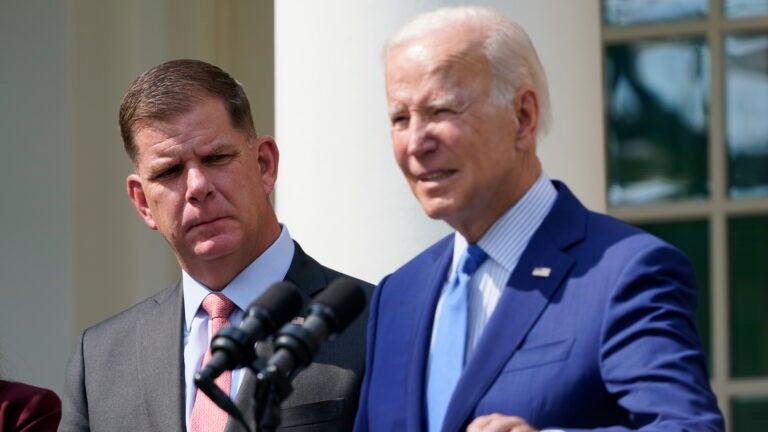
Former Boston Mayor Marty Walsh played a crucial role in the negotiations between freight rail companies and employee unions that dodged a massively impactful strike. Walsh, who now serves as Labor Secretary in the Biden Administration, said that he knew the pressure was on as he worked to bridge the gap between representatives from both sides.
“I knew the consequences going into this,” Walsh told The Boston Globe Thursday.
A deal was reached early Thursday morning after a 20-hour negotiating session.
If a deal had not been reached, the work stoppage would have potentially caused widespread shipping disruptions affecting food distribution, chemicals for water treatment, and more according to The New York Times. The resulting shortages could have increased the prices of everyday items, further worsening an already-high inflation rate.
Walsh built his career in organized labor, rising to the mayoral office after serving as President of Local 223 in Boston. He also worked as the head of the Building and Construction Trades Council. As Mayor, Walsh negotiated with Boston’s many municipal unions.
He told the Globe that he started this week encouraging both sides to reach an agreement. By Tuesday morning, he told representatives from both sides that, if they had not reached an agreement by the end of the day, to come to his office on Wednesday.
On Wednesday morning, the negotiating parties arrived at the office and were each given separate conference rooms, with Walsh’s personal office acting as a go-between space, he told the paper.
There were three main sticking points. One, which was resolved early Wednesday, centered on work rules. The other two were related to health insurance premiums and medical leave.
“I didn’t suggest to them what to do, what not to do,” Walsh told the Globe. “If they asked my opinion, which they did several times, both sides, I gave my opinion of how to get to the final deal … that went on for hours.”
Specifically, workers won the right to take unpaid time off to attend medical appointments without penalty, according to the Times. The workers were also promised an extra day off and a guarantee that their health insurance premiums would not go up between the time that the contract expired and the time that a new one was agreed to.
Now, the deal will be reviewed by union members ahead of a ratification vote, a standard procedure in labor negotiations, according to the Times. Workers have agreed not to strike in the meantime.
Walsh said that he was in his office working on the negotiations from 8:30 a.m. Wednesday to 5:30 a.m. Thursday.
“I wasn’t quite sure when I walked in in the morning how to get [the deal done], but as the day went on it got a little clearer to me that there’s a deal to be had here,” he told the Globe. “Both sides are not as far apart as they might have thought they were.”
Stay up to date on all the latest news from Boston.com





To comment, please create a screen name in your profile
To comment, please verify your email address
Conversation
This discussion has ended. Please join elsewhere on Boston.com