
Retired baseball player, who built largest Black-owned McDonald’s franchise operation, is suing chain for ‘racist’ policies
McDonald's responded to the lawsuit Tuesday by blaming Herb Washington for his business challenges.
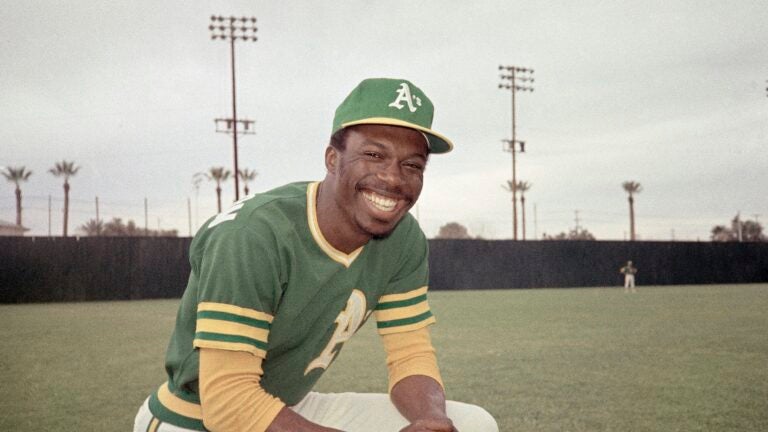
Herb Washington, a former Oakland A’s player who built the country’s largest Black-owned McDonald’s franchise operation, filed a lawsuit Tuesday accusing the fast food giant of systemic racial discrimination for its pattern of steering Black owners into restaurants in impoverished neighborhoods that yielded less profit, targeting them with unequal assessments that made it harder to renew their contracts, then pressuring them to sell to White owners.
Washington, 69, owned 27 McDonald’s restaurants in New York, Ohio and Pennsylvania during his four decades as a franchisee, but alleged that the company began a campaign to drive him out in 2017 in retaliation for speaking out against the “predatory, racially biased steering practices” against Black franchisees. Today he owns 14 McDonald’s restaurants.
“While McDonald’s has joined the chorus of brands releasing hollow solidarity statements in support of Black Lives Matter and has launched a marketing campaign to profit from that movement, it has done nothing to change its own internal policies that perpetuate systemic racism by disadvantaging and squeezing out its Black franchise owners,” said the lawsuit, filed in federal court in Ohio.
McDonald’s responded to the lawsuit Tuesday by blaming Washington for his business challenges.
“This situation is the result of years of mismanagement by Mr. Washington, whose organization has failed to meet many of our standards on people, operations, guest satisfaction and reinvestment,” McDonald’s said in a public statement. “His restaurants have a public record of these issues including past health and sanitation concerns and some of the highest volumes of customer complaints in the country.”
The company said it invested significantly in Washington’s franchise and offered him multiple opportunities to address the concerns.
Washington’s lawsuit comes amid an alarming exit of Black franchisees from McDonald’s and widespread allegations of racial bias. Last fall 52 Black former franchise owners sued McDonald’s for setting them up to fail despite the company’s public commitment to racial equity. McDonald’s denied the allegations and said it was committed to diversity and equal opportunity across its franchisees.
The decline in Black restaurant owners accelerated after Steve Easterbrook and Chris Kempczinski became presidents and chief executives of McDonald’s Corporation and McDonald’s USA, according to Washington’s lawsuit.
Black franchise ownership is at an all-time low today. In 1998, there were 377 Black franchisees in the McDonald’s system, according to the lawsuit. Now there are 186, even as the total number of stores has more than doubled to 38,999 over those two decades.
“These numbers are not a coincidence; they are the result of McDonald’s intentionally racist policies and practices toward Black franchisees,” Washington’s lawsuit alleges.
Black senior executives who objected to the company’s policies suffered swift retaliation, the lawsuit alleged. During Easterbook’s and Kempczinski’s leadership, the number of Black vice presidents and higher officer roles dropped from 42 to 7.
Washington’s lawsuit alleges that McDonald’s system is stacked against Black franchisees who make, on average, less than $700,000 in annual sales per store than White owners, which he said directly results from the company’s discriminatory policies that favor White owners.
McDonald’s charges fees to franchisees for the right to operate a restaurant for 20 years, typically on land and in buildings owned by the company. Franchisees make minimum monthly base rent payments on top of rent payments calculated on a percentage of gross sales revenue, an amount that varies from store to store. Owners pay all operational costs, including property tax and maintenance, monthly service fees and royalties calculated on the percentage of sales, as well as contribute to collective advertising. At the end of the 20-year term, the lease must be renewed for franchisees to continue operating – a key point when McDonald’s can cap their growth.
The disparities compound when Black owners like Washington are required to incur disproportionately high operational costs and low sales volume, the lawsuit alleges. The company grants rent relief at its discretion. But Washington alleges that McDonald’s disproportionately helps White franchisees while refusing similar requests from Black owners.
Washington, a former Michigan State track star who went on to help the Oakland A’s win the World Series in 1974, became a McDonald’s franchisee in 1980 at the age of 29. His first restaurant was located next to a public housing development in Rochester, New York, after the company steered him to a store in a distressed, predominantly Black neighborhood as his only option to enter the McDonald’s system, his lawsuit said.
When stores became available in suburban Rochester in the early 1990s, Washington said McDonald’s blocked the sale even though he had struck a deal with the White owner to purchase the restaurants. Instead, the company approved the sale to a White owner. The field-office executive who blocked the sale, Mike Andres, went on to become president of McDonald’s USA.
Around 2011, Washington said he had finalized a deal to purchase a store in the predominantly White suburb of University Heights near Cleveland – but said McDonald’s abruptly intervened and awarded the store to a White operator.
A McDonald’s spokesman told The Washington Post that the company does not place franchisees into specific restaurants. It only makes recommendations, and that franchisees are the ones who decide which restaurants they purchase and who they sell to.
After Washington complained that inner-city stores were losing value while White suburban stores continued to prosper and that Black franchisees’ stores were being evaluated unfairly within a corporate franchising committee, he said he was removed from the committee, according to the lawsuit.
To make matters worse, Washington said McDonald’s demanded that he make massive capital investments into the same restaurants it would eventually take from him – expenditures that benefited White franchisees that the company had approved to purchase his stores.
The mandate to quickly modernize restaurants under Easterbrook’s and Kempczinski’s leadership forced Black franchisees who had successfully managed to operate low-volume stores at a profit to take on increasing debt, creating a growing cash-flow gap, the lawsuit said. Washington accused McDonald’s of accommodating White franchisees’ requests for more time to complete the required renovations while denying the same opportunity to most Black franchisees.
The company then used their failure to renovate as a reason to deem Black franchisees ineligible for expansion and renewal of their contracts, the lawsuit said; those who were able to remodel suffered economic setbacks that made it possible for McDonald’s to cycle them out of the system at a lower buyback price.
“McDonald’s offered a publicly-facing anti-racist message, but its race-based steering policies hamstrung Black franchisees and prevented them from ever achieving equality with their White counterparts,” the lawsuit said. “Those policies and practices continue to injure Black franchisees to this day as they struggle to remain viable business owners in the face of McDonald’s unreasonable demands. Now McDonald’s is driving Black franchisees from its system by exploiting the very inequalities its long-standing discriminatory practices have caused.”
Get Boston.com's browser alerts:
Enable breaking news notifications straight to your internet browser.




To comment, please create a screen name in your profile
To comment, please verify your email address
Conversation
This discussion has ended. Please join elsewhere on Boston.com