
New timeline shows earlier radical turn for pair of attackers
WASHINGTON — The couple at the center of last week’s massacre in San Bernardino, California, had been radicalized before their marriage, and the husband, Syed Rizwan Farook, might have plotted an attack as far back as 2012 with one of his longtime friends, senior law enforcement officials said Wednesday.
The new timeline suggests that Farook and his wife, Tashfeen Malik, were considering violent action before the Islamic State rose to prominence in 2014 and began trying to inspire sympathizers to carry out attacks in the West. And the disclosures raise questions about how thoroughly U.S. law enforcement and immigration officials vetted the wife before giving her a visa to enter the United States from Pakistan a year before the shooting, which left 14 dead and 21 wounded.
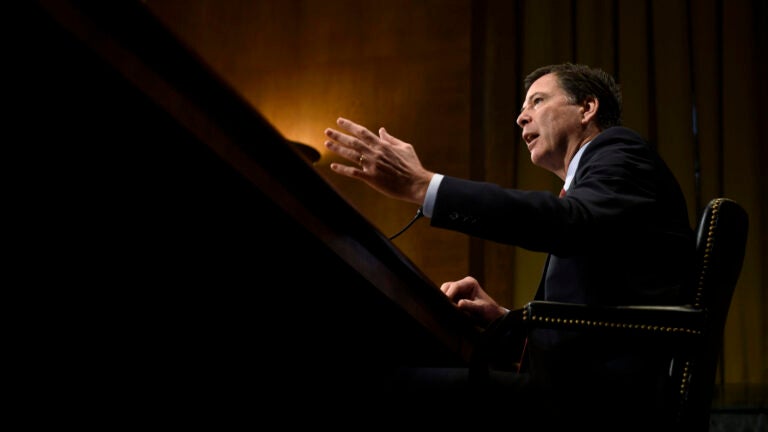
“ISIL inspiration may well have been part of this, but these two killers were starting to radicalize towards martyrdom and jihad as early as 2013,’’ FBI Director James B. Comey said during testimony before the Senate Judiciary Committee, using an acronym for the Islamic State. “And so that’s really before ISIL became the global jihad leader that it is.’’
Comey said the FBI still believed that the couple had been inspired by foreign extremist groups but that it had not found evidence the husband and wife team was ordered to attack by the Islamic State or any other group.
“We are working very hard to see if anyone else was involved in assisting, equipping or helping them,’’ he said. “And did they have other plans?’’
The account of a possible attack in 2012, came from Enrique Marquez, a longtime friend and former neighbor of Farook’s, according to law enforcement officials who would only speak anonymously about a continuing investigation. Marquez has been cooperating extensively in recent days with federal authorities, discussing at length his relationship with Farook.
Marquez, a Wal-Mart clerk who converted to Islam several years ago and either sold or gave Farook the two assault rifles used in last week’s attack on county public health workers in San Bernardino, has told the authorities that in 2012 he and Farook had plans for an attack at that time. It is not clear why they decided not to go forward with it.
Marquez, whose wife is a sister-in-law to Farook’s brother, has also told investigators that Farook had radical beliefs but that he did not know Farook and his wife were plotting the recent shootings or what may have motivated them.
Authorities are still seeking to corroborate what Marquez is telling them. Because he provided two of the four weapons used by the attackers, some investigators have questioned his credibility, thinking that he might exaggerate what he knows about the couple to win favor with the authorities.
In addition, Marquez is said to have mental health issues. Shortly after the attacks, he checked himself into a mental health facility in California. He has not been charged or detained.
In Comey’s appearance on Capitol Hill, he said that the couple, who some relatives say met on an online dating site, had radicalized at least as far back as two years ago.
They were “talking to each other about jihad and martyrdom before they became engaged and married and were living in the U.S.,’’ Comey said. He said that the “investigation to date shows that they were radicalized before they started courting or dating each other online.’’
Comey said the conclusion came from “data’’ and intelligence that U.S. authorities had obtained.
Malik declared allegiance to the Islamic State in a Facebook post around the time of last week’s shooting, which led the authorities to conclude that the shooting was a terrorist attack.
But authorities say that the couple may have decided to commit terrorism in the name of the Islamic State late in the planning process, after their views had hardened and they had already committed to violence.
With some members of Congress asking how Malik had been cleared for a K-1 visa to come to the United States, a spokesman for the State Department, John Kirby, said Wednesday that “it’s too soon to know what, if anything, might have been missed in the screening process’’ that allowed Malik to enter the country on the special 90-day visa for people planning to marry Americans. President Barack Obama has asked for the department to review the program.
Kirby added that “if in the context or in the process of the review we find things that we can do, we’re not going to wait for the review to be complete before we make the changes.’’
“But clearly,’’ he added, “we’re going to keep an open mind about the program going forward and make whatever changes we need to make.’’
More details about Farook and Malik and their relationship emerged Wednesday in interviews with family members, neighbors and classmates in California and in Saudi Arabia — including a fateful meeting at Islam’s holiest site that pushed the couple toward marriage.
Speaking by telephone from Saudi Arabia, Malik’s father, Gulzar Ahmed Malik, recounted a meeting between him and his wife and Farook’s mother during the annual hajj pilgrimage in the Saudi city of Mecca, in July 2013.
In an encounter just outside the Kaaba, the cuboid building at the center of Islam’s holiest mosque, Farook’s mother, Rafia, told the Pakistani couple that her family sought a “pious, religious girl’’ to marry their son, he said.
Malik replied that he was looking for a similar match for his daughter, and that he liked the young American man because, like his daughter, he had memorized the Quran. The couple married months later by telephone, as allowed under Islamic custom, Malik said, and they held a celebration in the Saudi city of Jiddah in July 2014, shortly after Malik had obtained her visa from the U.S. Embassy in Islamabad, Pakistan.
Malik’s state of mind at that time is a point of intense focus for U.S. investigators. She had spent the previous three or so years living with her mother at the family home in the southern Pakistani city of Multan, where she obtained a degree in pharmacology from the city’s largest university, and studied part-time at an Islamic center for women that teaches a literalist version of the Quran.
At home, her father said, she spent much of her time alone in her room, studying for university or reading the Quran.
“She was always busy in her studies,’’ he said.
The Multan police chief, Tariq Masood Khan, said in an interview that his investigators had found no links between Malik and local militants — a sensitive suggestion in a country whose citizens have taken part in several attacks in India, Europe and the United States.
“So far, the feedback I have received hasn’t raised any red flags,’’ he said.
New clues also surfaced Wednesday about what the husband and wife team might have been planning. According to law enforcement officials, the couple had not finished building at least some of the dozen pipe bombs that were found in their home, leading investigators to believe they had a much larger attack planned for the future.
In addition, although Farook had smashed his cellphones and taken steps to delete files from his computer, the FBI has been able to retrieve photos from them. One of the photos is of a local high school, suggesting to investigators that it may have been viewed as a target.
Law enforcement officials have also found that Farook had contacts with six people in Orange County, California, who federal authorities had scrutinized at some point in recent years for their apparent ties to terrorism. While officials do not believe these people were involved in the massacre, the connections have suggested to investigators that Farook was associating with like-minded people.


To comment, please create a screen name in your profile
To comment, please verify your email address
Conversation
This discussion has ended. Please join elsewhere on Boston.com