
Here’s what’s so rare about the El Faro’s sinking
“We have very few casualties in ships of that size.’’
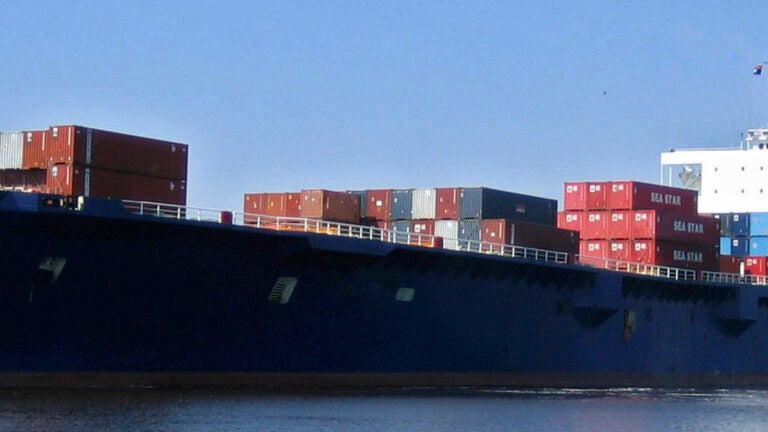
The sinking of the El Faro near the Bahamas last week was as disastrous as it was rare.
The Coast Guard believes the cargo ship, which planned to run its usual route from Jacksonville, FL to Puerto Rico, sank after its main propulsion system failed, leaving it powerless and in the path of Hurricane Joaquin. None of the ship’s 33-person crew – 28 Americans and five Polish nationals – have been found alive.
Ships of El Faro’s size have become far safer in recent years, according to data from insurance giant Allianz [PDF]. Last year, 75 large ships were lost at sea, the lowest number in a decade and half as many as in 2005, according to the data.
Large ships are defined as having over 100 gross tons. At 790-feet long and with a gross tonnage of 31,515, the 40-year-old El Faro was one of the largest vessels to be lost at sea in recent memory.
Captain Joseph Murphy, a professor at Massachusetts Maritime Academy, said it was “very rare’’ for a vessel of that size to sink. That’s particularly true for American-owned and American-operated ships like El Faro.
“We have very few casualties in ships of that size,’’ Murphy said. “The reason is American ships are well maintained. They might be old, but they’re inspected regularly, their crews are well trained.’’
The history of American shipwrecks has just a few references to compare to El Faro. One is the S.S. Edmund Fitzgerald, which sank on the Great Lakes amid heavy winds in 1975 with all 29 passengers lost. Gordon Lightfoot memorably used that tragedy as inspiration for his hit song “The Wreck of the Edmund Fitzgerald.’’
Survival procedures and inspection processes have also been heavily revamped since the S.S. Marine Electric sank off the coast of Virginia in 1983. Three passengers survived that sinking. The loss resulted in shipping industry reforms and made survival suits mandatory on ships in colder weather.
The last U.S. vessel to sink with all hands lost was the S.S. Poet in 1980. That ship, loaded with 13,500 tons of corn and headed for Egypt, never issued an emergency message. Neither the ship nor any member of its 34-person crew has ever been found.
The location of El Faro’s loss was also out of the ordinary. According to the Allianz analysis, there were 1,271 ships lost over the past 10 years. Just 35 of those – or about 3 percent – were lost in the West Indies, near where El Faro went down.
Though largely invisible to the public, shipping is the grease that keeps the world economic machine going. About 90 percent of all goods and trade are moved by sea, according to Rose George, who spent months on a shipping vessel to write her book Ninety Percent of Everything.
Gallery: Severe local weather through the years.
[bdc-gallery id=”140998″]





To comment, please create a screen name in your profile
To comment, please verify your email address
Conversation
This discussion has ended. Please join elsewhere on Boston.com