
Here’s what’s so rare about the St. Paul’s School rape trial
The case of the New Hampshire prep-school teen relies on the issue of consent—which doesn’t matter in most states.
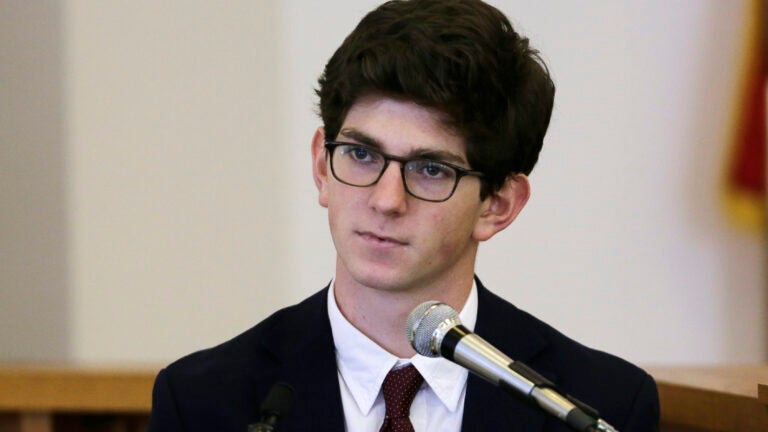
This week, the world watched as Owen Labrie, a former St. Paul’s School student accused of raping a 15-year-old girl, faced his accuser in a he-said-she-said trial that hinges on the question of if she made her lack of consent clear enough to Labrie.
She was laughing, the defense said, and lifted her hips to help him slide off her shorts. He said he had a moment of “divine intervention’’ and stopped before they had sex. She said she was “frozen,’’ and that he couldn’t understand her saying ‘no.’
The idea of consent has been central to the movement to reduce sexual assault on campus, but that idea doesn’t translate to assaults off campus and how they’re handed by the law, Emily Bazelon of the New York Times Magazinepoints out.
Bazelon’s piece, “The St. Paul’s Rape Case Shows Why Sexual-Assault Laws Must Change,’’ examines the legal anomaly that is Labrie’s case.
“Labrie’s guilt or innocence hinges on the question of consent,’’ she writes. “This is much less common than you might assume — in fact, in many states, Labrie probably would not face felony charges of sexual assault at all.’’
In the majority of states, the definition of rape still requires some form of physical force. People have been trying to change this idea since the 1970s, and yet it persists, writes Bazelon.
New Hampshire’s law differs because of its language, adopted in 1995, that says a person is guilty of sexual assault if he or she sexually penetrates another person when “the victim indicates by speech or conduct that there is not freely given consent,’’ Bazelon reports.
Read the full New York Times Magazine article here.





To comment, please create a screen name in your profile
To comment, please verify your email address
Conversation
This discussion has ended. Please join elsewhere on Boston.com