
Meet the Mass. heroes of same-sex marriage
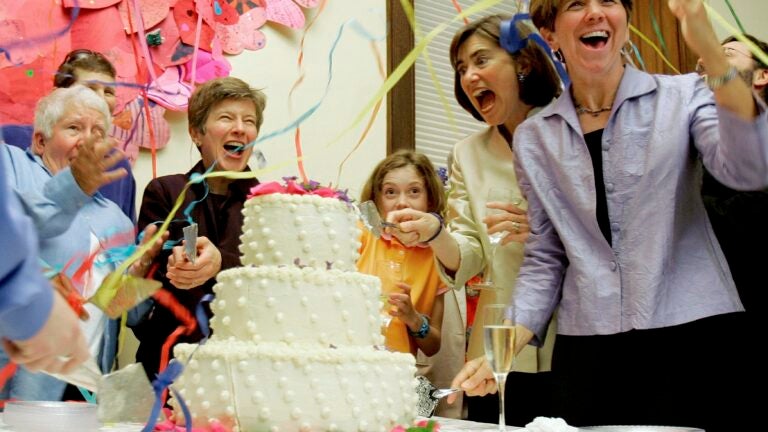
Julie and Hillary Goodridge needed a police escort when they walked into Boston City Hall to apply for a marriage license on May 17, 2004.
The Goodridges had been the plaintiffs in Goodridge v. Department of Public Health, the Massachusetts Supreme Court case in which they argued same-sex couples had the right to legally marry.
They won.
The Goodridges wed six months after the court ruled in their favor and as soon as Massachusetts began issuing marriage licenses.
Now, 11 years later, the Supreme Court has decided that same-sex couples will be allowed to marry no matter where they live.
The legal battle for gay marriage rights began in a cramped conference room in Boston in the summer of 2000. Mary Bonauto, an attorney at Gay & Lesbian Advocates & Defenders, told a group of activists she was prepared to bring a lawsuit against the state on behalf of gay and lesbian couples seeking marriage licenses.
At the time, Vermont had just enacted civil unions, and some Massachusetts legislators were tossing around the idea of passing a bill to prohibit marriage benefits for same-sex couples.
According to a Globe report from the time, some activists were worried a lawsuit would unleash a backlash from lawmakers, who could propose a constitutional amendment to ban gay marriage. The wary activists thought the lawsuit should wait a few years.
Bonauto disagreed. She had waited long enough. (She was out of the office Friday and unavailable to comment for this article).
Bonauto said she had received requests from couples seeking help to get married since she began her job at GLAD in 1990.
She refused to take the cases. The late ’80s were full of setbacks for gay rights, including the 1986 Bowers v. Hardwick U.S. Supreme Court decision upholding Georgia’s sodomy laws.
“I remember talking to these people and feeling really cheesy and lame for having to say to them, `We can’t do this for you,’ “ she said in an interview in the Globe. “But we needed to build precedents of respect for gay and lesbian people.’’
But in 1993, the Hawaii Supreme Court ruled that the state’s failure to recognize same-sex marriages equaled gender discrimination.
Bonauto felt the tide turning.

Bonauto and a group of New England gay rights attorneys began to meet regularly to discuss whether a similar case could happen in New England. In 1996, Bonauto co-counseled a case in Vermont, where two lawyers sued the state on behalf of three couples who wanted to marry in the state.
In 1999, the Vermont Supreme Court ruled that extending equal rights to same-sex couples was “simply . . . a recognition of our common humanity.’’ But it didn’t grant marriage licenses, instead opting for civil unions.
After the Vermont decision, the Globe reported that GLAD was bombarded with calls to bring a marriage suit in Massachusetts.
Bonauto knew it was time.
In April 2001, she filed a lawsuit on behalf of seven same-sex couples who had been denied marriage licenses. The plaintiffs would become the face of the same-sex marriage movement, so they were chosen carefully. According to the Globe, Bonauto said they had to vary in age, ethnicity, and profession. They had to be well-spoken, but not radically political. They also had to be longtime couples who were committed to one another.
Bonauto learned from the failures in the Vermont case. She and her team recognized that in Vermont, the plaintiffs’ case had focused on the rights and protections given to married couples, such as hospital visits and tax benefits. The Vermont Legislature took these arguments into account with its civil unions solution, and granted the couples several rights and protections without allowing for marriage itself.
To avoid a similar fate in Massachusetts, the lawyers needed to show the court that marriage is more than just these protections. It’s a human right.

The Goodridge case was first heard in the Suffolk Superior Court in March 2002. The plaintiffs lost. The judge, Thomas Connolly ruled in May that “procreation is marriage’s central purpose.’’
The case went to the Massachusetts Supreme Judicial Court in March 2003.
In November 2003, the court officially granted same-sex couples marriage rights.
Two justices, Francis X. Spina and Robert J. Cordy, dissented. They are still serving on the Massachusetts Supreme Judicial Court, and did not immediately respond to a request for comment about the Supreme Court decision.
The national ruling said “In forming a marital union, two people become something greater than they once were … it would misunderstand these men and women to say they disrespect the idea of marriage … they ask for equal dignity in the eyes of the law. The constitution grants them that right.’’
Massachusetts recognized this right 11 years ago. Beginning today, the rest of America will, too.
Reaction to the Supreme Court’s gay marriage decision
[bdc-gallery id=”317428″]



To comment, please create a screen name in your profile
To comment, please verify your email address
Conversation
This discussion has ended. Please join elsewhere on Boston.com