The Boston Globe’s food critic called out St. Louis food. Now, their newspaper is firing back.
The St. Louis Post-Dispatch's food writer says lobster rolls are "a waste of perfectly good lobster," while Sam Adams is "the best beer named for a terrorist."
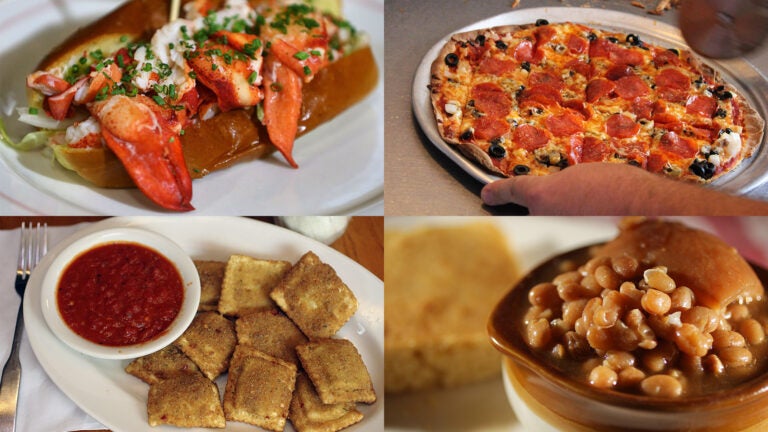
Folks, it looks like we have a food fight.
With the Boston Bruins and St. Louis Blue facing off in the Stanley Cup Final, the two cities’ largest newspapers are also going at it over the respective merits of each other’s local cuisine. And things are getting personal.
“Do you know how Bostonians were sore losers for decades until their sports teams started winning things, and then they became sore winners?” St. Louis Post-Dispatch food writer Dan Neman wrote Tuesday. “How many World Series championships have they won? Nine? That’s adorable.”
The St. Louis Cardinals have won 11. Fair enough.
However, the main subject of Neman’s ire wasn’t Boston’s pro sports prowess — with which St. Louis cannot compete, when taking into account the three other major sports (they barely ever even had a basketball team). It was an article published Monday by Boston Globe food critic Devra First, taking on the at-times baffling phenomenon of St. Louis-style food.
“Let us start with the low-hanging fruit, and by fruit I mean pizza,” First wrote, referring to the thin-crust, square-cut style adored by St. Louis natives.
Jayson Tatum, you might want to look away.
From First’s article:
When people say “St. Louis-style pizza,” on the other hand, it is instantly clear what they mean, so points for that. It has a yeast-free, cracker-thin crust. The “cheese” in question is a processed type called Provel, which sounds like a medication for treating male-pattern baldness but is actually a blend of cheddar, Swiss, and provolone. It gets gooey when it melts, but it doesn’t stretch. People from St. Louis love it, crave it. For people from everywhere else, it’s a little like biting into a vinyl shower curtain. It’s not so much an acquired taste as an inherited one.
What kind of twisted mind would look at a round pizza and think: “I’m going to cut this into squares”? A twisted mind from St. Louis. Brownies in a square pan get cut in a crosshatched pattern. Chocolate cake in a round pan does not. When we go out for pizza in Boston, we go out for a slice. That is as it should be. “Hey, wanna go grab a square?,” said no one ever.
It’s no wonder Paula Deen tried to lay claim to it, calling it ooey gooey butter cake, like that would fool anyone. In truth, its invention was a mistake: In the 1930s, according to lore, a baker was trying to make a regular cake but mixed up the measurements of butter and flour. Many of your regional specialties seem to be created by accident, St. Louis. Maybe that means something?
She did concede that St. Louis barbecue is a formidable equal to New England seafood, just as their famed frozen custards save face against Boston’s best ice cream. However, First concluded her article with perhaps the most damning indictment of St. Louis food: So-called BagelGate.
Today I introduced my coworkers to the St Louis secret of ordering bagels bread sliced. It was a hit! pic.twitter.com/XNGbljtpYz
— Alek Krautmann (@AlekKrautmann) March 26, 2019
In a tweet this past March, NOAA programmer Alek Krautmann introduced his co-workers — and the world — to the “St. Louis secret” of ordering bagels cut into thin, vertical slices like a loaf of bread.
“It was a hit!” Krautmann tweeted.
It was not. Krautmann’s tweet went viral for the wrong reasons, resulting in a solid 24 hours of memes envisioning purposefully botched “St. Louis-style” foods.
“Your cutting skills lack the most basic grasp of geometry and your culinary triumphs are born from mistakes, but you sure know your way around the ice,” First wrote Monday, concluding her letter to St. Louisans. “So best of luck in the Stanley Cup Final. Now get out there and play some St. Louis-style hockey!”
Neman didn’t address his city’s alleged bagel-slicing tendencies and even accepted that First’s jokes about St. Louis pizza were funny. But going after toasted ravioli and gooey butter cake was apparently a bridge too far.
“It’s on,” he wrote.
Neman’s first target: Scrod, a staple of Boston cuisine, at least according to Wikipedia.
“The city is on the ocean, where it has access to literally the finest seafood in the world, and the best they can do is scrod?” he wrote.
Neman said scrod is “a fish with the absence of flavor” and noted its use as a catch-all term for various types of whitefish, usually cod or haddock.
“In Boston, they just cook up any old whitefish and call it scrod because, apparently, Bostonians can’t tell the difference,” he wrote.
Neman then turned his wrath toward the lobster roll — yes, seriously — an “idea that was imported from Maine or Connecticut,” which in fairness appears to be true. His next contention is more debatable.
“A lobster roll is just a lobster sandwich served with either mayo (Maine) or butter (Connecticut) on a mis-sliced hot dog bun,” Neman wrote. “You get more roll than lobster with a lobster roll, which means it is a waste of perfectly good lobster.”
Neman turned up the heat even more when it came to Boston’s beer.
“Of course, Boston is known for Sam Adams, the best beer named for a terrorist (let’s face it, that’s what he was),” he wrote, apparently referring to the Sons of Liberty’s at-times violent efforts to undermine British rule of the American colonies.
Left unmentioned are the more recently acclaimed local breweries, from Trillium to Night Shift, that draw beer drinkers to the Boston area. Instead, Neman dialed in on Sam Adams and how it compares with St. Louis’s own Anheuser-Busch and the “the most popular beer in America, Bud Light.”
“The St. Louis brewery alone accounts for 13 million barrels a year — that’s better than three times the entire output of quaint little Sam Adams,” he wrote.
Is this an argument for quantity over quality? OK. And again, left unmentioned is the fact that Anheuser-Busch was bought out by a Belgian brewer more than a decade ago.
Finally, Neman roasted a few more classic Boston foods — even though, as First wrote, one could go “years” without seeing any of these supposed local staples on a menu (“when Durgin-Park closed, it took half our dishes out with it”). No matter, Newman dug in:
What other foods does Boston call its own? Well, they have their famous baked beans. But what are baked beans? They’re just beans that have been baked.
First, they soak the beans overnight, then they simmer them for a couple of hours, then they add super-fancy ingredients (ketchup, mustard, molasses, bacon) and then they bake them for another four hours. It takes 20 hours to make them, and what do you end up with?
Beans.
Nor is the Boston Cream Pie any more impressive. First acknowledges that it’s not even pie, but she fails to mention that it is just two bland layers of yellow cake on either side of vanilla pudding, with a thin layer of chocolate on top to try to fool you into thinking it’s worth eating.
According to Neman, Parker House rolls are “nice,” but pale in comparison to St. Louis’s particular brand of spicy potato chips — as does clam chowder to their sausage and barbecue.
“It all comes down to this,” Neman wrote. “Boston was founded by the British; St. Louis was founded by the French. Whose cuisine would you rather eat?”
In this case, it may actually matter how you slice it.