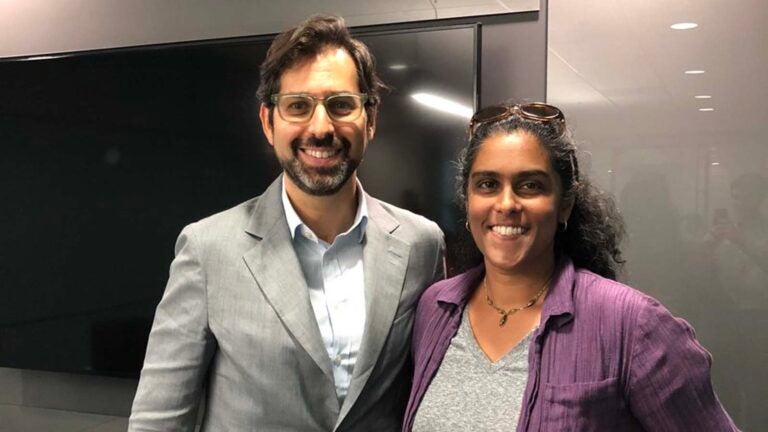
Q&A: ‘On Point’ host Meghna Chakrabarti on taking over the NPR show and what she misses about covering Boston
“I didn’t feel like I was coming into a challenging situation at all. I felt like I was coming into a situation where there was a great amount of opportunity.”
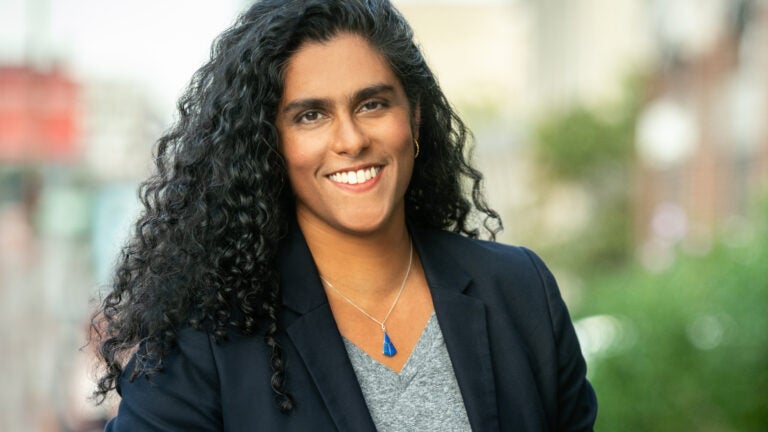
Meghna Chakrabarti was working toward a graduate degree in environmental science and risk management at Harvard when she had what she called a “moment of revelation.”
Related Links
Her work was not keeping her up at night.
Born in Boston but raised in Oregon, Chakrabarti says she comes from “a very scientific family.” And it was something her father said to her when she was around the age of 10, about what it takes to produce great scientific work, that led to her moment of realization that she was in the wrong field years later.
“My dad said to me, he was like, ‘Daughter, if you’re not kept awake at night thinking about your experiments and you can’t wait to get back to the lab’ — I still remember almost word for word what he said — ‘If you can’t wait to get back to the lab to try your latest idea then you just should not be a scientist because you will not be a great scientist,’” Chakrabarti said.
Her new career in public radio was cemented when she got “bitten by the bug” while working as an intern with WBUR’s Inside Out documentary unit. Working in radio, she found herself staying up at night, being excited about the stories she’d be researching the next day.
Since then, she’s worked as a reporter for WBUR’s news department, served as a fill-in host on “Here & Now,” and hosted the station’s “Radio Boston” for eight years.
And now, in addition to hosting the popular podcast “Modern Love,” Chakrabarti hosts the nationally-syndicated call-in show “On Point,” which she took over in mid-August along with NPR media correspondent David Folkenflik. Boston.com spoke with Chakrabarti to learn more about what it’s been like hosting the show, what she misses about covering Boston, and how she spends her time when she isn’t on air.
[Note: This interview has been lightly edited for clarity and length.]
Boston.com: What has it been like to go from hearing from Bostonians [on
“Radio Boston”] and being locally-focused to having a national audience with “On Point”? Have you noticed particular differences in your interactions with listeners or the people you’re hearing from?
Meghna Chakrabarti: I think it’s been really exciting. But it has been different. Because over the eight years of “Radio Boston” — you’re talking to your neighbors. It almost felt like on a daily basis I was just talking to this giant, extended family of mine in Greater Boston. We’re kind of living the same experiences, we’re dealing with the same travails, we all intimately know the people who are representing us. There was a greater degree of familiarity, and you could kind of dive into the middle of a conversation instead of having to start at the beginning. So it was a little less formal, a little more relaxed. Like I said, it’s like having a giant conversation with 50,000 members of your own family. Which is great. And I really, truly loved that, especially over time. Because we were covering stories repeatedly from different angles, so there was this big body of knowledge, too, that we all collectively had.
At “On Point,” you’re talking with orders of magnitude higher number of people. And the biggest difference is not so much in the way they interact with me. We’re all coming from different experiences, really different places, really different perspectives. And that diversity is part of the excitement. So it’s less familiar, but more expansive.
Now over time, I don’t think there’s anything to stop a national show or a person hosting a national show to form that same familiarity. But it’s just going to take time, and I’ve only been at it for a couple of months.
Do you miss doing a locally-focused show at all?
Part of me will always miss it. It’s funny, my first child was born just a couple of months after I started “Radio Boston,” so it was kind of like I had two children at once. One of them happened to be a radio show, so I will always be emotionally attached to it. And Greater Boston is a fabulous place to be a journalist, too. There is so much going on here. … But it was also absolutely the right time for me to take this next step. And “On Point” is a fabulous program. It’s a measure of how lucky I’ve been so far that I can fairly say that I miss what I’ve done so far, but I’m so excited to be where I am now.
Sometime after it was announced that you would be doing four days and that David Folkenflik would do one day, there was some kind of misunderstanding by people online that this was because they were not letting you have five days —
— I was really touched by all that.
You reminded everyone that you were happy with the situation. Can you just speak a little bit to that? Why was that important for you to have that [schedule]?
I could speak for hours about that but I won’t. This is a huge program, and its standards are rightfully very high. And I am not a person who likes to perform below standard. So because of that and where I am in my life with my family, it was just very clear to me that in order to do a great job, four days a week I could probably do a great job or at least aim to do a great job. Five days would be burning candles, very rapidly, at both ends. I did not want to sacrifice the quality of “On Point,” and I didn’t want to knowingly go into a situation where I couldn’t do the best I could.
Obviously you and David took over as permanent hosts after Tom Ashbrook was dismissed following the investigation into his workplace behavior. What was the most challenging thing about coming into “On Point” after that? Was there anything that you tried to do, or communicate, or keep in mind for yourself to start off and take on this job as a host?
I don’t think I would frame it as a challenge. Because I didn’t feel like I was coming into a challenging situation at all. I felt like I was coming into a situation where there was a great amount of opportunity. And I really mean that. Because to be honest, this isn’t news, any team that goes through a process like that, it was tough for them. But on the other side of that process, there’s this opportunity to say, ‘OK, so what do we do now? How do we build a culture and team environment where people’s work, that they’ve already been doing tremendously, is celebrated and valued and that we’re building opportunities to grow individually and as a program?’
So it didn’t feel like a challenge. I was really excited.
As part of coming in and having this opportunity, was there anything that you wanted to change or evolve? Did you talk with people when you came in about things that you wanted to do right away?
No, I didn’t talk to them right away about things that I wanted to do. Because you learn over time that change is inevitable whenever you have personnel changes. I saw that at “Radio Boston.” Because even though all of these programs are very host driven, ultimately the host is just the final person in the process, and the process is so profoundly determined before that by all the producers doing their great work.
… I didn’t come in at all and be like, ‘Oh this is what I think ‘On Point’ should be.’ I know where I come from, what my interests are, what my strengths are, and I’ve got ideas. But I think really the most important thing first and foremost was not this radical restructuring of the show, because I don’t actually think that it needs radical restructuring. But it was establishing a relationship. Not only with my staff, but with all of “On Point”’s listeners. Because let’s not forget, they went through a transition, too. They’ve got to trust me and get to know me, understand that the person behind the mic right now absolutely believes in the continuing mission of the show and those core values won’t go away.
So that was my goal at the beginning. Now, over time, if we want to evolve the show, we’ll talk about it as a staff. And there are lots of good ideas already.
You previously worked as a producer on “On Point.” So what’s that like to have been in that position and now to be in the position of hosting?
I think every host should have been a producer at one point in their career.
The ideal host is someone who’s done a lot of production and reporting, I think. It’s not rocket science. You can’t know what it takes to do a job unless you have done that job. So I know what it takes to be a producer on this show. I know how much work they have to do. I know the extent of the research they have to discover. I know what it’s like to try and find the best guests, to brainstorm about what the most compelling angle is. I know about the soft skills that are needed to manage what can be both very difficult guests with the time pressures and the deadlines. I just know that because I did that for five-and-a-half years. So on a day-to-day basis I’m never going to question what they’re doing.
What’s been your favorite part so far about working on the show? Do you have a favorite segment or interview that comes to mind?
So many. So many. What’s my favorite part of working on the show? That’s a good question. Because my first answer is, ‘All of it.’ It’s a great team. It’s a really amazing feeling as a journalist to not only have a terrific team supporting you but to then, because you’re on a national platform, to have the entire universe of topics and people and ideas to pick from. Right? It’s like being in a candy store. It’s like being in a journalism candy store.
On a more serious note, we’re just in a very intense and challenging time as a nation, so I feel like it’s our duty, and I take this very seriously, to try and do the best that we can for our listeners to provide great journalism and analysis. And that’s an amazing opportunity to have.
What do you want people to know about you that they might not know already?
I have spent the past two years in this long, slow, occasional project of trying to strip sand and refinish every door in my condo. … The reason why I do it, is it is my 10 minutes to do something that’s just quiet and focused and not actively engaging with the cacophony of the world right now.
It’s almost meditative to just sand an old door and then come back and put a primer coat on it and then sand it again. There’s something deeply fulfilling about the slow progress of that. I actually look forward to the times that I get to do it. And it’s taken me two years only for 10 doors. But I’m almost done! I’m almost done. And my next project is that we have all these brass fittings for the doors. You can’t have tarnished brass!