
Sign up for the Today newsletter
Get everything you need to know to start your day, delivered right to your inbox every morning.
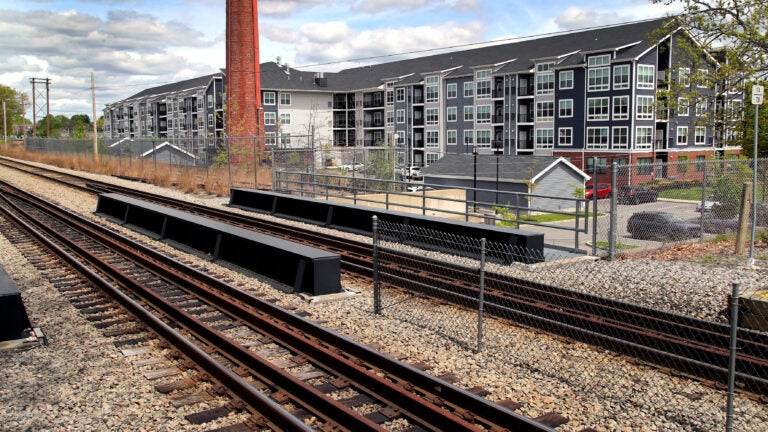
Since the MBTA Communities Act was passed in 2021, questions, concerns, and criticism about the law have abounded.
As 31 of the 177 towns and cities required to comply with the law reached their Feb. 13 deadline to submit action plans to the state, those questions have likely been renewed.
We asked Boston.com readers for their questions about the law, and took seven common misconceptions generated from those responses to housing and zoning experts to answer.
Below, Emma Battaglia, a land use planner with the Metropolitan Area Planning Council, and Ed Augustus, the Secretary of the Executive Office of Housing and Livable Communities, weighed in on some common misconceptions.
Where do these misconceptions come from? Short answer: A general fear of the new and unknown. Such worries are common and understandable, especially when it comes to changes happening in your community, Battaglia said.
“There’s often an overall misconception that new housing is going to hurt your neighborhood or hurt your property values, and that allowing more flexible zoning is going to be the vehicle that drives that. I think that’s where the roots of the misconceptions are coming from,” she said.
Click on the myths below to jump to each section:
The MBTA Communities Act requires towns and cities to zone for multi-family housing as of right, but it does not require those communities to actually build anything, according to Augustus, the EOHLC secretary.
“As of right” means development is allowed in a district under a zoning ordinance or by-law (in the case of the MBTA Communities Act, this would be a 3A zoning ordinance) without the need for a discretionary process such as a special permit, variance, or other discretionary zoning approval.
By allowing multi-family housing as of right, the law removes some of the friction around the ability to have multi-family housing in a community, but it doesn’t necessarily make it any easier to actually build new housing; Communities will still have to contend with the costly, lengthy realities of development.
“The laws of gravity have not been suspended: interest rates are still a challenge, the cost of materials are still a challenge … All the law really is doing is saying, ‘Hey, we’re going to take some of the uncertainty out of the ability to build multi-family housing in these 177 communities,’” Augustus said. “But you still have to solve all of the other challenges that are associated with building housing.”
And even if multi-family housing does get built, it’s likely to be far fewer units than the required 15 units per acre, according to Battaglia.
“In most of the situations, the minimum unit capacity that a municipality would have to meet, the actual number [of built units] will be much lower, because of the reality of developing a site,” she said.
Moreover, if any development does occur, it will likely be a yearlong process, Battaglia explained.
“Rarely does zoning ever create anything immediately. It’s really meant to be a long-term strategy,” she said.
Readers are correct in that there are no affordability requirements in the law, meaning communities do not have to zone for multi-family housing that is affordable. But the assumption that the law won’t address the state’s housing crisis misses the larger goal of the law – and the economic principle of supply and demand, Augustus said.
“When you create options for folks within those communities, it inevitably allows for more choices. More choices and a lower vacancy rate in a community and in the state as a whole, is going to have an impact on the overall affordability of the housing market,” he said.
Even without an affordability provision in the law, towns and cities in Massachusetts are still able to include affordable housing in development plans because of inclusionary zoning (IZ). IZ programs can be mandatory or voluntary, and aim to help spur the construction of affordable housing.
Nearly 75% of the IZ programs in Massachusetts are mandatory, according to a 2021 study by The Harvard Joint Center for Housing Studies. These programs require developers to set aside a portion of units (often between 10 and 15%, Battaglia said) within a development that are affordable.
She emphasized that even if no new affordable units are added to a community, the addition of “any new housing is good.”
“Obviously we need more affordable housing. No one’s denying that. But we just need to increase the supply, because the demand is so constricted,” she said.
The MBTA Communities Act applies to 177 cities and towns throughout the eastern part of Massachusetts, from Salisbury down to Fall River and west all the way to the Worcester area. One notable exception is Boston, perhaps the definitive “MBTA community.” So why is it not included?
The MBTA Communities Act is part of Chapter 40A, the state laws that govern zoning throughout Massachusetts. But Chapter 40A does not cover Boston, which “has always been handled separately as it relates to zoning,” Augustus said.
“It’s not like Boston was specifically exempted from the MBTA communities requirement,” Battaglia said. “Anything that’s passed under Chapter 40A just doesn’t apply to Boston.”
The Metropolitan Area Planning Council (MAPC) tracks housing production throughout the Greater Boston area, Battaglia added, and the city itself does a lot to add new units to the region. Between 2015 and 2023, Boston was responsible for permitting 48% of all the new units throughout the municipalities tracked by the MAPC. Of all the deed-restricted affordable units permitted in that time, Boston was responsible for 67%.
Addressing concerns about communities being “turned into Boston,” Battaglia stressed that the MBTA Communities Act has a minimum gross density requirement of 15 units per acre and that reaching this requirement does not mean massive buildings need to be built.
“I don’t think people realize that you can easily reach 15 units per acre with a two or three story building,” she said.
There are consequences. Any noncompliant community can be ineligible for a variety of state grants. The state’s website lists 13 discretionary grant programs that take compliance into consideration when making award recommendations. Further, the MBTA and other state agencies that consider local housing policies when awarding grants can use compliance in their decision-making process.
When Milton residents rejected changes to the town’s zoning bylaws and put the town in noncompliance with the law, the state took action. It withheld a $140,800 grant from Milton that would have funded improvements to a seawall that local officials said was in need of repair to protect the town from coastal flooding. Attorney General Andrea Campbell successfully sued Milton for its failure to comply.
However, the Supreme Judicial Court ruled last month that the original guidelines for the law’s implementation were not promulgated properly. The EOHLC had to file emergency regulations while new formal ones are being crafted. The new regulations will likely look very similar to the original guidelines, and that change should not have any “substantive impact” on the broader law, Augustus said.
But due to that ruling, Milton and other noncompliant communities were given extra time to submit action plans to the state laying out their strategy to reach compliance. The deadline was end-of-day Feb. 13. Those communities will then have until July 14 to submit a district compliance application to the state.
Regardless, the SJC ruling affirmed that the Attorney General’s office has the right to enforce the law. But the specifics of what that enforcement looks like will potentially need to be determined through future legal action.
“The Attorney General can sue any individual municipality. Milton was making the argument that they couldn’t even be sued by the Attorney General. This just affirms that they can. I’m almost certain that it’s going to take future court cases probably, to iron out what the enforcement mechanisms might be,” Battaglia said.
Short answer, no, the MBTA Communities Act takes into account the community’s distance from the MBTA, how much development is already there, and derives their multi-family unit requirements from the housing stock already in the community.
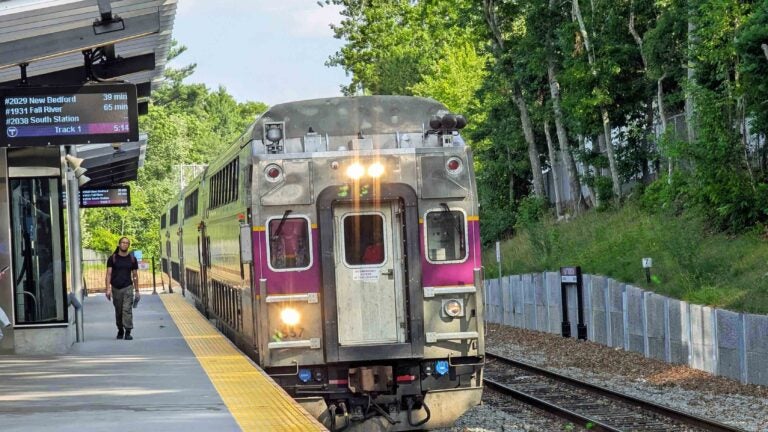
The MBTA Communities Act first splits up all 177 communities into four different categories: rapid transit, commuter rail, adjacent, and adjacent small town communities.
There are a dozen rapid transit communities (like Newton and Brookline) and 72 commuter rail stations (like Worcester and Newburyport). There are 58 adjacent communities (like Arlington and Burlington), and 35 adjacent small towns (like Dover and Lakeville.)
From there, the law uses the community’s housing stock in 2020 to mandate a certain number of units to be accommodated with the new zoning, which the law considers “reasonable.” For example, Cambridge, a rapid transit community, must rezone for 25 percent of the city’s total units, which in 2020 was 53,907. Their rezone must accommodate 13,477 units.
Commuter rail communities must rezone for 15 percent of their total housing units, adjacent communities 10 percent, and adjacent small towns 5 percent. That means in small towns with around 4,000 or so housing units, their multi-family units should be zoned to accommodate around 400.
However, additional requirements can still change the unit totals, like density and developable land. The law does require the multi-family zoning district to be a “neighborhood-scale district, not a single development site,” according to the law’s regulations.
In all of the communities but the 35 adjacent small towns, the zoning district must be 50 acres, or 1.5 percent of the developable land, whichever is less. In the adjacent small town communities, the law does not dictate where the housing has to be built, and there is no minimum land area.
In commuter rail or rapid transit communities, the rezoning has to impact developable areas a half mile around MBTA stations. For example, Cambridge, Brockton, Brookline, Needham have the most developable area around stations, so 90 percent of their districts have to be the station area.
However, municipalities can’t piecemeal the multi-family zoning. At least half of the district must be on contiguous lots of land. And for all communities, it does have a minimum gross density requirement of 15 units per acre.
There is no aspect of the law that requires municipalities to upgrade their infrastructure for the rezoning, and in turn, the multi-family housing itself. Augustus and Battaglia said it’s mostly local developers who pay for some infrastructure improvements, and state programs can address any lagging.
“It’s not always black and white, but it’s usually everybody at the table. The developer, … the state and the local community, to figure out how to solve whatever infrastructure issues,” Augustus said.
However, an influx of multi-family housing in the coming years also won’t necessarily hurt a community, particularly in regards to school populations and traffic, Battaglia said. In Massachusetts, most communities haven’t seen an increase in student population, and if anything, are actually seeing a decline in enrollment.
A 2024 MAPC study even found no association between increased housing unit development and school enrollment. Instead, increases in student population were linked to other factors such as “demographic trends, parental preferences, and the characteristics and affordability of available housing,” according to the study.
Generally, zoning is deferred to towns and cities, but there are multiple state laws that override local zoning. Some readers think the state shouldn’t dictate zoning laws at all, but each municipality must abide by Chapter 40A, the state’s zoning laws adopted in the 1970s.
Chapter 40A includes rules of the boards of appeals, special permits, solar developments, and laws around pornographic bookstores, movie theaters, and strip clubs.
Section 3A was signed by Governor Charlie Baker in 2021 as part of those zoning laws, created with a state power enshrined in the Massachusetts Constitution. The SJC also upheld the MBTA Communities Act as legal and constitutional.
‘The reality is, and I think the SJC case reaffirmed, the state has a role in zoning. It just does,” Augustus said. His office also pointed to another state zoning mandate, Chapter 40B, which waives some local zoning to prioritize affordable housing, as long as at least 20 percent of the units are affordable.
While municipalities in Massachusetts have a right to self-governance granted by Home Rule authority in 1966, all zoning by-law changes must be approved by the Attorney General’s Municipal Law Review office.
According to the office, Campbell has 90 days to approve any proposed zoning by-law amendments or adoptions to ensure its legality. So, no, towns and cities have always had to abide by state law when zoning their communities.
Get everything you need to know to start your day, delivered right to your inbox every morning.




To comment, please create a screen name in your profile
To comment, please verify your email address
Conversation
This discussion has ended. Please join elsewhere on Boston.com