

Sign up for the Today newsletter
Get everything you need to know to start your day, delivered right to your inbox every morning.
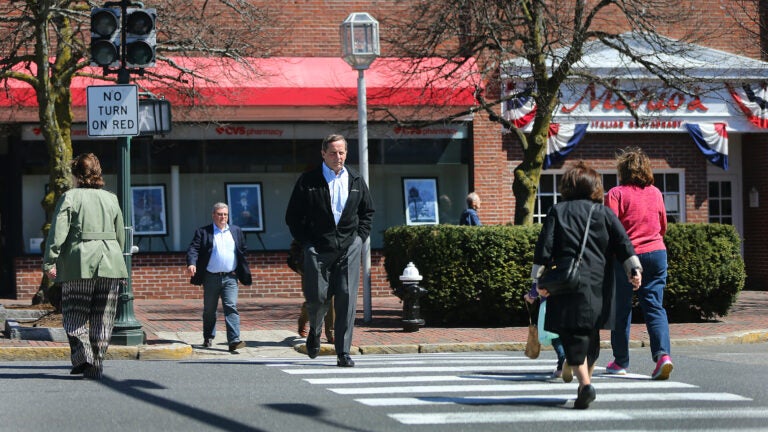
Milton’s battle over the MBTA Communities Act went before the state’s highest court last week, positioning the commuter town at the forefront of a growing opposition movement railing against the 2021 law meant to boost Greater Boston’s housing supply.
Yet while several communities have joined Milton’s rebellion, others have embraced the MBTA law’s rezoning mandate, and early adopters are starting to see results.
Take Lexington, where housing proposals have begun pouring in. Or Westwood, which recently saw a 160-unit mixed-use project break ground. Somerville, meanwhile, is in the midst of a triple-decker renaissance.
“I’ve been working on zoning for 20 years, and zoning policy for 20 years, and I haven’t seen anything like this before,” zoning expert Amy Dain said of the MBTA communities law and its scale. “It’s really exciting.”
Dain, whose newsletter “Upzone Update” has been tracking the law’s progress since January, said the only other local zoning movement that comes close in scale is the “Big Downzone” of the 1970s, when many Greater Boston communities either prohibited multifamily housing developments or made them more difficult to build.
“Definitely, there’s been nothing close to this — definitely not on the side of allowing more multifamily housing — since then,” she said. “And really, I don’t know that there’s been ever a time where there’s been such scale of zoning for multifamily housing all at once.”

Signed by then-Gov. Charlie Baker in 2021, the MBTA law requires 177 communities served by or located near the T to zone for more multifamily housing. The law doesn’t actually mandate new construction, instead setting “unit capacity” targets for each community’s zoning — in other words, the number of units that could be built in a specific zone if the land were completely empty.
Whether the law will be as transformative as lawmakers hoped remains to be seen, though affordable housing advocates say it’s a step in the right direction. But with dozens of cities and towns staring down a year-end deadline for compliance, there’s been growing pushback among some who argue the zoning mandate is too broad, or goes too far.
Milton approved and then overturned zoning changes that would have complied, and the Supreme Judicial Court is now weighing Attorney General Andrea Campbell’s push to force the town’s hand. During a joint appearance days before the SJC heard oral arguments in the dispute, Campbell and Gov. Maura Healey took a moment to spotlight the dozens of communities that, rather than fighting the MBTA law, have opted to embrace it.
“When communities say yes to housing production, they are saying yes to making housing more affordable for the teachers, first responders, and middle-class families that make our communities strong,” Healey said. “We’re grateful for the communities that have adopted these changes and look forward to celebrating many more who will keep up this momentum this fall.”
Success stories include Lexington, one of the first two communities to achieve compliance with the MBTA Communities Act.
The town “really wanted new housing to be in desirable locations, so near retail and civic services, near places that could help support businesses,” Planning Director Abby McCabe said, adding, “We weren’t looking for isolated locations on the edge of town.”
Lexington has seen seven applications for new developments under its MBTA Communities zoning, for a combined total of 960 proposed housing units. The town’s Planning Board has so far approved two of those projects.
“It’s actually a lot more than we expected,” McCabe said of the influx of applications.
When the Planning Board was discussing the rezoning early on, “they did want to find locations that would be developed, that would actually create housing,” she explained. “We just didn’t expect it to be this fast. It took a little while to get applications, but now we’re getting a new application pretty much every couple weeks, so it’s just at a faster rate than we were anticipating.”
Most applicants are estimating two years of construction, and a project at 89 Bedford St. is already underway, according to McCabe.
“They’re moving along, and they hope that they could even be … occupied by the end of 2025, which is ambitious,” she said. “I think most of the others, it will probably be 2026 or 2027.”
In other communities, pushback against the MBTA Communities Act has brought on a wave of concerns about overburdening public resources like water and sewer services. For some of the larger projects on the table in Lexington, McCabe said developers are mitigating those concerns by working closely with the town to perform water and sewer capacity analyses before breaking ground.
That’s not to say there hasn’t been some pushback among Lexington residents.
“It’s a mix,” McCabe said. “Change is definitely hard, it’s naturally scary for people, especially for the neighbors.”
She said the town has also seen a lot of support for these new developments, though there have been growing calls for improved bus service to match the increase in density.
“We’re providing the housing, but we really need the MBTA to come forward with more of the public transportation,” McCabe said.
For now, the more immediate impacts can be seen in the increased workload before the town’s planning and conservation officials, she said.
“Lexington Planning Board and Town Meeting really embraced the zoning,” McCabe said. “Change is scary. I’m sure that a lot of people are worried that this development is faster than expected, but they’ve been showing their mettle and they really embraced this change and [are] working hard to make sure this works for the community.”
Asked whether Lexington’s success makes it an outlier among communities that have adopted MBTA rezoning, Dain demurred.
“I don’t want to call them an outlier, because my hope is in the long run, that won’t be an outlier,” she said. “Maybe call it like an ‘early mover,’ but we have to wait and see.”
Proponents of the MBTA law notched another victory last month in Westwood, where Petruzziello Properties began construction on The Block, a 160-unit mixed-use development to be located on a former industrial site near the commuter rail’s Islington Station. Approved in 2023, The Block is Westwood’s first development under its MBTA Communities zoning.
“In addition to creating 160 housing units, The Block at 22 Everett included many community-driven ‘firsts’ for the Town and paved the way for a much-needed clean-up of the site,” Westwood Housing & Land Use Planner Amanda Wolfe explained in an email interview.

Wolfe said the development will not only offer three-bedroom units, micro transit, and a fully accessible public playground, but it’ll also have the first units in Westwood available to households earning no more than 60% of the area median income — an even more affordable price point than the 80% AMI the zoning bylaw requires for a certain percentage of units.
The Block development takes up the entirety of the first Mixed-Use Multi-Family Residential Overlay District (MUMFROD) Westwood established in 2022, and the town’s 2024 multifamily zoning expansion only recently received Campbell’s approval, Wolfe noted.
“The Block at 22 Everett demonstrated how the MUMFROD bylaw can result in a successful project, but it is too early to tell how it will impact developer interest,” she added.
Still, Wolfe touted the Planning Board’s track record of approving multifamily housing even before the MBTA Communities Act. The way she sees it, the law offered yet another opportunity for the town’s housing development.
As Dain noted, the history of the MBTA Communities Act is still being written.
“It’s still an open question about how much housing all of this rezoning will lead to, and that is somewhat in municipal hands,” she said.
“Preliminary thoughts are like, ‘This isn’t going to solve the whole housing shortage.’ I mean, I don’t think we ever thought it would,” Dain continued. “So it’s important for policymakers to be thinking about additional policy levers that can be pressed to help solve this challenge.”
Still, she pointed to a recent MassINC Polling Group survey of 800 likely voters, which found that 50% thought the MBTA Communities Act was a “good policy,” compared to 31% who considered it bad.
“Maybe part of the turning of the tide on that and the growth of support is partly that a lot of communities successfully adopted the local zoning, and people feel good about that,” Dain said.
Between Town Meetings and the MBTA law’s upcoming compliance deadline, “there’s a big fall ahead,” she acknowledged. The Milton case pending before the SJC adds yet another layer of uncertainty for rezoning efforts.
“One way or another, there’s still just a lot of work ahead,” Dain said. “And even if MBTA Communities is fully implemented, there’s going to be more work ahead to make sure there’s housing for everybody, and appropriate housing, safe housing, diverse housing, and housing in places where people want to live and have access to jobs and schools and places they want to go to.”

Get everything you need to know to start your day, delivered right to your inbox every morning.




To comment, please create a screen name in your profile
To comment, please verify your email address
Conversation
This discussion has ended. Please join elsewhere on Boston.com