

Sign up for the Today newsletter
Get everything you need to know to start your day, delivered right to your inbox every morning.
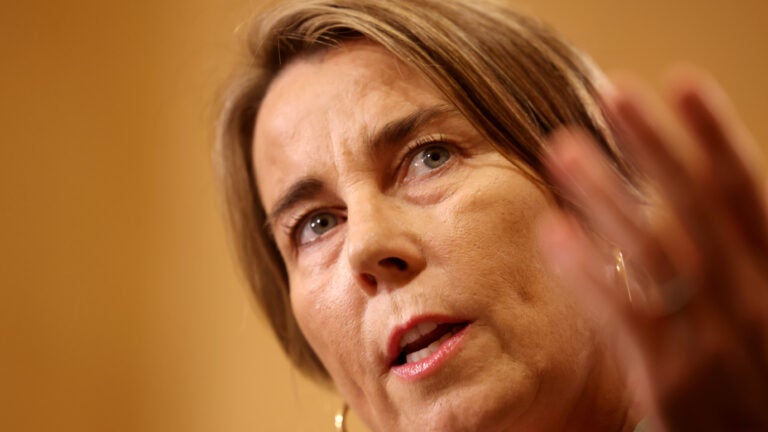
Gov. Maura Healey proposed legislation Tuesday that would require social media platforms to verify the age of users and limit the ways in which young users are exposed to “addictive” design features on these platforms.
Healey’s move comes amid a growing national push for more restrictions on social media companies. Critics, including lawmakers on both sides of the aisle, say that social media is fueling a mental health crisis among young people, and that big tech companies are willingly ignoring the issue.
“We’re taking steps here in Massachusetts to protect our young people, to actually take the power away from social media platforms and give that power to young people and to parents,” Healey said. “The social media platforms have already shown, over the last decade, that they are not responsible caretakers or protectors of our young people.”
The governor’s bill would force social media companies to implement “age assurance” systems on their platforms and set up specific guardrails for users under the age of 18. For these users, default settings would automatically disable common features like infinite scroll, auto-play videos, and feeds based on user-specific algorithms. The default settings for young users would have to disable location tracking and notifications. The settings would restrict social media access overnight and during school hours, while limiting cumulative daily use to two hours.
Users 15 and younger would not be able to modify these default settings without a parent or guardian.
The proposed bill requires social media companies to give users a simple way to flag harmful content and reset algorithm-based feeds. The companies would have to give users periodic reminders about how long they’ve spent using the platforms and about the negative health impacts social media can have.
Last summer, the state Senate approved legislation that would require public school districts to implement “bell-to-bell” cellphone bans. Such bans would bar phone use throughout the school day, including during recess and lunchtime.
The Massachusetts House of Representatives passed a bill earlier this month that also would implement “bell-to-bell” phone bans. But the House bill took restrictions a step further, as it would block children under the age of 14 from using social media platforms entirely.
Healey endorsed the social media ban in the House legislation, saying her proposed restrictions are “complementary.”
Both Healey’s proposal and those pending in the Legislature can work in tandem to make Massachusetts a nationwide leader in fighting the influence that “social media conglomerates” have on young people, Massachusetts Teachers Association President Max Page said.
“Our members … are telling us that their students are not ok. They are lonely and depressed at rates unseen before. They are dysregulated, leading to harm to themselves and to others, including our educators. And they are distracted by a technology that is designed to do exactly that: exploit their young brains to keep them in a solitary loop for hours on end,” Page said.
While there is strong support for these policies among lawmakers and other officials, serious questions remain about their feasibility and broader impacts. It is unclear how policies like the two-hour daily limit and the default settings restrictions would be enforced across social media platforms.
Evan Greer, director of the Boston-based national digital rights organization Fight for the Future, said that Healey’s proposals ignore the specifics of how companies would actually comply with any legislation. This risks empowering the companies even further. For example, companies may begin checking IDs and sharing user data with other companies in order to comply with the proposed policies, she said.
“Governor Healey is right that we can’t trust Big Tech, so why does she want to force our kids to send them even more data, and force them to share that data even more widely?” Greer said in a statement.
Greer supported efforts to hold companies accountable, strengthen privacy, and crack down on features like algorithmic feeds and infinite scroll.
But social media bans like the one outlined in the House bill are “completely unworkable” and “unconstitutional,” she said. LGBTQ youth with unsupportive parents and undocumented residents who may not have access to a government ID could be particularly harmed by the bans, she added.
“Governor Healey’s rhetoric does not line up with the actual evidence on this issue. While numerous studies have shown that excessive social media use is harmful to youth mental health, other studies have shown that cutting LGBTQ youth off from social media actually leads to worse mental health outcomes,” Greer said. “The data is quite nuanced, and while it supports action to crack down on predatory business practices, it does not support an outright ban, which will not work and will lead to even more harm to young people.”
In a major development in March, a California jury found that Meta and Google were at fault for deliberately building addictive features that are meant to exploit the brains of young people.
Last week, the Massachusetts Supreme Judicial Court found that Meta is not immune from lawsuits over addictive features, clearing the way for Attorney General Andrea Campbell to sue the social media giant that owns Facebook, Instagram, and WhatsApp.
Healey said she was happy to see how the SJC ruled. Her team has been following litigation around the country and working for months on these proposals, she added.
“These companies have designed products to be addictive and to exploit young peoples’ insecurities. That’s what’s happening,” Healey said.
Get everything you need to know to start your day, delivered right to your inbox every morning.



Be civil. Be kind.
Read our full community guidelines.To comment, please create a screen name in your profile
To comment, please verify your email address