
Sign up for the Today newsletter
Get everything you need to know to start your day, delivered right to your inbox every morning.
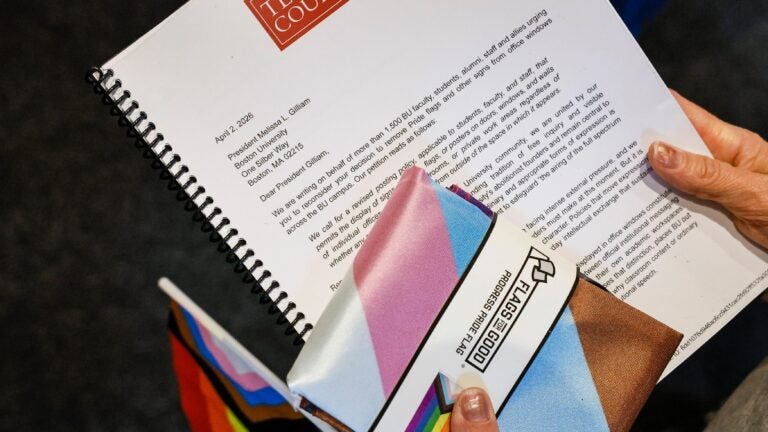
Boston University President Melissa Gilliam announced Monday that BU will temporarily pause its signage policy following months of controversy over the removal of three Pride flags from campus.
The policy, part of BU’s Events and Demonstrations guidelines, states that materials “may not be affixed to any University-owned property, including walls, windows, or furniture,” if they are outward-facing. Administrators cited the policy when removing the Pride flags from campus locations last month.
Requests to remove the flags began in August 2025 and continued into the fall. By December, the issue had sparked protests, and tensions escalated further in March when the flags were removed from three campus sites, prompting another rally.
Last week, a coalition of students, faculty, alumni, and staff gathered outside Gilliam’s office to protest the removals and deliver a petition addressed to Gilliam and the university’s Board of Trustees. The petition urged officials to allow signage in private spaces, regardless of whether it’s visible from outside.
In an email to the university community, Gilliam discussed the impact the controversy has had, particularly on LGBTQ+ students.
“Our University and our policies exist within a larger social context—one that is dynamic and complex,” she said. “In the public conversation about Boston University’s time, place, and manner policies, that spotlight has fallen disproportionately on our LGBTQIA+ community, and I have heard how difficult and painful that has been. I am deeply sorry.”
Gilliam said the pause is intended to create space for further discussion and reflection.
“In this moment, however, it is critical that we can hold these matters separate. One is a discussion about a policy; the other is a discussion about our core values and respect for members of our community,” she said. “I am troubled that they became conflated. It signals to me that we need more time and opportunity to consider these matters.”
Gilliam added that the university will explore additional ways to support the community and create opportunities for dialogue around the issue.
“We will not always agree on every issue — nor should we. We do not need to shy away from difficult conversations,” she said. “But we do need to agree to have those conversations and to listen with open minds. I look forward to many thoughtful, productive discussions to come.”
Get everything you need to know to start your day, delivered right to your inbox every morning.






Be civil. Be kind.
Read our full community guidelines.To comment, please create a screen name in your profile
To comment, please verify your email address