
Sign up for the Today newsletter
Get everything you need to know to start your day, delivered right to your inbox every morning.
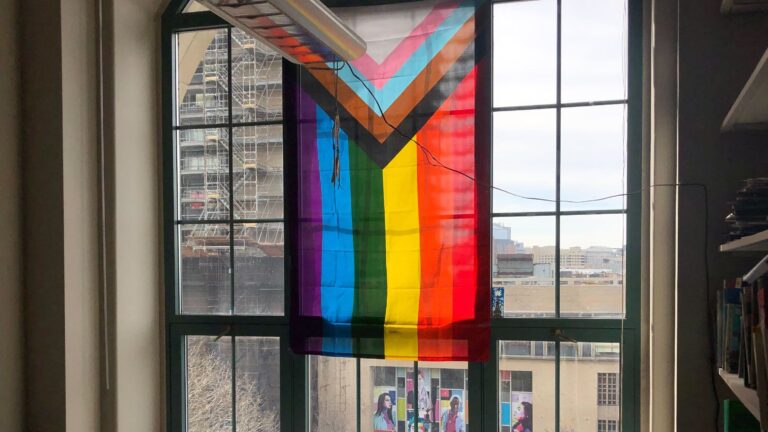
While many were away for spring break two weeks ago, Boston University administrators removed Pride flags from three campus locations, sparking renewed debate over free expression, institutional policy, and LGBTQ+ visibility.
The flags had been displayed in the Women’s, Gender, and Sexuality Studies offices at 704 Commonwealth Ave., in Professor Liz Bettini’s office in the Wheelock College of Education and Human Development, and in Professor Nathan Phillips’s office in the College of Arts and Sciences.
Their removal marked the culmination of a months-long dispute between faculty and the administration over the university’s signage rules.
Joseph Harris, co-president of the BU chapter of the American Association of University Professors, said administrators first required that the Pride flags be removed in August 2025. Requests continued into September, and by December, the issue had sparked a campus protest.
University officials said the removals were part of enforcement of BU’s Events and Demonstrations Policy, which restricts signage in outward-facing windows. According to the policy, materials “may not be affixed to any University-owned property, including walls, windows, or furniture,” when visible externally.
BU spokesperson Colin Riley said in a statement that the policy applies equally to all forms of signage.
“This is a content-neutral policy, meaning any signage must be removed, and policy enforcement is not an endorsement nor rejection of any point of view,” he said. “We remain committed to ensuring BU is an inclusive, welcoming, and supportive community, and there are many ways to express and demonstrate our values consistent with policies.”

However, BU AAUP Co-President Mary Battenfeld said the policy’s enforcement is not “content-neutral,” as other posters, such as ones of Taylor Swift, have not been taken down from public-facing windows.
“When you tell students, when you tell faculty, when you tell staff, when you give a message that you can’t express your opinion, that is anti-free speech. It’s anti-democratic,” she said.
Faculty members responded by sending letters to BU President Melissa Gilliam. Among them was Keith Vincent, an associate professor in the Women’s, Gender, and Sexuality Studies department who identifies as gay.
“It felt like a gut punch,” he said. “I felt a little violated that they had actually gone into our space and taken it down.”
As of Tuesday, Vincent had not received a response to his letter.
“Their position is indefensible,” he added.
For Vincent and others, the issue extends beyond policy interpretation to student well-being. He said Pride flags serve as a visible signal of support for LGBTQ+ students — many of whom feel isolated.
“People don’t understand how for queer people visibility can be life-saving, and so having those flags out there sends a really, really important message,” he said. “And I just don’t understand why the university would want to mess with that.”
The university adopted the “Living Our Values” initiative last year, which contains eight core values — integrity, inclusion, community, collaboration, excellence, learning, service, and global engagement. These values are consistent with the symbolic meaning of the Pride flag, Harris, the AAUP co-president, said.
In November 2025, the Women’s, Gender, and Sexuality Studies program issued its “Statement on the Pride Flag,” detailing the flag’s history and its significance to students, Harris said.
“Pride flags have special status. They signal safe harbor. They signal welcome. They signal acceptance,” he said. “For communities that historically have faced a lot of stigma, this can be really important.”
Research by BU School of Public Health Professor Julia Raifman suggests the implications extend far beyond symbolism, Harris said. LGBTQ+ adolescents are more than three times more likely to report a recent suicide attempt than their heterosexual peers, and institutional policies signaling inclusion are directly associated with reduced mental health inequities, according to the research.
At an administrative meeting Thursday, which faculty were not formally invited to attend but members of the AAUP observed, Gilliam, the university’s president, described window-facing displays as a “privilege,” according to Harris. She emphasized that the university is not targeting any specific group and characterized BU’s approach as “less draconian” than policies at other institutions.
That framing has drawn criticism.
“Free speech is protected in the Constitution, and to suggest that expressing oneself is a privilege, I think really takes issue with that,” Harris said.
Criticism has expanded beyond campus. At a Monday Boston City Council hearing organized by students through the Committee on Education, dozens of speakers called for greater transparency, student representation, and protection of expression across schools in Massachusetts.
One BU doctoral student, who only identified himself as Michael and said he is gay, discussed the flag removals at his campus.
“The Pride flag is a symbol of acceptance, tolerance, welcoming, openness, progress, and love,” he said. “We’re under this constant threat right now. Universities are not taking us seriously.”
On Tuesday, university officials spoke with BU Today, addressing frequently asked questions about the policy and the controversy surrounding it. Administrators emphasized the policy is not new and does not restrict free expression or signage inside campus buildings.
Officials said some outward-facing signs remain in place because the university is prioritizing direct outreach and dialogue rather than immediate removal.
“Because of that, enforcement may not always appear uniform at a given moment,” the post reads. “In some cases, a display may remain in place while a conversation is underway.”
According to university officials, outward-facing signs are subject to removal because they can be perceived as representing the institution’s views.
“Individuals may say what they want; however, they speak for themselves and not for the University,” the post states. “The policy on outward-facing signage is designed to prevent individuals from speaking for the institution.”
Battenfeld, the AAUP co-president, noted that the initial requests to remove Pride flags came during a period of heightened national debate over LGBTQ+ rights and diversity initiatives. She pointed to actions by the Trump administration, including executive orders targeting transgender individuals and broader anti-DEI efforts, as contributing to a climate of concern.
“That was all very disturbing — not just that it happened, but that [the university] chose to do it at that particular moment,” she said.
Battenfeld also referenced a declaration by the Human Rights Campaign labeling the current moment a national state of emergency for LGBTQ+ Americans. At the local level, she pointed to incidents including the theft of flags honoring murdered transgender people from Boston Common and removals of Pride displays in several Boston neighborhoods, including Jamaica Plain and Roslindale.
“BU doesn’t want to be associating itself with that kind of hate,” she said. “And I feel like this policy does that, and students understand that.”
Because BU is a private institution, the First Amendment does not directly apply; however, legal experts say the situation may still raise concerns under Massachusetts law.
Naomi Shatz, a Boston-based attorney who represents students in discrimination cases, pointed to the Massachusetts Civil Rights Act, which prohibits interference with constitutional or statutory rights through coercion, intimidation, or threats — even by private entities.
“If BU is restricting free speech, and they’re doing it in a way that is threatening or via coercion, then that could violate the Massachusetts Civil Rights Act,” she said. “Those professors could have claims under the law against BU, even though it’s a private institution.”
Shatz said that a key question is whether the university is applying its policies consistently and in good faith.
“If they’re not applying it uniformly, then you’re going to have discrimination concerns and issues that they are censoring people based on the content,” she said.
Harris noted the ruling in Abramowitz v. Trustees of Boston University, where a Suffolk Superior Court judge ruled against the university after administrators entered student rooms without consent to remove anti-apartheid banners. In that case, the court found that the university’s actions violated the Massachusetts Civil Rights Act.
Shatz also questioned whether the Events and Demonstration Policy is being used appropriately in this context. She said that the language appears to focus on organized events rather than everyday office displays.
“They don’t actually have a policy that prohibits hanging flags in your office window, but they’re trying to take a policy that has nothing to do with this issue and sort of layer it over this situation where it doesn’t actually fit,” she said. “To me, that raises concerns.”
Battenfeld said she would like to work with administrators to revise the policy — similar to what Harvard University has done.
Meanwhile, the AAUP chapter is organizing a petition aimed at students, faculty, alumni, and other stakeholders to raise awareness and push for change, Harris said.
“We’d like to see our president succeed, and her many visions — and also for the university itself — to thrive,” he said. “We believe that people are going to remain exercised about this, and they’re going to speak up and speak out, and hopefully we’ll see some effort at resolution that involves supporting free speech.”
Vincent said BU should allow flags to fly, regardless of if they are “problematic” or “distasteful.”
“Let people criticize it. Let there be robust discourse about it,” he said. “Don’t preemptively take it down. And I think that’s the best policy for a place that supposedly values diversity.”
Get everything you need to know to start your day, delivered right to your inbox every morning.




Be civil. Be kind.
Read our full community guidelines.To comment, please create a screen name in your profile
To comment, please verify your email address