
Sign up for the Today newsletter
Get everything you need to know to start your day, delivered right to your inbox every morning.
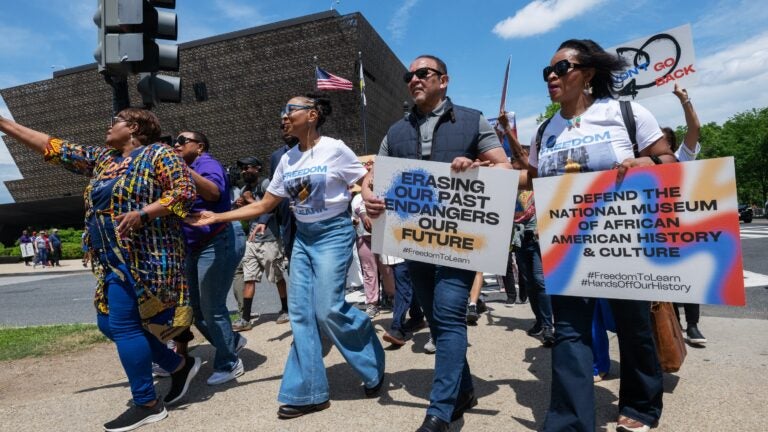
As a coalition files a lawsuit in Boston over the Trump administration’s order reshaping how history is presented at national parks, sites in Massachusetts and across New England are already pulling films, altering signage, and rethinking partnerships.
The Restoring Truth and Sanity to American History executive order directs the National Park Service to remove or alter content or exhibits that “inappropriately disparage Americans past or living.”
A subsequent secretarial order from the Department of the Interior instructs the agency to review monuments, memorials, statues, markers, and similar properties and “restore Federal sites dedicated to history,” installing content that emphasizes “the greatness of the achievements and progress of the American people” or the “beauty, abundance, and grandeur of the American landscape.”
The lawsuit was filed in Boston Feb. 17 by Democracy Forward, a coalition representing six advocacy groups for U.S. national parks, including the National Parks Conservation Association.
“We filed the litigation to stop the Trump administration from erasing history or censoring history at these national park sites,” NPCA Northeast Regional Director Kristen Sykes said.
According to the lawsuit complaint, after the executive order was adopted, the Secretary of the Interior directed the Park Service to “immediately undertake” efforts to identify and report “disfavored information.” In February, park staff were told that all new public-facing content must be submitted to the Interior Department for review.
Massachusetts is home to 18 National Park Service sites. Several local sites across New England are already seeing concrete changes as a result of the order.
At Lowell National Historical Park, officials stopped showing two films about labor history, reportedly “to ensure compliance with the Interior Secretary’s order,” the lawsuit states. The films addressed harsh working conditions and industrial pollution, Sykes said.
Sykes said a staff member at the visitor center indicated the films were being “updated.” Still, removing such material — even temporarily — limits public understanding, she said.
“If you go to a national park site and history or science is removed, you’re not learning about this place,” Sykes said. “You’re not getting the full story.”
Boston.com reached out multiple times to the Park Service, including to Lowell officials, and was directed to email [email protected] each time. No response was received from this email address.
Last summer, the Park Service instructed officials to respond to queries about removed content by saying the administration is focused on “historical accuracy,” according to the lawsuit.
Elsewhere in New England, Acadia National Park removed signs discussing climate change impacts and the significance of the Cadillac Mountain to the Wabanaki people, according to the lawsuit complaint.
In Philadelphia, an exhibit at the President’s House Site in Independence National Historical Park examining the paradox of slavery and freedom during George Washington’s presidency was also removed, according to the lawsuit complaint.
A federal judge ruled Feb. 16 that the exhibit must be restored after the City of Philadelphia filed a lawsuit against the interior secretary. U.S. District Judge Cynthia Rufe ruled that materials must be restored in their original condition and Trump officials cannot install replacements that explain the history differently.
Rufe began her written order with a quote from the dystopian novel “1984” and compared the Trump administration to the book’s totalitarian regime, which revised historical records to align with its own narrative.
Many of Boston’s history institutions operate independently but also in partnership with the Park Service.
The Museum of African American History, a nonprofit with partnership agreements with NPS, is not currently feeling pressure to change its interpretation, said CEO and President Noelle Trent. Being an independent entity means it does not require internal NPS vetting of exhibits or programs, Trent said.
However, the museum recently discontinued a specific financing agreement with NPS because it required compliance with White House executive orders, Trent said.

“We are more vulnerable than state-funded museums. We’re more vulnerable than federally funded museums, and so the support for us, especially financially in this moment, is absolutely critical to our continued existence,” Trent said. “We help ensure a holistic understanding of our regional communities. If we do not exist, our communities, our cities, our towns have an impartial understanding of history.”
At Old North Church, operated by the nonprofit Old North Illuminated, Executive Director Nikki Stewart said the organization retains control over its interpretation because it is not federally owned. But it has also chosen not to pursue new NPS grants due to compliance requirements tied to executive orders.
“We’re not comfortable with the requirements of the grant agreements, and that would open us up to the censorship that we are currently not subject to,” Stewart said.
Revolutionary Spaces, which operates historic sites along the Freedom Trial and within Boston National Historical Park, has not faced any direct pressure but has discussed contingency plans, President and CEO Nathaniel Sheidley said.
“We have said we’re going to continue to do what we do,” Sheidley said. “If that means that we work differently with the National Park Service for this period of time, then we would be comfortable doing that.”
For Mass Humanities, which partners with and supports local nonprofits in the humanities, the financial impact has already landed.
Executive Director Brian Boyles said the organization’s annual operating grant — received for more than 50 years as the state affiliate of the National Endowment for the Humanities — was terminated in April 2025 after first being reduced by roughly half.
“We were told that the work we do no longer aligned with the president’s priorities,” he added.
The cuts forced staff layoffs and program cancellations, Boyles said.
“We’re put in the difficult position of choosing to continue to fulfill our mission or complying with the types of directives that the National Park Service is facing,” he said. “That’s a pretty difficult choice, given that we don’t believe that there’s anything to hide when it comes to American history.”
After signs were removed at Acadia National Park, Maine Congresswoman Chellie Pingree published an op-ed and sent a letter to the Secretary of the Interior, citing concerns about the management of national parks.
As the top Democrat on the House subcommittee that oversees the Department of the Interior’s budget — including funding for national parks — Pingree said she felt a strong responsibility to ensure the parks are managed properly.

Traditionally, there’s ongoing dialogue about the business of national parks, Pingree said, but during the Trump administration, that hasn’t been the case.
Pingree is now exploring ways to use the appropriations process to influence NPS. She said she is considering language in the upcoming 2027 budget cycle that would restore removed signage, make funding contingent on doing so, or at least on providing a full report justifying changes.
“It’s a little harder to win on these issues when the Republicans oppose it,” Pingree said. “But I’m hoping that with continued pressure from the public and using what tools we have, that we’ll be able to restore the previous signs and to stop this overreach.”
Massachusetts Sen. Ed Markey has long been involved in the issue. Last summer, he joined Black history experts for a walking tour of Boston’s historic sites.
“I’m animated by the history that Massachusetts created, and I feel a responsibility to protect and to further educate our country,” he said. “Censoring history is an act of violence.”
Markey called the lawsuit the “highest form of patriotism.”
“MAGA supporters are not just trying to rewrite policy. They are attempting to rewrite the truth, and we must stand up,” he said. “If we don’t learn from the struggles that is the movements of our past, we will repeat the same mistakes over and over again.”
Sykes said the secretary’s order is written in vague language, leaving room for interpretation — and putting other New England national parks at risk of having exhibits removed or censored.
“We’re really concerned about what could be perceived as not complying with the order,” she said, pointing to the Enola Gay controversy — when historical references to the plane that dropped the first atomic bomb were flagged or removed because its name contained the word “gay.”
Even though the MAAH ended its financing agreement with NPS and operates independently, Trent said uncertainty about the future remains.
“Our concern in this moment is to make sure that history continues to be made available,” Trent said. “We have learned to expect the unexpected from this administration, but it has very real consequences.”
For those concerned about the state of public history, Stewart said their best defense is public engagement.
“The best way to fight censorship is to engage with the content,” she said.
Particularly in Massachusetts, the stakes feel personal for organizations dedicated to preserving history, Boyles said.
“Massachusetts is not a state of people who want to conform,” he added. “I think it remains a state very committed to its role in American democracy, for us to shutter those programs would be essentially to tell you that we needed to change Massachusetts.”
Get everything you need to know to start your day, delivered right to your inbox every morning.


To comment, please create a screen name in your profile
To comment, please verify your email address
Conversation
This discussion has ended. Please join elsewhere on Boston.com