
Sign up for the Today newsletter
Get everything you need to know to start your day, delivered right to your inbox every morning.

Cocaine levels in Nantucket’s wastewater are surging. After testing 50% above the national average in September, the island’s readings doubled that pace in October and November, hitting 100% above national levels.
The spike comes as local police have carried out several major cocaine busts in recent months, including the largest seizure in the department’s history, which seized nearly six pounds of cocaine.
In an interview with the local newspaper, the Nantucket Current, Police Chief Jody Kasper noted that the busts were due to the department cracking down on all illicit drug distribution, not just cocaine.
Kasper told the paper that wastewater surveillance data doesn’t align with what officers see daily.
“We’re not having a lot of people come into the booking room, and when we search them, finding cocaine in their pockets, or we’re not pulling over a lot of people and finding cocaine present,” Kasper said. “So, it’s not something that is in our day-to-day work that our officers and detectives are seeing out there.”
The data, which goes back to June 2025, shows cocaine levels remaining consistently above the national average, with one large spike in October and November. The data shows an accompanying Benzoylecgonine spike in November.
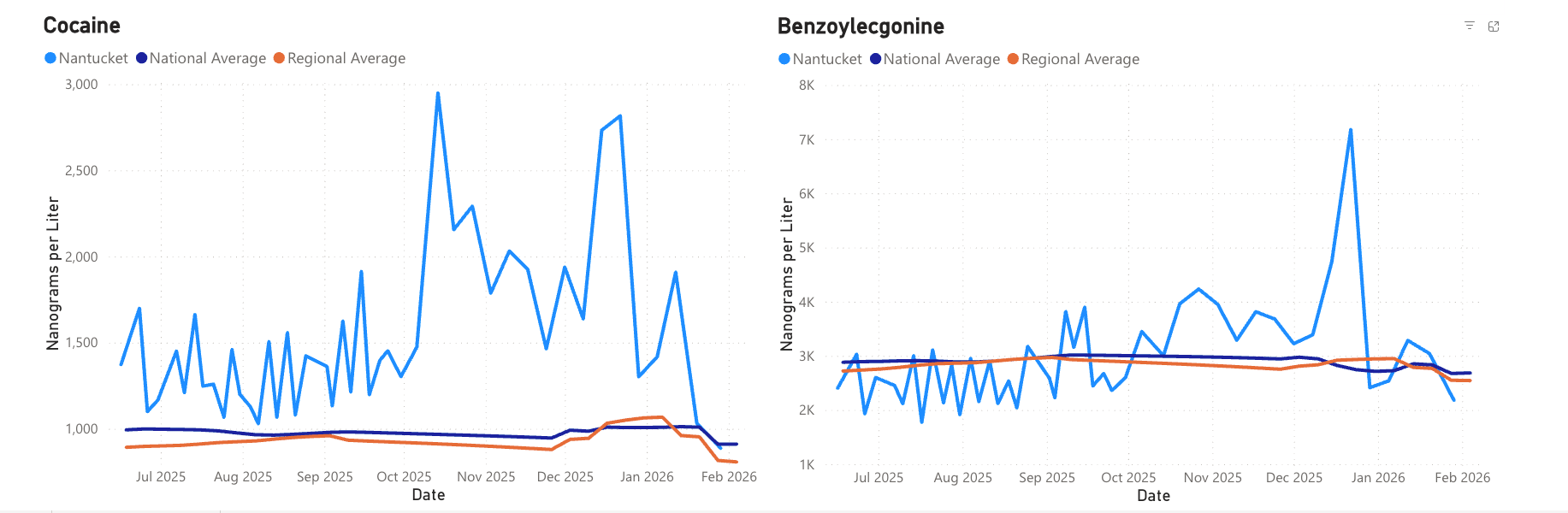
According to Nantucket, cocaine and its primary metabolite, benzoylecgonine or BZE, typically trend together in wastewater data because the body converts most consumed cocaine into BZE before excretion.
When cocaine levels rise without a corresponding BZE increase, it shows that some portion of the cocaine entering the sewer system did not come from human consumption but may have come from cocaine being disposed of instead.
The town says that because Nantucket’s cocaine levels are above national and regional averages, while the BZE is often at or below the average, the most likely explanations include dumping events, small-scale disposals, or concurrent use with alcohol, which changes the way it is metabolized and reduces BZE information.
The town does not track the amount of alcohol in its wastewater.
The town also tracks a wide range of other substances, including methamphetamine, fentanyl, and a variety of prescription and illicit opioids, as well as emerging compounds like xylazine.
The data does not provide exact numbers, but it can help the town identify concerning patterns that require intervention.
“I think every community has its own challenges with substances,” Kasper told the Current. “This data has been helpful for us to better understand what our problem is here in Nantucket.”

Get everything you need to know to start your day, delivered right to your inbox every morning.



To comment, please create a screen name in your profile
To comment, please verify your email address
Conversation
This discussion has ended. Please join elsewhere on Boston.com