
Sign up for the Today newsletter
Get everything you need to know to start your day, delivered right to your inbox every morning.
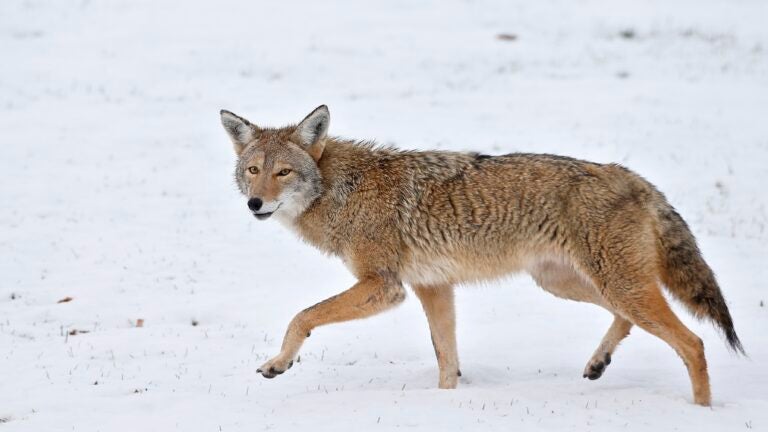
With coyote mating season well underway, Bostonians have spotted the animals on the prowl around the city.
From January through March, eastern coyotes are not an uncommon sight in Massachusetts. Though they thrive in forests and rural areas, they have adapted to survive in urban and suburban areas, according to Mass Audubon.
This winter’s frigid temperatures have made it even easier for coyotes to roam around. Earlier this week, one resident spotted a pack on the prowl crossing Boston Harbor by Dorchester Bay.
In recent weeks, residents have reported spotting coyotes during the day.
A local wildlife photographer shared images of a young adult coyote on May Street in Jamaica Plain on Jan. 26. A Reddit user posted videos of a coyote trotting through a South End alley near Claremont Street on Feb. 6, while another South End resident posted about seeing one sitting in the snow in the Worcester Street Community Garden that same day.
While they are mainly nocturnal animals and are most active at dawn and dusk, coyotes can appear at any time, according to Mass Audubon.
Coyotes are generally more active during the winter, so sightings become more common. However, this increase in appearances is not indicative of a growing population; in fact, it is “neither growing nor shrinking,” according to MSPCA-Angell.
“Coyotes are territorial animals who actively defend their territory from transient coyotes, traveling between two to thirty square miles while on patrol,” the nonprofit said on its website. “A single coyote traveling through their territory may be reported several times, which may lead people to believe that there are more coyotes then there really are.”
This behavior is normal for coyotes, but the increased sightings mean that residents need to be more vigilant around them.
The state’s Division of Fisheries and Wildlife, or MassWildlife, encourages residents to keep pets indoors, remove human-associated food sources, and “haze” coyotes should they encounter the predators.
Though the animals tend to avoid humans, they view unprotected pets as potential prey, according to MassWildlife.
Pets should be kept indoors as much as possible to avoid coyote attacks, according to MassWildlife. When they are allowed outside, they should be kept on a leash and directly supervised.
“Do not supervise your pet from a distance on your porch or at your backdoor,” MassWildlife says on its website. “Most coyote attacks involve dogs that are unsupervised or being supervised from a distance in a backyard.”
Coyotes are opportunistic omnivores, so they will take advantage of whatever naturally available food is nearby. This can include garbage, compost, pet food, bird seed, and backyard chickens, according to MassWildlife.
To deter coyotes, wildlife officials recommend “hazing” them with tactics like making loud noises, waving your arms or jacket, and physically chasing the animals until they leave. MassWildlife noted that hazing won’t work unless it’s done aggressively.
“Hazing will not be effective if it’s done from inside a building, from behind a screen door, or from a car,” the DFW said. “Hazing is most effective when it’s done repeatedly, when a variety of techniques are used, and when many people participate.”
That said, coyote attacks on humans are exceptionally rare in Massachusetts. In the last 60 years, fewer than 10 incidents have happened statewide, according to Mass Audubon.
Get everything you need to know to start your day, delivered right to your inbox every morning.




To comment, please create a screen name in your profile
To comment, please verify your email address
Conversation
This discussion has ended. Please join elsewhere on Boston.com