
Sign up for the Today newsletter
Get everything you need to know to start your day, delivered right to your inbox every morning.
The MBTA Communities Act, signed by former Gov. Charlie Baker in 2021, has been described by housing researchers and activists as “historic,” an official with the Executive Office of Housing and Livable Communities (EOHLC), the state agency responsible with overseeing the law, told Boston.com.
But the law has also faced fierce pushback from residents and towns across the state. Opponents say the law is overstepping, but proponents say the law is needed to address the state’s housing crisis.
In early January 2025, the Supreme Judicial Court upheld that the controversial law is constitutional and confirmed that Attorney General Andrea Campbell can sue towns for not complying.
However, the ruling also found the state’s guidelines were “unenforceable,” and required new emergency regulations to be issued.
The EOHLC filed emergency regulations on Jan. 14, allowing communities that missed their end-of-2023 and 2024 deadlines extra time to comply with the law. These communities were required to submit action plans to the state outlining their process to comply by Feb. 13, and district compliance applications by July 14.
We’ve updated our guide to help you understand the law, the new regulations, and what it means for your town.
Click on the following links to jump directly to each section, where we break down definitions and aim to answer your questions.
Jump to specific information on the MBTA Communities Act with the links below:
Use our interactive map to see your town’s obligation and compliance status under the MBTA Communities Act.
Search for your town in the search bar at the left under the legend, or click on your town to learn more.
The MBTA Communities Act was signed into law by former Gov. Charlie Baker in 2021 and is codified as Section 3A of the Massachusetts General Laws, Chapter 40A.
The purpose of Section 3A is to encourage the production of multi-family housing by requiring MBTA Communities to adopt at least one zoning district where multi-family housing is allowed as of right. Failure to comply with the law results in the town or city’s loss of eligibility for certain funding programs.
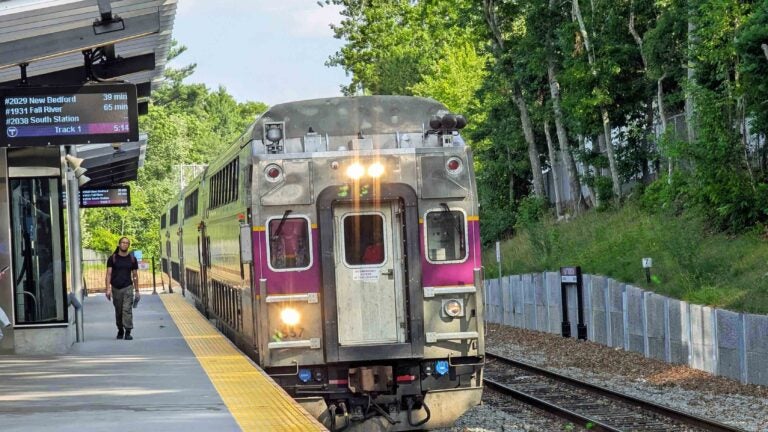
The term “MBTA Community” describes towns and cities that are served by the MBTA, or are adjacent to communities served by the MBTA. In total, there are 177 MBTA Communities across the state that are required to comply with the law. Even though Boston is served by the MBTA, it is exempted from the Zoning Act, including section 3A.
Eighty-four communities host MBTA service, including rapid transit, commuter rail, ferry, or bus. Ninety-three communities share a border with a city or town that is served by the MBTA.
The state split the MBTA communities into four different community categories based on their proximity to MBTA services: rapid transit community, commuter rail community, adjacent community, and adjacent small town.
This is how the state defines each community category:
There are 12 rapid transit communities, 72 commuter rail communities, 58 adjacent communities, and 35 adjacent small towns.
Each community category also had a specific deadline by which they had to comply with the law. Rapid transit communities were required to comply by the end of 2023, while commuter rail and adjacent communities faced an end of 2024 deadline.
Those timelines were later revised. Communities that missed their 2023 and 2024 deadlines were required to submit an updated action plan to the state by Feb. 13, 2025, followed by a district compliance plan by July 14, 2025. Adjacent small towns were given until December 31, 2025 to come into compliance — a deadline that has now passed.
There are two forms of compliance: district (or “full compliance”) and interim compliance. District Compliance is achieved when an MBTA community adopts a multi-family zoning district that meets all the requirements of the compliance guidelines and is certified by the Executive Office of Housing and Livable Communities (EOHLC).
There are 133 communities compliant with the law, as of Jan. 23, 2026, and seven additional communities are considered to be in conditional compliance. This means that EOHLC and the conditional compliant communities have agreed on compliant 3A districts in principle, but those districts will require local votes for final approval. The communities in conditional compliance include Bridgewater, Concord, Everett, Hopkinton, Lancaster, Plymouth, and Salisbury.
Interim compliance means an MBTA community is taking active steps to enact a multi-family zoning district that complies with Section 3A, and the community’s deadline has not yet passed.
When the EOHLC is in the process of reviewing a community’s action plan (which outlines their strategy to reach compliance) then the community will achieve “interim compliance” and will retain eligibility for the funding sources that require compliance with Section 3A. While EOHLC reviews compliance applications, communities continue to be in interim compliance.
There are 25 communities in interim compliance as of Jan. 23, 2026. These communities have submitted action plans to the state outlining their strategy to reach compliance with the law, and/or have voted to pass 3A zoning by deadline.
MBTA communities that are non-compliant with Section 3A are those that have not submitted compliance applications to the state by their deadline. As a result of non-compliance, these communities become ineligible for funding from certain state sources. This funding covers local infrastructure generally, such as road, bridge, water and sewer improvements (known as MassWorks); local infrastructure projects that support housing (known as HousingWorks); EOHLC grants to communities with a “Housing Choice” designation; and state funding under the Local Capital Projects Fund.
If non-compliant communities did submit an application to one of those three grant programs, their applications would not be eligible to be reviewed. The EOHLC said they would discourage a community from making the effort to try and submit a grant application in non-compliant. Non-compliant communities can apply for other grant programs, however.
In addition, the Healey-Driscoll Administration notified communities that compliance with the MBTA Communities Act will be considered when dispensing certain discretionary local aid. However, any non-compliant community can always come back and submit an application, according to an EOHLC official said.
“The difference is if you meet your deadline, you can stay in interim compliance, which is really important for submitting grant applications. If you miss the deadline, you’re non-compliant throughout our review,” they added.
There are 12 non-compliant communities as of Jan. 23, 2026. These communities missed their end-of-2023, 2024, and extended July 14, 2025 deadlines to submit district compliance applications to comply with the law.
The non-compliant communities include: Carver, Dracut, East Bridgewater, Freetown, Halifax, Holden, Marblehead, Middleton, Reheboth, Tewksbury, Wilmington, and Winthrop.

Get everything you need to know to start your day, delivered right to your inbox every morning.



To comment, please create a screen name in your profile
To comment, please verify your email address
Conversation
This discussion has ended. Please join elsewhere on Boston.com