
Sign up for the Today newsletter
Get everything you need to know to start your day, delivered right to your inbox every morning.
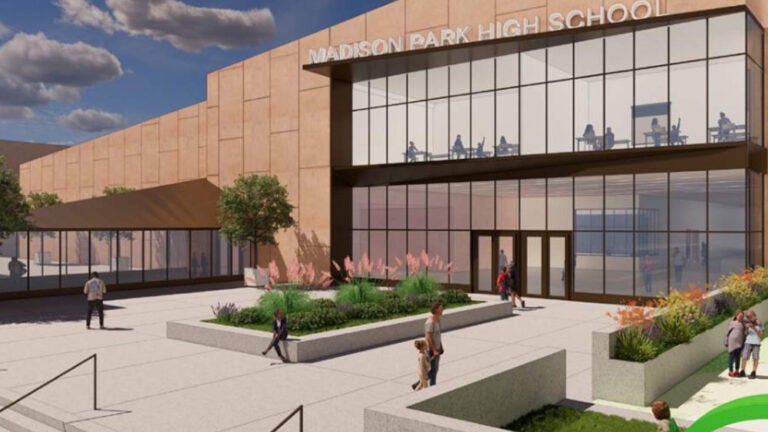
Boston is walking back its plans to turn a long-vacant parcel in Roxbury into a life-sciences hub and affordable housing, with city leaders looking to put the redevelopment on hold while they consider building a new Madison Park vocational high school at the site.
The reversal has been met with sharp criticism from some in Roxbury, where community leaders spent decades helping shape the long-awaited redevelopment. But with decreasing demand for lab space and a roughly $700 million Madison Park Technical Vocational High School building project on the line, the Wu administration is sticking to its guns.
Appearing on “Boston Public Radio” Tuesday, Mayor Michelle Wu said the redevelopment “was not happening on its own” due to the economics, not the Madison Park rebuild. She further suggested the developers’ pitch to subsidize affordable housing with lab space has become a “pipe dream” in today’s economy.
“It’s time to come to terms that those promises are not able to be delivered on by that developer, and now we are finding a way to actually make something work,” she said.
Roxbury residents who learned about the change of plans at a community meeting last week said that while they welcome a revamped Madison Park school, they also want the economic development they were promised.
“On the one hand, everyone wants to see Madison Park win,” said Armani White, executive director at Reclaim Roxbury, an organization partly focused on building wealth in the community. “On the other hand, we also want to see the community development that we selected also win.”
Sitting at 7.7 acres, the publicly owned plot on Tremont Street comprises land that was cleared of businesses and housing more than 50 years ago as part of an urban renewal initiative to prepare for the doomed Inner Belt project. After residents fought plans to run a massive highway through their neighborhoods, the land ultimately remained vacant.
A proposal to put a large retail and residential complex on the site, known as Parcel P3, fell through in 2019 and sent city leaders back to the drawing board. In 2023, planning officials tapped HYM Investment Group and My City at Peace for a redevelopment slated to add affordable housing, green space, life-sciences buildings, and a museum for Embrace Boston, an organization that honors the legacy of Coretta Scott and Martin Luther King Jr.
However, demand for lab space has taken a nosedive in the years since, slowing progress and leaving the parcel empty still.
“It’s not news to anybody that we are at a dramatic downturn of development of all kinds throughout the city,” Boston Chief of Planning Kairos Shen told the Roxbury Strategic Master Plan Oversight Committee Jan. 12. “It’s affecting all of the neighborhoods of the city, and Roxbury is not immune to that economic condition.”
Now, the city is planning to let the P3 development rights lapse at the end of the month, rather than renewing the designation awarded to HYM and My City at Peace. Doing so frees up P3 for inclusion in an upcoming feasibility study that will explore options for the Madison Park project, including building a new school or renovating the existing 1977 facility.
“We believe that letting the current designation expire for P3 is the most transparent and prudent course of action when the city has identified a public purpose and another potential path forward for this parcel,” Shen explained.
The city’s decision follows last month’s announcement that Madison Park had been selected for the Massachusetts School Building Authority’s Core Program Eligibility Period, the first step toward securing critical state funding.
“The benefit of including P3 in the conversation about this Madison Park reconstruction is really significant,” Shen said. For one thing, he explained, building a new school at P3 would save on swing space costs while leaving the existing school facilities and athletic fields intact and available for use.
According to Trish Cafferky, the city’s deputy chief of operations, pursuing a new Madison Park school at P3 could save Boston between $84 million and $147 million, depending on the design. She put the estimated cost of renovating the existing school or building a new one on the athletic fields between $680 million and $720 million.
“This is expected to be likely the most expensive school project in the history of Massachusetts, let alone Boston, and that’s partly a function of the vocational nature of the school,” Cafferky said. “It’s just a very unique kind of school building.”
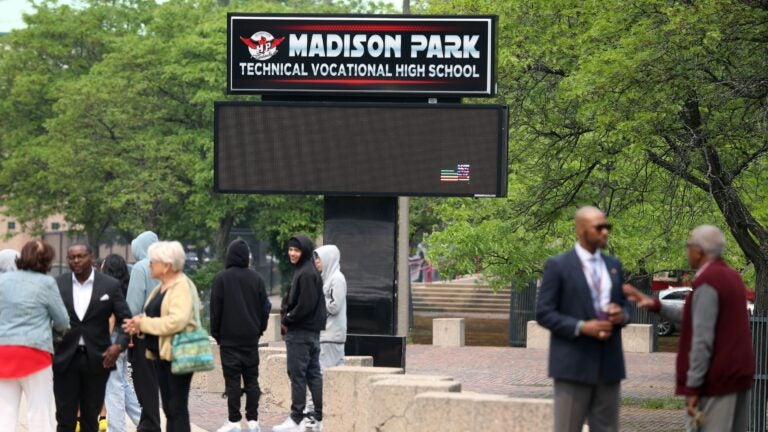
As Boston’s only technical vocational high school, Madison Park serves about 1,000 students across industries such as auto repair, cosmetology, plumbing, and dental assistance. The feasibility study process is expected to take about two years, and according to Cafferky, the city is tentatively looking to start on construction by 2030.
Following the feasibility study, the city should have a firmer grasp on how much of P3 might be needed for a new Madison Park school and how much will be left over for redevelopment, Shen told the Boston Planning & Development Agency board Jan. 15. Once that happens, he said, city leaders have vowed to invite the P3 development team back to the table.
“I ultimately hope that we can ultimately have our cake and eat it too, although we won’t be able to do it all at the same time,” Shen added.
Though Shen said the upcoming feasibility study will include “significant” public engagement, community members who weighed in during the Jan. 12 meeting had sharp criticism of the city’s process.
“This is fundamentally taking agency away from the Black community, and frankly, it’s just racist,” said Rodney Singleton, a member of the District 7 Advisory Council. “I’m just horrified that we would be suggesting this.”
Former Boston City Councilor Tito Jackson argued officials are effectively pitting Madison Park against neighborhood economic development, “which is wholly unfair.”
“There is a false choice that is being made right now, and I have to call it out. This does not have to be an ‘or,’” he said. Jackson further noted the lack of community involvement in the decision to let the development rights lapse, calling on city leaders to “tap your brakes.”
“You’re making a pronouncement right now. You’re telling people what you’re going to do, not asking them what we should do,” he said. “That’s not how we rock here in Roxbury.”
Roxbury Strategic Master Plan Committee members offered mixed views. Sue Sullivan pointed out the city has spent decades trying to get P3 developed, with nothing tangible to show. Dorothea Jones, meanwhile, noted the time and effort HYM and My City at Peace put into getting the green light from Boston officials and Roxbury residents, only to see an abrupt reversal.
“More than likely, the people that had received the designation were people that were from our community, are of our community, and — I’m going to be perfectly frank — it’s almost like the land is being taken back a second time from people in this community,” Jones said. “And I just have a problem with it.”
In a joint statement, HYM and My City at Peace said they are “deeply saddened” by the city’s decision. Since receiving the P3 designation, they said they have “raised and invested substantial capital, advanced the project in good faith, and met our commitments to The Roxbury Oversight Committee and the broader community — despite significant economic and political headwinds.”
The developers also said they remain fully committed to P3, Roxbury, and Boston at large, standing ready to “continue working collaboratively to deliver housing, jobs, education, and opportunity.” Like Jackson, they decried the “false choice” between a new school and community investment.
“This site can, and must, do both,” the developers said.
On that, Wu seems to agree.
“The long story short is that the school and economic development will both happen, and now they have a chance of actually both moving forward to build wealth in our community, to reinforce and make real the dreams of community members who for 60-plus years have been working on this parcel,” she said on “Boston Public Radio.” “But it has to happen in the right order now.”

Get everything you need to know to start your day, delivered right to your inbox every morning.




To comment, please create a screen name in your profile
To comment, please verify your email address
Conversation
This discussion has ended. Please join elsewhere on Boston.com