
Sign up for the Today newsletter
Get everything you need to know to start your day, delivered right to your inbox every morning.
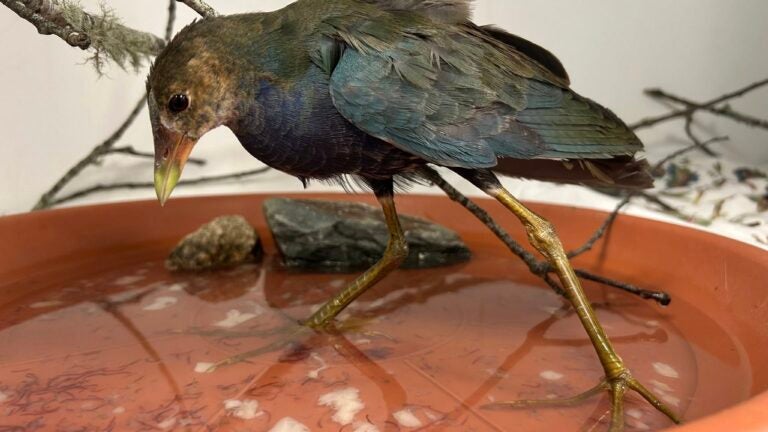
Brightly-colored birds known as purple gallinules can often be seen wading through wetlands in Florida and areas further south. But recently, a handful of these tropical birds have made their way far north to New England.
Last Friday night, a New Bedford resident found a purple gallinule in her backyard, exhausted after battling high winds. She called the New England Wildlife Center, and the organization took the bird in.
It is “significantly underweight and in delicate condition,” according to the Wildlife Center. But a preliminary exam and X-rays did not find any broken bones or major injuries. The bird is resting comfortably at the Wildlife Center, as staff there works to resupply its nutrition levels. They are being mindful to avoid “refeeding syndrome,” which occurs when a starving animal is given too much food too soon, according to a Facebook post from the Wildlife Center.

“Our first priority is getting him healthy. If he continues to do well we will work closely with our partners at MassWildlife to determine the best path forward to make sure he can ultimately get back where he belongs,” the organization wrote in the post, which also contained photos of the bird.
The Wildlife Center attributes the bird’s presence in Massachusetts to a strong storm last week, saying that shifting pressure systems and accompanying storms can push purple gallinules off course. One was found in Eastham in 2010, according to the Wildlife Center.
The same storm system that pushed the bird into New Bedford appears to have also brought a purple gallinule to Maine. One was found in the town of Houlton, just miles from the Canadian border, last week. The bird was eventually given over to Maine Wildlife Rehabilitation for an examination.
While the staff there was initially concerned about the possibility of severe frostbite, they only discovered a minor injury to the bird’s foot and “mild corneal ulceration,” the organization said in a Facebook post. It is now rehabbing at Avian Haven in Freedom, Maine.
Wildlife rescuers are planning to transport that bird down to Florida alongside another purple gallinule that was found in Vermont recently, according to Maine Wildlife Rehabilitation. The group is also aware of a purple gallinule that was rehabbing at a wildlife center in New York.
“We may be seeing increased numbers of individuals far outside of what we previously believed their range to be. Though they dispersed this far north naturally, this species is not at all well adapted for the cold and would not survive long in Maine’s winter conditions,” the organization said.
Purple gallinules are “remarkable fliers” that have been found far outside their normal habitats, in places like Iceland, Switzerland, and the Galápagos, according to Cornell University’s Lab of Ornithology. Their year-round range covers most of South America, the Caribbean islands, and a large portion of Florida. During breeding season, they can be found a little farther north in states like South Carolina, Georgia, Alabama, and Mississippi.
While strong storms were blamed for the recent sightings in the Northeast, researchers are seeing increasing evidence that these sightings may not be purely accidental. There is some indication that “so-called vagrants” are more likely during years when severe drought threatens the purple gallinule’s core habitat, according to the Cornell lab.
A large portion of Florida was experiencing moderate drought conditions last week, with some pockets of more severe drought. On the whole, however, the state has not had sustained periods of intense drought this year.
Get everything you need to know to start your day, delivered right to your inbox every morning.





To comment, please create a screen name in your profile
To comment, please verify your email address
Conversation
This discussion has ended. Please join elsewhere on Boston.com