
Sign up for the Today newsletter
Get everything you need to know to start your day, delivered right to your inbox every morning.
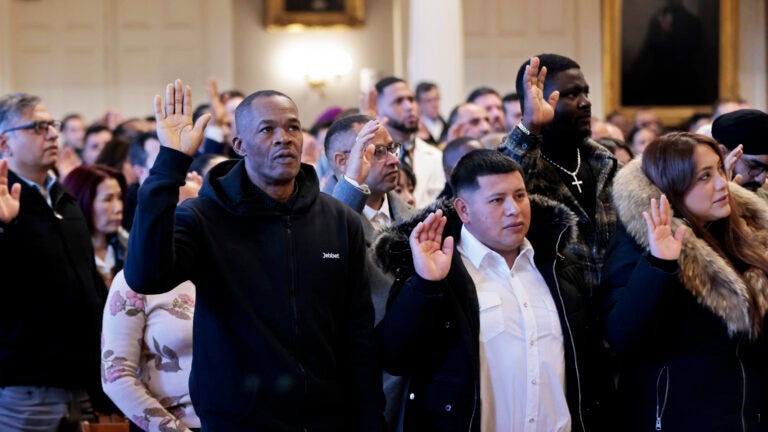
Sen. Ed Markey introduced legislation this week meant to deliver more protections for people on the verge of gaining their citizenship. The move is a direct response to the Trump administration’s efforts to cancel naturalization ceremonies for immigrants from certain countries.
Democratic leaders and immigrant advocates have been outraged since news broke last week that naturalization ceremonies in Boston and elsewhere were being canceled. Four people were directly prevented from attending previously scheduled naturalization ceremonies in Faneuil Hall, according to Markey’s office.
People who have naturalization ceremonies scheduled have already been thoroughly vetted and passed multiple tests on their way towards gaining citizenship. But now, U.S. Citizenship and Immigration Services officials have been instructed to pause the process for anyone originally from what the Trump administration refers to as a “high-risk” country.
Those 19 countries are Afghanistan, Burma, Burundi, Chad, Cuba, Republic of the Congo, Equatorial Guinea, Eritrea, Haiti, Iran, Laos, Libya, Sierra Leone, Somalia, Sudan, Togo, Turkmenistan, Venezuela, and Yemen.
“Becoming a naturalized U.S. citizen is not easy and involves an application, background checks, passing English and civics tests, and an interview,” Markey said in a statement. “For those who get over those high hurdles, the naturalization and oath-taking ceremony represents an enormous achievement and the final step in the path to making America their home. The Trump administration has no right to deny it to those who have followed the rules, done the work, and been approved for citizenship.”
Markey’s bill is supported by Project Citizenship, a Boston-based nonprofit that provides services to people working to become citizens. At least 21 Project Citizenship clients have had their ceremonies canceled because of their country of origin, Executive Director Gail Breslow said this week at a press conference alongside Boston Mayor Michelle Wu.
One client, a Haitian woman in her mid-50s who has been living in America for more than 20 years, was pulled out of line at Faneuil Hall by USCIS officials who were asking immigrants one by one where they came from, Breslow previously told Boston.com.
“No applicant for naturalization should be prevented from taking the oath of allegiance because of their nationality. This legislation will ensure that immigrants who have been thoroughly vetted and approved for U.S. citizenship are able to naturalize without delay, irrespective of their place of birth,” she said in a statement.
The bill, dubbed the Naturalization and Oath Ceremony Protection Act, would guarantee that people whose naturalization applications have already been approved are allowed to attend their ceremonies, swear their oaths of allegiance, and receive their certificates of naturalization.
In order to cancel these final steps, the Department of Homeland Security would have to make an individualized determination that an applicant either is “statutorily ineligible” or obtained their naturalization approvals through fraudulent means. DHS would need to provide written, advanced notice to applicants detailing the specific reasons that their naturalization process is being halted. The applicants would get the opportunity to respond in writing, and an official not involved in the original adjudication would need to review the case.
The bill would bar “categorical or discriminatory exclusions,” like ones based on an applicant’s place of birth. It also prohibits “secret or informal policies,” meaning any DHS policy affecting naturalization ceremonies would have to be publicly issued in the Federal Register.
The new USCIS policies that led to the recent cancellations were outlined in a memo issued on Dec. 2. Officials cited the recent shooting of two National Guard members in Washington, D.C., which was allegedly done by an Afghan national.
“The United States has seen what a lack of screening, vetting, and prioritizing expedient adjudications can do to the American people,” the memo reads.
The people who had their naturalization ceremonies cancelled received brief notices from USCIS that only cited “unforeseen circumstances” in explaining the changes. The recipients were told that more information would be forthcoming, and that they may have to be re-interviewed by USCIS.
The moves are part of the Trump administration’s larger efforts not just to deport undocumented immigrants, but to curb immigration into the country as a whole. Officials are openly advocating for “remigration,” a term with ties to far-right groups in Europe and the racist “great replacement theory.”
In addition to the naturalization ceremony cancellations, the federal government is reportedly exploring ways to strip foreign-born Americans of their citizenship. USCIS leaders are asking that individual field offices around the country supply them with 100 to 200 denaturalization cases per month in the fiscal year 2026, The New York Times reported.
Denaturalization is a rare process that can only occur if naturalized citizens are found to have willfully misrepresented key facts while gaining citizenship or if they illegally procured naturalization without being eligible in the first place. Denaturalization cases require significant resources from the government, as it must meet a high burden of proof.
The numbers that USCIS is aiming for would mark a drastic increase in denaturalization. Between 1990 and 2017, the US averaged only 11 denaturalization cases per year, according to the Immigrant Legal Resource Center.
Get everything you need to know to start your day, delivered right to your inbox every morning.




To comment, please create a screen name in your profile
To comment, please verify your email address
Conversation
This discussion has ended. Please join elsewhere on Boston.com