
Sign up for the Today newsletter
Get everything you need to know to start your day, delivered right to your inbox every morning.
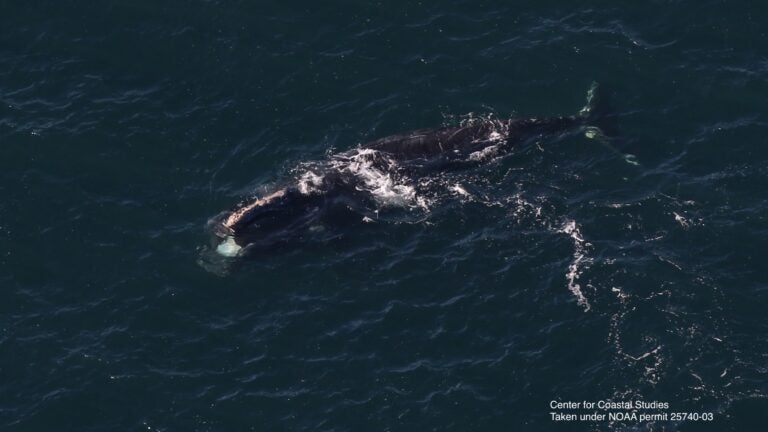
For seemingly the first time, researchers have confirmed that a North Atlantic right whale initially seen in European waters made its way across the ocean to the coast of North America.
North Atlantic right whales are some of the most critically endangered animals on the planet, and the revelation could give scientists new insight into how to track and conserve the species.
The whale in question was spotted by researchers from the Center for Coastal Studies during an aerial survey on Nov. 19. Staff from CCS conduct these surveys in order to track population numbers and determine when certain protections go into place.
“About four-and-a-half hours into the survey, we broke from our trackline to document a group of humpback whales about 23 nautical miles east of Boston. While photographing the humpbacks, we were surprised to spot a lone right whale feeding at the surface nearby. We quickly diverted to photo-document the whale, our first right whale sighting of the season. The first sighting of the year is always exciting, but we didn’t yet realize just how remarkable this one would turn out to be,” CCS researcher Ryan Schosberg said in a statement.
There are only an estimated 384 North Atlantic right whales on Earth. As such, individuals are meticulously documented in a catalog maintained by the New England Aquarium. They generally live along the East Coast, traveling from calving grounds as far south as Florida up into Massachusetts Bay and even Canadian waters.
North Atlantic right whales were historically also found in European waters, but that population is thought to have been eliminated by whaling. The species got its name because they were deemed the “right” whales to hunt during the height of the whaling industry. Some sightings do occasionally occur in Europe every few years, but those whales are rarely photographed well enough to be cataloged and are sometimes never seen again.
CCS documents about half of the entire North Atlantic right whale population in Cape Cod Bay each year, and it is very uncommon for the researchers to find a whale that they can’t identify. So it was a shock for Schosberg and his colleague Annie Bartlett when they discovered this whale that could not be identified. They reached out to staff from the aquarium for another assessment.

The aquarium researchers who maintain the catalog found one potential match: a whale that was only seen one other time, in Donegal Bay off the coast of Ireland in July 2024. It was reported by the Irish Whale & Dolphin Group.
“While the photos from the 2024 Ireland sighting showed some unique features, we were unsure the quality of the photos would be sufficient to identify the whale in the future. After a flurry of matching effort and emails, we were excited to discover the first ever photo-ID match between Ireland and the U.S. East Coast,” Lindsey Jones, a scientist at the aquarium who helps manage the catalog, said in a statement.
When Schosberg received the news, he remembers being “shocked.” When the whale was first spotted in Irish waters in 2024, he and others tried unsuccessfully to match it to a known individual in the catalog.
“It was an impressive match by their team, and such an exciting international right whale story,” he said.
Scientists say that this match could help them better understand how right whales continually search for suitable habitats in a wide area. In this light, historic habitat data could have newfound importance.
While researchers conducted this work, they also used data from the catalog to determine that six other whales that were first photographed off the coast of North America were later seen in European waters.
“Securing any international photo ID matches of large whales requires a lot of effort and a fair bit of luck. When these matches are made across ocean basins, you need to get even luckier. So, we had zero expectation of matching this solitary right whale from Donegal Bay in July 2024, the first validated Irish record with photographic evidence in over a century,” Pádraig Whooley of the Irish Whale & Dolphin Group said in a statement.
Since 2017, North Atlantic right whales have been experiencing an “unusual mortality event,” which occurs when there is a spike in the number of whales that are dying, becoming injured, or falling ill. The population fell about 25% from 2010 to 2020.
The species faces many threats, most notably from fishing gear and vessel strikes. They live in coastal waters that are in close proximity to major ports and shipping lanes, exposing the whales to constant danger. Mating and socializing occurs near the surface, further putting the whales in danger.
The whale population could slowly be rebounding. Conservationists received some good news this year when the North Atlantic Right Whale Consortium released its annual population estimate. The 2025 figure is eight higher than last year’s count. Experts are pointing to new policies in Canada, which include updated vessel speed restrictions, as being important factors in conservation efforts.
International cooperation is crucial, Daniel Palacios, the head of the Right Whale Ecology Program at CCS, said in a statement.
“Seeing a whale photographed in Ireland reappear off Boston is extraordinary. Encounters like this highlight both their resilience and the importance of international cooperation to support their recovery,” he said.
Get everything you need to know to start your day, delivered right to your inbox every morning.





To comment, please create a screen name in your profile
To comment, please verify your email address
Conversation
This discussion has ended. Please join elsewhere on Boston.com