
Sign up for the Today newsletter
Get everything you need to know to start your day, delivered right to your inbox every morning.
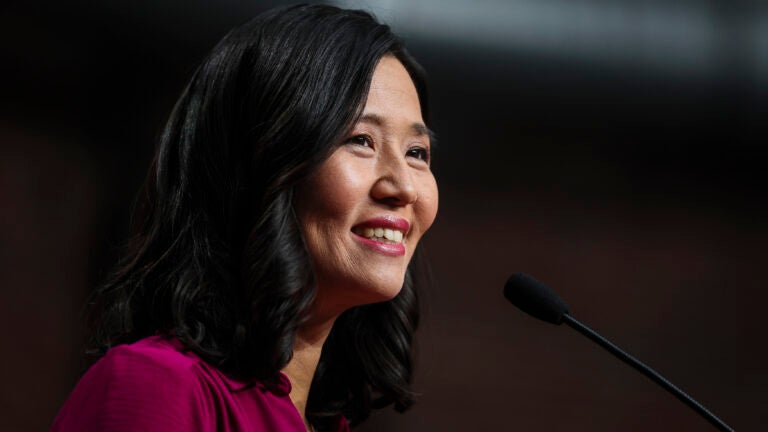
Fresh off a dominant reelection bid, Boston Mayor Michelle Wu is gearing up for a renewed test of her political capital. This week, Wu restarted her public push to shift more of the city’s tax burden onto commercial real estate in order to provide savings for residential homeowners.
This effort has been stymied by state lawmakers twice already. Now, Wu is hoping that the third time is the charm on Beacon Hill.
Boston is heavily reliant on property taxes, which fund about 70% of the city’s budget. When the COVID-19 pandemic caused high office vacancy rates, commercial property values began to fall and residential property values rose. Over the past few years, a number of other factors have continued this trend. As a result, residential property owners were hit by a sharp spike in their property taxes to make up the difference.
Wu needs state approval to alter Boston’s property tax formula, a system she described Wednesday as “very strict and rigid” during an appearance on the “Java with Jimmy” show. Wu says that her goal is to decrease the tax break for commercial property owners while blunting the impact of another tax spike for residential property owners.
In fiscal year 2026, current projections show that overall residential property values will increase by 2% while overall commercial values will decrease by 6%. As such, the average single-family homeowner in Boston is set to see a 13% hike in their property taxes beginning in January, according to a letter Wu sent to business groups and fiscal watchdogs this week.
The average single-family homeowner was hit with a 10.4% increase last year. Another increase would mark the eighth straight year with a spike of more than 5%, Wu said. She described this as “unsustainable” and “avoidable.”
In the letter, which was sent to the leaders of the Boston Municipal Research Bureau, the Greater Boston Chamber of Commerce, the Massachusetts Taxpayers Foundation, and NAIOP Massachusetts, Wu warned that allowing continued double-digit residential property tax increases would weaken the local economy and Boston’s ability to attract and retain talent.
“The high cost of housing is the greatest threat to our regional and statewide competitiveness in today’s economy, and years of significant residential property tax increases compound this threat,” she wrote.
Last year, Wu shepherded two versions of the plan through the City Council and the House of Representatives, only for them to stall and die in the Senate. In February, the City Council passed a new version of the proposal, which has remained stuck in the State House since then.
For success on Beacon Hill, Wu recognizes that she needs the support of the business-backed groups. She urged them to publicly reaffirm support for the legislation in her letter this week.
The mayor did strike a deal with the four groups last year. This was done after being told by Senate leaders that such a compromise was necessary for support in that chamber, Wu said. But the compromise was later “abandoned,” Wu wrote in her letter.
In 2024, the Wu administration initially projected that residential property owners could see a 14% property tax spike year over year without the proposal’s approval. The state Department of Revenue later certified property valuations, causing officials to project an expected 10.5% increase, a development that blew apart the calculus Wu was counting on last year to pass her proposal.
Senate President Karen Spilka declined to bring the legislation to the floor for a full vote, saying that the new projections left lawmakers and stakeholders with “serious concerns” about economic impacts. State Sen. Nick Collins of Boston used a procedural move to block any action from being taken on the measure, accusing the Wu administration of negotiating based on “false information” and stoking a “campaign of fear and manipulation.”
In the midst of Wu’s ongoing efforts, Spilka is staying noncommittal for the time being.
“The Senate President will discuss this bill with members, as she does with all pieces of legislation. The Senate remains committed to working with stakeholders across Massachusetts to find solutions to increase housing affordability and drive down costs for residents and families,” a spokesperson for Spilka said in a statement.
Collins used stronger language.
“Unfortunately, the City has committed to raising property taxes on everyone during a time of financial strain. At the same time, the City is once again withholding critical valuation data from policymakers and the public,” Collins said in a statement. “We are asking the City to release the data.”
Wu, in her letter, said that the final property valuations from last year “landed squarely within the range of estimates presented throughout the process.”
“At the end, they backed out of a deal when they said the numbers ended up not looking so bad. But we know now that that wasn’t true. The numbers were bad,” she said during her “Java with Jimmy” appearance.
Collins said that he supports tax relief for homeowners, but is opposed to what he characterized as Boston’s “effort to circumvent Prop 2½, which would remove the people’s right to vote on local tax increases.” In his statement, Collins advocated for two pending pieces of legislation that he said would provide relief without jeopardizing the local economy.
In a statement to Boston.com Wednesday, NAIOP CEO Tamara Small maintained that property valuations certified by the state last year “materially differed” from the data provided by the city in earlier discussions.
Even if this year’s property valuations do show significant challenges ahead, Small said that the solution is not to “further punish the business sector by increasing its tax burden.” She voiced concerns about incentivizing new investments and encouraged the city to explore other options.
“Whether borne by a business tenant or a property owner, increased taxes translate into higher costs across the board and make it harder to incentivize new investment at every level of business,” Small said. “Instead, the City should use the resources available to lower the tax burden for its most vulnerable residents. NAIOP continues to urge the City to closely examine recent anti-growth policies that hinder new development while also exploring ways to diversify its revenue streams to ensure Boston does not rely on any one sector to fund the City’s budget.”
Steve Poftak, CEO of the Municipal Research Bureau, said that the organization appreciates Wu’s letter and will analyze the data it presented.
“In particular, we view the City’s guidance for limiting expenditures in the upcoming budget as an important development and share the view that the City is navigating challenging circumstances. The Research Bureau will also be monitoring the upcoming City Council hearing on tax classification and awaiting the state Department of Revenue’s certification of the data. At this point, we will not be commenting further on this matter until we have had the chance to further review all available information,” he said in a statement.
The other two groups did not return requests for comment.
Wu also sent a letter about this topic to the City Council this week, drawing attention to this year’s reined-in budget and saying that the city will continue to limit expenditures amid ongoing economic uncertainty. She is asking city department leaders to propose fiscal year 2027 budgets that are 2% below the current budgets.
Wu described the cost of housing as being the most urgent issue facing residents.
“We are delivering on reducing commercial vacancies through business recruitment and supports, driving up foot traffic in our commercial corridors, and converting underutilized office space into more than one thousand new units of housing, but in the meantime, residents should not have to subsidize commercial tax bills,” she wrote to the City Council. “We must use every available tool to make Boston more affordable for our families.”
Read Wu’s letter to the leaders of the Boston Municipal Research Bureau, the Greater Boston Chamber of Commerce, the Massachusetts Taxpayers Foundation, and NAIOP Massachusetts below:
Wu Tax Letter 12.3.25 by Ross Cristantiello
Get everything you need to know to start your day, delivered right to your inbox every morning.




To comment, please create a screen name in your profile
To comment, please verify your email address
Conversation
This discussion has ended. Please join elsewhere on Boston.com