
Sign up for the Today newsletter
Get everything you need to know to start your day, delivered right to your inbox every morning.
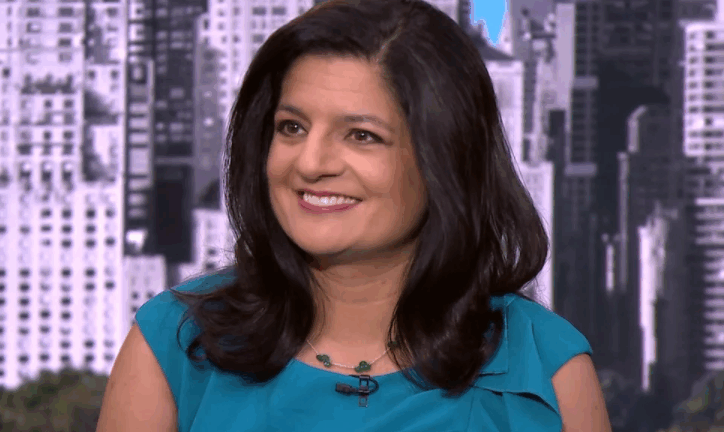
After working on and off in Boston for 30 years, journalist Indira Lakshmanan is returning to the “hub of the universe” as a co-host of the “Here & Now” news magazine, co-produced by WBUR and NPR.
Coming back to Boston and WBUR is “a dream come true,” Lakshmanan told Boston.com.
Lakshmanan grew up in Pittsburgh, but spent summers and holiday breaks exploring Boston and riding the Green Line while she visited her father and stepmother who lived in Newton, she said.
She went on to study art history at Harvard University, where her eldest son is currently a sophomore, before starting her career in journalism at NPR, she said. After that, Lakshmanan worked at The Boston Globe as a local reporter and then as a foreign correspondent from 1993 to 2007.
Then, Lakshmanan moved to Washington, D.C. where she worked as a columnist, foreign correspondent, and reporter for various publications, including The Boston Globe for a second time, while serving as a guest host for numerous Boston-based public radio shows.
Now, Lakshmanan is rejoining the team at WBUR to co-host NPR’s third-most-popular show alongside Scott Tong and Robin Young, according to a press release from WBUR. Her return to public radio and an NPR station is a “homecoming,” she said.
“There are so many stories to tell and Boston is a fantastic base from which to tell them,” Lakshmanan said. “Some of the biggest stories happening right now in America with significance to the entire country are the pressure on higher education, the cuts to federal funding, the huge endowment taxes, the ideological pressure on universities, as well as the pressure on the health sector.”
Lakshmanan’s return to WBUR comes at a time where public radio is under attack by the Trump administration following the $9 billion in funding cuts, including $1.1 billion that had been allocated for the Corporation for Public Broadcasting, passed in July.
“It’s really important that people give as much as they can afford to, because they’re not just supporting the news and information and features for themselves, they’re supporting it for other people,” Lakshmanan said of public radio’s reliance on listener donations.
“I think there is sort of the importance right now of journalism that people can trust, journalism that is in the public interest. And one thing that’s so special about public radio and public television, for that matter, is we’re not charging people. It’s open to everybody. It’s free to everybody,” she added.
Beyond radio, Lakshmanan is excited to return to her old favorite spots — the ICA, MFA, and Isabella Stewart Gardner Museum — as well as to try new places, including the first Boston restaurants to make the Michelin guide, she said.
The Isabella Stewart Gardner Museum “was a special place of sort of meditation and respite for me when my son was being treated [for childhood cancer] at Boston Children’s,” she added.
“I feel like I love a bunch of places in Harvard Square that are kind of holes in the wall that may or may not be famous, but that have great comfort food and a great atmosphere and are just chill places to be.” After living in the city during college and her time at the Globe, she said, “I know Cambridge better than the rest of Boston.”
Lakshmanan arrived in Boston last week and will be on-air for “Here & Now” in mid-December, she said.
The following responses have been lightly edited for clarity.
Indira Lakshmanan: Oh, incredible. I am so happy. It’s a dream come true. I mean, people say it as a joke, but Boston is the hub of the universe. So what can I say? There’s a reason they call it the hub.
My ties to Boston go way back. My dad and stepmother were professors at Boston University for more than 30 years. When they moved here, I was young and they lived in Newton, and so I learned how to ride the T at a very young age and would ride the Green Line from Newton Center into town. I learned how to sail not only on Newton’s Crystal Lake — and I was a lifeguard at Crystal Lake — but I grew up sailing on the Charles through that fabulous community boating, $1 for any kid in the Boston area … with the most incredible facilities, the most incredible teachers. And that actually was how I got onto the sailing team in college, because I had learned those skills completely for free both on Crystal Lake and on the Charles River.
One thing that I think is great about Boston that has been with me since childhood is the incredible investment that the city and the environs, the suburbs, make in culture and education. I got my first Boston Public Library card probably when I was 11 or 12 years old. And the free access to museums, and as I said, the access to all sorts of sporting opportunities and taking the T made it so easy for kids to get around. Boston’s just an incredibly accessible place that provides, I think, cultural and educational opportunities to all. And that’s something that really shaped me, obviously, as a kid, being here part-time, so I feel like I partly grew up here, too.
I was lucky enough to go to college here and I was lucky enough to then work at the Globe after college, and I worked there for 14 years, the first time. I started as a nighttime general assignment reporter and then I was the Boston police reporter, and then I did a special year-long special project on children at risk and in need in Massachusetts, and then went overseas for the Globe. I spent, I want to say, something like 11 or 12 years overseas for the Globe, which was incredible.
I always had to keep in my mind the readers, who were the readers of the Globe, and who were the people back home, who were going to be reading my stuff from Afghanistan, from Colombia, from Cuba, from North Korea, from all of the places that I was fortunate enough to go and report from what was going to matter to a Boston audience. The Boston audience is really smart and really, I’d say, aware, educated, international, so it’s like a high bar. I always felt that I was writing for not just a Boston audience, but a national audience.
Some of the other things that I feel are so special about Boston, I mean, it’s not going to be an original observation, but higher education and medicine in this community are so incredible and cutting edge. I’ve been fortunate enough to take advantage of those both in terms of being a faculty kid and then being a student at Harvard. My older child is a sophomore at Harvard now. And so that’s actually a really fun thing and he’s excited, believe it or not, about me coming back. He’s like, “Find a place near me.”
And we had to actually take advantage of Boston’s incredible world-class medical resources, because our older son actually had cancer twice as a small child. So when he was just 20 months old, we were in Boston Children’s Hospital and Dana Farber for four months. Then he relapsed when he was 4, and at that point, we already had moved to Washington, but we came back to Boston Children’s to have his transplant because it was the best place we could possibly be. So I unfortunately have a lot of firsthand knowledge with Boston Children’s, Dana Farber, and the Jimmy Fund. But, there’s no place I would have rather had him treated.
The whole university community here is so amazing, and this year it’s been probably the number one story for me, watching what’s happening to Higher Ed and the pressure on universities and the cutoff of funds and everything. This has obviously been a focal point and the pressure on both Harvard and MIT in particular has been intense. So, you know, there’s never a quiet moment. Boston is a busy place and has a lot of important stories that affect the whole rest of the country.
There’s no better time to come back. Although The Boston Globe was really where I cut my teeth and learned so much and spent 14 years between local and foreign news and it was amazing, I actually started my career at NPR in Washington. So I started on the foreign desk at NPR, and then was an overseas stringer for them for a year in Chile and then came back to the foreign desk at NPR during the first Gulf War. For me, this is also a homecoming to public radio, a homecoming to NPR.
The news that the Trump administration was doing a rescission of the money that had already been granted to the Corporation for Public Broadcasting — that was an absolute gut punch, not just for public media, not just for NPR and PBS and all the local stations who depended on that funding, for CPB, it was a gut punch to the public. Americans all across the country, in a lot of small communities, rural and remote communities, public radio is the only source of news. And a lot of these are news deserts. So it may be seen as somehow punishing certain coastal elites, but that’s not the case. The audience of public radio is everybody.
While there have been encouraging signs from the audience — fundraising has been good — and I think that public radio is grateful to listeners, because we depend on them, this is really a critical moment to step up to the plate where we need members. We need the community. So in Boston, we need people to be members and supporters of WBUR, and in every community, we need people to be members and supporters of their public radio stations. Because it’s about journalism that people can trust, where there is not an agenda. For example, “Here & Now” is a news magazine. You might be hearing an interview with a member of Congress and then the next minute you might be hearing an interview with a novelist who just won a great prize, or a musician.
And some stations are already in real distress, some smaller stations, and particularly this is affecting stations in Alaska, native radio stations on reservations. There are some stations out there that depended 80 and 90%-plus on CPB.
This is a moment where public media is needed more than ever as a trustworthy source. There are figures out there looking at, what kind of media does the public trust and not trust? And the trust in public media is generally much, much higher than the trust in commercial media. I think public media is nonpartisan, and it, you know, hurts me when I hear it that some people say they think it’s biased — it’s certainly not.
I am just so thrilled to be here. There’s a whole Renaissance in the arts going on in Boston that I think is of interest to a national audience. So many other shows are based in Washington or New York, and we’re the third key city on the eastern seaboard and it’s great to have a show that’s based here to give a different perspective. We’re telling stories that are happening out of Washington, that are happening out of Wall Street, and that are happening out of cultural institutions in Washington and New York. To also have the perspective of Boston is just a gift to the viewers, both in Boston and nationwide.
In terms of what I’m looking forward to, I mean I’ve been in the news business for three decades now and I’ve been fortunate enough to cover news, features, opinion, the arts, business, and even an occasional sports story. I’ve been lucky enough to sort of cover all the different areas and that’s what I’m so excited and thrilled about with “Here & Now.” Alongside the other two flagship weekday NPR National Programs, “Morning Edition” and “All Things Considered,” “Here & Now” is right in the middle of the day, which gives us a chance to tell sometimes longer stories than they can tell during the morning or the evening commute. We can sometimes get deeper into some cultural issues and zig where others are zagging. The three shows work incredibly well together as a sort of mosaic holding the day together, that you get your morning news, your midday news, your evening news and information.
I just feel really lucky to be part of that family of weekday shows that are out there providing the best, most trustworthy, most interesting news and features for a Boston audience and a national audience.
Get everything you need to know to start your day, delivered right to your inbox every morning.


To comment, please create a screen name in your profile
To comment, please verify your email address
Conversation
This discussion has ended. Please join elsewhere on Boston.com