
Sign up for the Today newsletter
Get everything you need to know to start your day, delivered right to your inbox every morning.
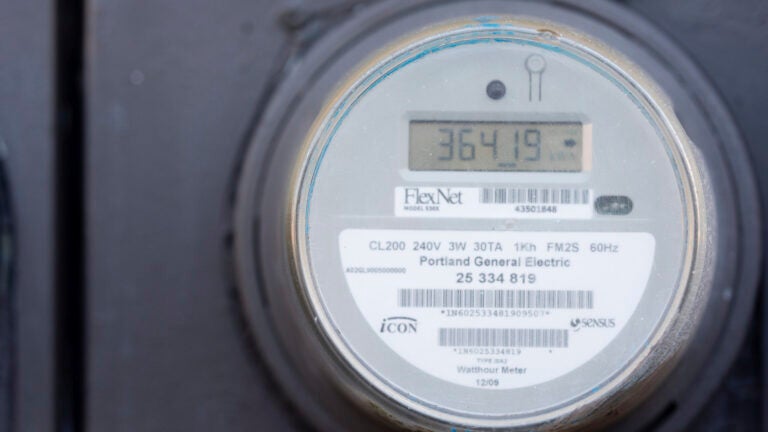
As the weather gets colder in New England, pending gas and electric bills start to become more nerve-racking, with ratepayers never seeming to know how high the cost will be. Meanwhile, New England ranks amongst the most expensive in utility bills in the country, with the Boston region outpacing the national average.
So, when a user opens the bill and finds that delivery fees actually outweigh the cost of supply, many may start to wonder what it is they are paying for.
To find out what’s behind the bill, Boston.com reached out to utility companies and delved into the details — and also into who may be doing something to combat those unpredictable cost spikes.
On most bills, there are two categories: supply and delivery.
According to Eversource and National Grid, delivery charges cover the costs of operating networks, including day-to-day maintenance to ensure reliability and emergency response, upgrading aging infrastructure, and connecting customers.
These delivery charges are the only costs that utility companies have some say over, although the Department of Public Utilities closely regulates them.
The delivery fees also include payments to state-mandated energy-efficiency programs, such as Mass Save, and income-eligible assistance programs.
External factors, such as global market prices and extreme weather, drive supply costs, leaving both companies with little control over them. The cost companies pay for the supply is the cost they pass on to consumers. Neither company profits from it.
“As winter approaches, we are focused on using every available tool to manage costs within our control and to ease short-term pressures from factors not within our control, like extreme weather and global supply prices,” a National Grid spokesperson said in a statement.
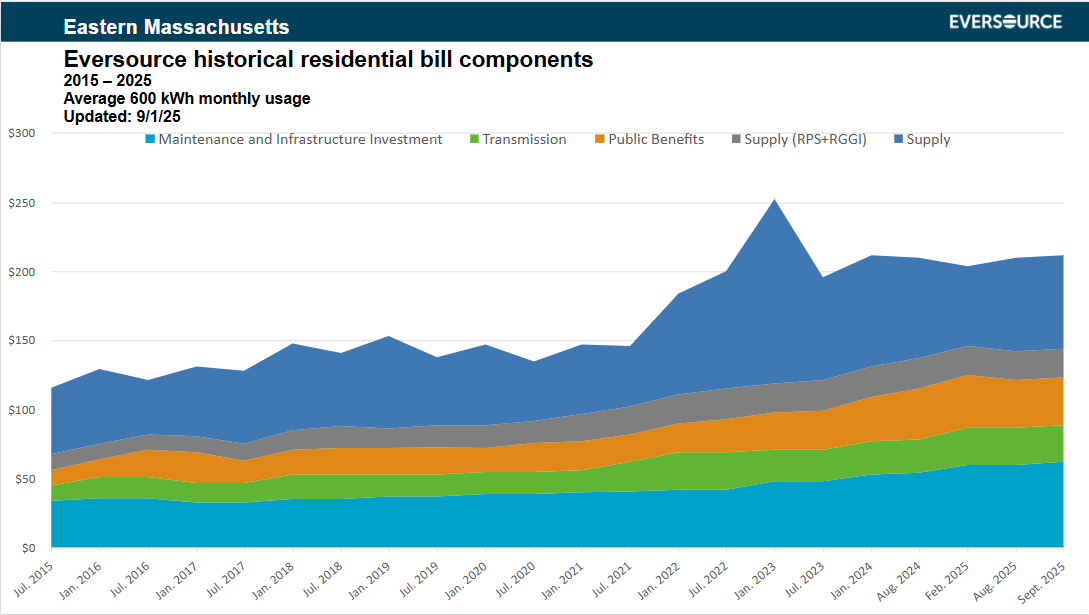
William Hinkle, the spokesperson for Eversource, noted that costs for all three buckets — delivery, public policy programs, and supply — have increased over the past decade.
Hinkle said the cost of maintaining and operating the Eversource system is rising due to inflation, supply chain challenges, and higher labor costs. Prices for materials and equipment are up, he said, and keeping a highly skilled workforce requires increasingly competitive wages, especially in an area with a high cost of living.
“People see rising costs across the country, and we are not insulated from that,” Hinkle said.
Adding to the overall cost is the increase in the number of public policy programs that ratepayers pay into.
These programs include Mass Save, which helps residents and businesses with affordability, offers free home assessments to make energy-efficient upgrades, provides no-cost insulation and air-sealing upgrades to income-eligible residents, and offers discounts on energy-saving appliances and more.
But with more programs, Hinkle says, the cost per ratepayer rises.
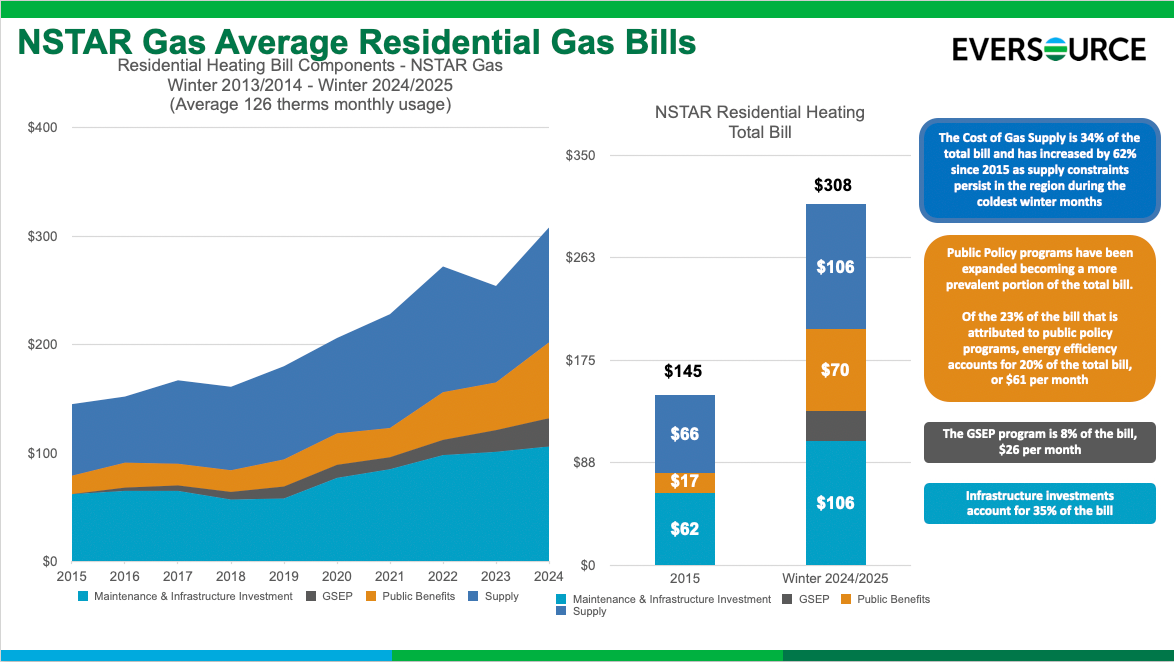
For NSTAR gas customers, the programs went from $17 of a total bill in 2015 to $70 in 2025. For Eversource Gas Company of Massachusetts (formerly Columbia Gas) customers, the price rose from $16 in 2015 to $49 today.
Hinkle says everyone pays into the Mass Save programs, so they should take advantage of them.
By reducing energy usage, he said, “it is one of the most impactful things you can do to lower the bill.”
The supply of gas has also increased by 62%, adding $41 to the overall bill over the last decade. Hinkle says the average NSTAR gas bill went from $144 in 2015 to around $319 today.
“People are understandably frustrated with the cost of energy, and we are aggressively trying to keep our costs under control,” said Hinkle. “But there are a lot of costs beyond a utility’s control, and it speaks to the need for collaborative problem solving and multifaceted solutions to address these challenges.”
“No one is going to be able to do it alone,” he said.
A proposed bill in the Massachusetts House by Rep. Mark Cusack, a Democrat representing Braintree and parts of Holbrook, is taking steps to loosen the state’s 2030 climate mandate to lower greenhouse gas emissions by making the target nonbinding, The Boston Globe reports.
The bill would gut aspects of the state’s energy efficiency program, Mass Save, to help people save money on their energy bills.
However, the House put the bill on hold, CommonWealth Beacon reported, with leadership saying it would not take it up this week.
State Sen. Kelly Dooner, a Republican from the 3rd Bristol and Plymouth District, has also filed a bill to address utility affordability.
The bill would cap delivery rate increases to 3% a year and establish a commission to recommend cost-reduction measures for consumers and reforms to utility delivery fees.
“These recent increases have proven that there is no oversight,” said Dooner in a video posted on Instagram by the New Bedford Guide. “I don’t know who sat at that table and thought this [increase] was a good idea for Massachusetts residents who can barely afford groceries …”
She continued, “I think whoever was sitting at that table should not be sitting at that table any further because it is apparent they are out of touch with everyday people.”
In addition, Gov. Maura Healey in October called for the DPU to launch the first-ever comprehensive review aimed at lowering gas and electric costs.
In her letter, Gov. Healey requested that the DPU scrutinize proposed utility rate increases on behalf of ratepayers, including those for utility infrastructure, to avoid unnecessary spending and reduce costs.
She also called on the DPU to expedite new solar construction before President Donald Trump’s administration ends federal tax credits.
“Winter is on the way and I know we’ve been focused on lowering energy costs, lowering people’s heating bills, stopping the kinds of price spikes that we saw last year,” said Healey at a related press conference in October.
She continued, “The bottom line is that gas and electric bills are too high, too volatile for people in the Northeast. And so we’re doing everything within our power to cut them down.”

Get everything you need to know to start your day, delivered right to your inbox every morning.




To comment, please create a screen name in your profile
To comment, please verify your email address
Conversation
This discussion has ended. Please join elsewhere on Boston.com