
Extra News Alerts
Get breaking updates as they happen.
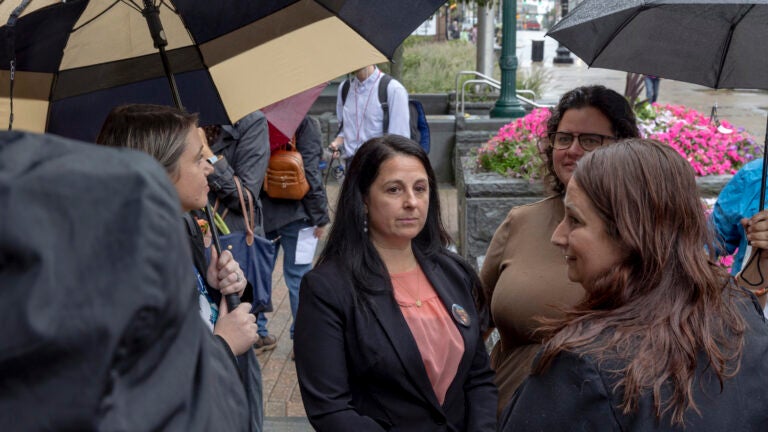
WORCESTER, Mass. — Early on Election Day, Etel Haxhiaj pulled a campaign sign from the back seat of her car and found a spot on the sidewalk outside Blessed Sacrament Church, a polling place in Worcester, Massachusetts. A cold wind tugged at the sign in her hands, threatening to blow it away.
Haxhiaj, 45, was a two-term City Council member in the city. By that night, she would know the fate of her campaign for reelection. Voters would judge her handling of everyday municipal business, but many would also consider a thornier question: Should Haxhiaj have intervened in an immigration enforcement action on a street in her district?
The encounter in May — a chaotic confrontation among residents, city police officers and federal immigration agents — had grabbed national attention after videos of it went viral. Haxhiaj had placed herself in the middle of it, standing between the police and an immigrant family. Six months later, she was fighting charges of assaulting an officer and interfering with the police. And she was facing a worrisome reality: Her actions in May could cost her the election, even in this diverse, immigrant-friendly, majority-Democratic city.


The controversy had brought new campaign donations and support. But it had also set off a fierce backlash. An angry man had accosted Haxhiaj outside a supermarket as she walked with her children. A bomb threat had been sent to her city email: “This is what you lunatic progressive get,” it said in capital letters. Days before the election, a local firefighters union had rescinded its endorsement of her after receiving complaints from its members.
Worcester is the second-largest city in Massachusetts, a liberal state where 61% of voters had supported Kamala Harris for president. But its politics are complicated.
Moderate Democrats have long held power, but since 2020, more socially progressive Democrats have run for office, Haxhiaj among them. An immigrant from Albania, she became the first Muslim on the council in 2022. Another progressive, an immigrant from Vietnam, became the first openly nonbinary member the same year.
As the newcomers pushed for racial justice, LGBTQ+ protections and changes in policing, tensions ticked up. So did a perception among some voters that basic city business, such as road repairs and snow removal, had taken a back seat.
In that unsettled atmosphere, Haxhiaj’s clash with Immigration and Customs Enforcement and the police had the effect of a match on dry kindling.
Elsewhere in the lead-up to Election Day, progressive Democrats had big momentum. In New York, Zohran Mamdani led the race for mayor by a sweeping margin. In Boston, Mayor Michelle Wu would coast to victory unopposed. In Worcester, about 50 miles to the west, the picture was less clear. Would voters tolerate a council with diverse views and backgrounds, looser ties to business interests and vocal disagreements between members?


Outside the towering stone church where Haxhiaj stood waving at traffic on Election Day, a man in a passing truck appeared to glare at her. Seconds later, a car honked in support.
She had written two speeches: one for victory, another for defeat. There was little left to do but grip her sign and wait.
Six days before the election, in a packed union hall, it was hard to tell which candidate was winning louder applause — Haxhiaj or her only opponent, José Rivera.
Moderators of the debate had waited only minutes before asking about the encounter with ICE in May on Eureka Street, in a residential neighborhood within the district. Haxhiaj remained unrepentant.
“We have all seen secret police snatching people off our streets,” she said. “My job as councilor is to protect my constituents, especially women and children.”
At least half the crowd roared in approval. But the cheering sounded just as loud when Rivera took the microphone and disagreed: A city councilor’s role, he said, was to defuse tensions, not elevate them.
“We are a country of law and order, and I think it’s important to show that we respect law enforcement,” said Rivera, 52, a court officer, former professional boxer and former Democrat who is no longer affiliated with a party.
It had never been in question that ICE would come to Worcester. President Donald Trump’s border czar, Tom Homan, had not attacked the working-class city of 200,000 like he had Boston. But Worcester had long been a destination for refugees and asylum-seekers, with lower rents and a constellation of organizations to help them.
Liberal-leaning residents of Worcester had begun preparing for aggressive immigration enforcement even before Trump’s inauguration. Some attended training on how to serve as so-called informed observers, documenting the actions of federal agents. They set up messaging groups to share updates on ICE’s movements in the city.
Haxhiaj, who works as a housing advocate, had not taken the training. But when friends texted her about a conflict that was unfolding after an ICE arrest on Eureka Street on the morning of May 8, she rushed to join them. Driving there, she felt nervous but determined.
“I kept thinking, something bad is happening to my constituents, and I need to be there to protect them,” she said.
Federal agents had detained a Brazilian woman who they said was in the country illegally. After Haxhiaj arrived, she stood by the woman and her daughters, one a teenager and the other holding a baby. Haxhiaj shielded them with her arms and demanded that the agents show a warrant. After the woman was placed in an ICE vehicle, her daughters clung to the car, trying to prevent it from leaving.
Haxhiaj declined to describe what happened on the street, citing her ongoing court case. But body camera footage from the incident shows pushing, pulling and moments of contact between civilians, ICE agents and police officers who had been summoned by ICE to clear the crowd. At one point, officers tried to lay hands on Haxhiaj’s arms, and she shook them off. At another, her hands flew out and appeared to make contact with an officer’s chest.
When federal agents finally drove away with the woman, her younger daughter ran after the car, crying and screaming. Police officers raced to stop her, and the teenager ended up on the ground. “She was just howling, ‘No, no, no,’” said Maydee Morales, a community activist who was there. “It’s a sound I will never forget.”
The ICE action did not result in a deportation. After four months in detention, the Brazilian woman was released and granted asylum. The police charges against her teenage daughter, for disorderly conduct and resisting arrest, were dropped.
But soon after the incident, the local police union called for an investigation into Haxhiaj’s actions, citing her “reckless interference and agitation of that crowd.” In early June, the Worcester police announced they were charging her with assaulting an officer and interfering with the police, both misdemeanors. (The department did not respond to interview requests.)
“I did the humane thing,” Haxhiaj said when the charges were announced. “Nothing more, nothing less.”
She pleaded not guilty and asked a judge to dismiss the charges. The next hearing in her case is scheduled for Wednesday.
On a bright Saturday morning in September, Haxhiaj parked on Eureka Street and studied a list of likely voters. She had been back there only once or twice since May. Several yards had signs for her opponent.
She had always considered neighborhood canvassing the most important kind of campaign work. “If you love this job, you love door knocking,” she said.
But now, approaching strangers’ doors felt dangerous. It was hard to forget the man who had called her ugly names outside a supermarket, or the man who had verbally assaulted her and another councilor as he followed them through a cemetery on Memorial Day, angry at her defense of what he called “illegals.”
Still, a sense of urgency drove her back to the streets of her district this fall. Two years ago, she had beaten Rivera by just 174 votes. This race could be even closer.
In some ways, the confrontation in May had brought her full circle. As a teenager, she had watched her home country, Albania, descend into violence. Her family fled to Greece, where they lived without legal status, hiding their nationality.
Her father had been arrested on a bus on his way to work one day and jailed for his immigration status. He was released just in time for the family’s green card interviews, after which they were granted the chance to start new lives in the United States.
Years later on Eureka Street, “I saw a family in distress,” Haxhiaj said. “My instinct was to use the power I’d been given to defend them from the things my family had experienced.”
She would do the same again, she said. But she had not realized how much it could cost her.
As she stood on Eureka Street again to knock on doors, a van rounded the corner. “Have fun in prison!” a man inside shouted at her through an open window.
Even before the events of May 8, Haxhiaj had been something of a lightning rod, beloved by some residents for her progressive approach to issues like housing, homelessness and zoning, but accused by others of using inflammatory rhetoric and spending too much time on polarizing national concerns.
She had alienated some Jewish voters in 2023 by opposing a council resolution that condemned Hamas because it did not acknowledge Palestinian suffering. And she had angered the Worcester police force by pushing for reform after a damning Justice Department report last year on police misconduct.
After May 8, many liberal city residents criticized the police, infuriated by what they saw as collaboration with ICE on Eureka Street. Days after Haxhiaj was charged, a City Council meeting had to be adjourned when protesters packed the chamber, chanting “ICE out of Worcester now.”
Around the city, strangers thanked her. After she and her sons had finished lunch at a TGI Friday’s restaurant in July, the bill came with a handwritten note from their server. “We need more people like you,” it said. “Keep up the good fight.”


Criticism of Haxhiaj was quieter, but widespread. Steve Quist, who runs a Facebook page about city politics and lost to Haxhiaj in a past council race, said that her actions were “a step too far.” Even if she did not “slug” officers on Eureka Street, he said, “she kept pushing them away, and that’s assault.”
Quist predicted that Rivera would win the election, boosted by Haxhiaj’s “attack on public safety” and by voters seeking a return to “common sense” from “chaos.”
“We want leaders who talk about sidewalks, not national issues,” he said.
At the polls on Election Day, a few voters shared their views: A pastor who said he voted against Haxhiaj because he opposes illegal immigration. Another man who said he did the same because he wanted councilors to prioritize problems they can fix.
There were also voters like Rob Tisdell, 37, who grew up on Eureka Street and cast his ballot for Haxhiaj because of what she did there.
“I was thrilled to see someone from government taking a stand,” he said.
After the polls closed, volunteers from Haxhiaj’s campaign headed to an African restaurant where a buffet of chicken, rice and plantains waited. Early vote tallies showed her barely leading. Then the count refreshed, and the crowd grew quiet: Rivera had surged ahead.
Huddled with family at her home nearby, Haxhiaj felt her heart sink as the gap widened. In the end, she would lose by 375 votes, 3,956 to 3,581.
“I let so many people down,” she thought on the short drive to the restaurant.


Speaking to her supporters just inside the door, her voice wobbled at times. She pledged to continue to “protect our neighbors” and “push for a better city.”
Through her tears, she had already begun to imagine how her loss would free her: to be better rested, more focused and fiercer, outside the confines of elected office. “An unleashed Etel is more powerful,” she said days later on a local podcast.
Reflecting on the outcome a week later, she saw low voter turnout as a factor, as well as a powerful police union that had mobilized against her and business interests that had backed her opponent. She also saw misogyny. But the shadow of Eureka Street, and the charges against her, had been critical obstacles, she thought.
Still, she could not accept the view that the ICE crackdown, and other federal actions in her district, were none of her concern, or the City Council’s.
“These are real people,” she said. “People who don’t want us to talk about it are either refusing to believe their neighbors are affected, or they are choosing to ignore them.”

Rivera, for his part, said he had already received a slew of emails from constituents seeking his help to get streets and sidewalks repaired.
“Independents, Democrats, Republicans all want the same things,” he said. “We all want a good city, so let’s unite and not be part of that divisiveness.”
This article originally appeared in The New York Times.
Get breaking updates as they happen.



To comment, please create a screen name in your profile
To comment, please verify your email address
Conversation
This discussion has ended. Please join elsewhere on Boston.com