
Sign up for the Today newsletter
Get everything you need to know to start your day, delivered right to your inbox every morning.
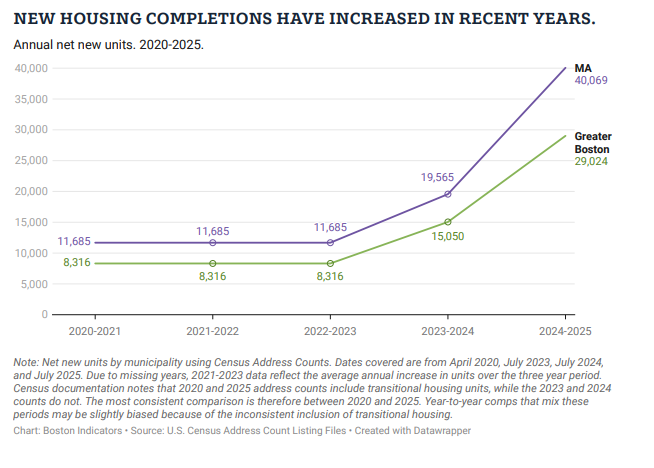
Greater Boston may be building more homes, but that hasn’t made it any easier to find an affordable place to live. A new Boston Foundation report released Wednesday finds that while housing construction is up, new building permits are slowing — and affordability continues to slip further out of reach.
The report also examines how cities and towns are responding to the state’s MBTA Communities Act, finding that while many have changed zoning rules to comply, few have actually turned those plans into new housing.
“By requiring zoning changes but not the creation of new housing, the state both respected local control over housing policy and provided loopholes,” said Katherine Levine Einstein, associate professor and co-director of the Boston University Initiative on Cities, in a statement.
She continued, “Some communities have seized on [the loopholes] to meet the letter of the law but not its intent, which was to create thousands of new homes for Massachusetts families.”
Boston Indicators researchers found good news in a dataset from the U.S. Census Bureau, the Address Count data, which tallies new postal addresses as a proxy for housing units.
The data showed that Massachusetts created 97,656 new units between April 2020 and July 2025, with over 71,000 of them in Greater Boston.
However, the latest permit numbers are tempering the growth in new housing, signaling a slowdown in construction.
The report says the number of building permits issued in the state has fallen sharply in the past four years, from a peak of nearly 20,000 permits in 2021 to just over 14,000 in 2024.
In Greater Boston, developers pulled 15,019 permits in 2021, compared with just under 9,000 in 2024, and 2025 figures to date are even lower.
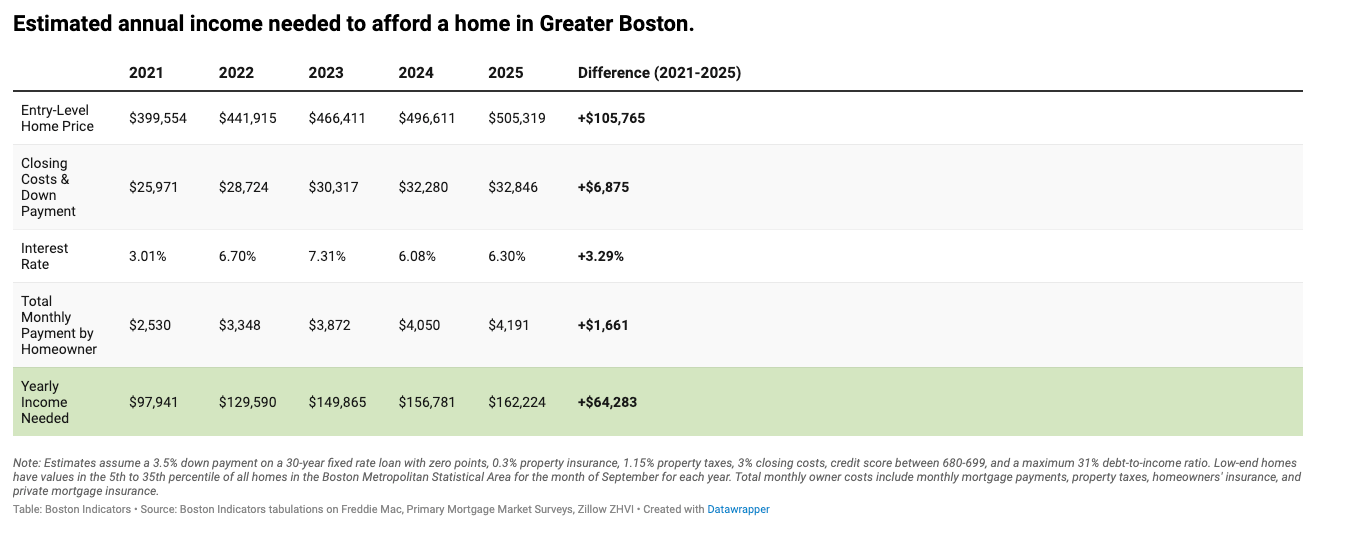
Despite the growth in new units, the report found that the housing affordability crisis has worsened further since the pandemic.
Comparing the monthly mortgage payment on an “entry-level” home in 2021 to 2025, the report found that while a household income of just under $98,000 would be considered enough to afford the $2,520 monthly payment in 2021, a household would need an income of over $162,000 in 2025 to afford a mortgage payment of over $4,200.
“The sobering reality of this combination of price increases and higher mortgage rates is that just one in seven renters in Greater Boston has the income to access a ‘starter home’ in our region,” said Luc Schuster, the executive director of Boston Indicators, in a statement.
He continued, “The data show just how much work we have to do if we are to expand opportunities and unfreeze the market.”
Renters are not immune to the crisis.
For more than a decade, roughly half of all renters in Greater Boston have been cost-burdened, meaning they spend more than 30% of their income on housing. More than one-quarter are severely cost-burdened, paying over half their income toward rent and utilities. The report found those numbers remained unchanged in 2025.
Furthermore, the report found that rents have increased across all neighborhoods within the metro core communities since 2022, with only some increases slowing in some places in 2024.
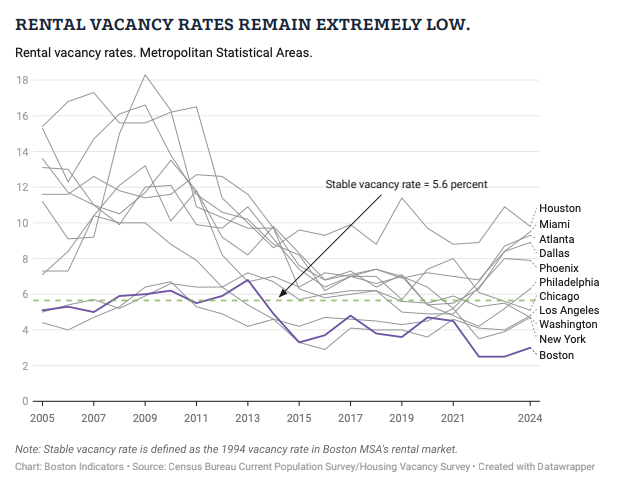
Rental vacancy remains tight, at just under 3% in 2024, making Boston the tightest market across major U.S. metros. Low vacancy rates mean fewer options for renters and give landlords an upper hand in increasing rents.
In 2021, then-Gov. Charlie Baker signed a landmark housing bill, MBTA Communities, into law, requiring 177 communities to change their zoning and land-use policies to allow for the construction of more housing near public transportation. However, the law did not require the municipalities to build any new housing.
The research found that some communities struggled with the process, leading to contentious meetings, including at least one where police had to be called.
Across the 104 cities and towns with available data in compliance with the law, communities created 362 MBTA Communities districts covering about 12,500 acres. Together, these areas can accommodate up to 487,000 multifamily housing units — about 62% of which are within a half mile of a transit station.
But the report found that while there was housing production in places like Lexington, which zoned aggressively for more housing, there was almost none in places like Wellesley and Needham, which took a more gradual approach.
“It’s easy to get lost in the numbers of units, permits, and cost burdens, but we must remind ourselves that at the end of the day, we are talking about real homes, families, and communities,” said Lee Pelton, President and CEO of the Boston Foundation.
He continued, “If we want vibrant communities and a robust workforce, we need to step up and use the tools and innovations at our disposal to bring greater equity and affordability to families.”

Get everything you need to know to start your day, delivered right to your inbox every morning.



To comment, please create a screen name in your profile
To comment, please verify your email address
Conversation
This discussion has ended. Please join elsewhere on Boston.com