
Sign up for the Today newsletter
Get everything you need to know to start your day, delivered right to your inbox every morning.
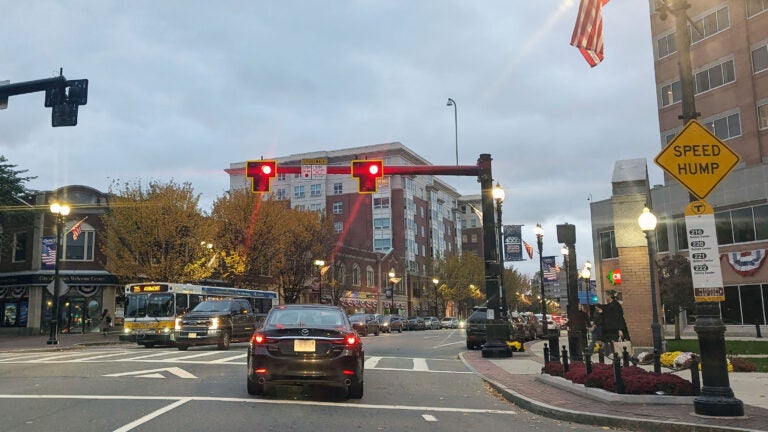
Massachusetts drivers are facing a new kind of red light — and many aren’t sure what to do.
Across the state, 40 hybrid traffic lights — or pedestrian hybrid beacons — have been installed with more on the way to help people safely cross roads. But the design is confusing drivers and causing safety issues, according to researchers at the University of Massachusetts Amherst.
Unlike traditional traffic signals, these hybrid lights turn off when traffic moves freely, and are activated when a pedestrian presses the button to cross.
Then the light sequence begins: A flashing yellow indicates to drivers they should slow down. A solid yellow means prepare to stop. Then, two solid red lights appear, signaling drivers to stop completely, while pedestrians have a walk signal to cross. Finally, two flashing red lights allows drivers to proceed if there are no pedestrians and the crosswalk is clear — similar to a stop sign. Cars have a “green light” when the hybrid light sequence ends and is turned off.
The five-stage design aims to balance pedestrian safety and improve traffic flow. MassDOT published a video in 2021 explaining what drivers should do at these signals. But UMass Amherst researchers suggest many drivers still haven’t gotten the message.
Across 10 sites in Mass., researchers found that nearly a quarter of motorists drove through the solid red lights, and 65% drove through the flashing red lights even when pedestrians were present, which is the equivalent of running a stop sign.
The confusion can be dangerous, especially in shared paths used by cyclists and runners, who may be moving too quickly for rolling drivers to see in time.
Some drivers are even stopping when they shouldn’t. According to the report, 9% of drivers stopped when the lights were off, and 19% stopped during the flashing yellow phase, when they were expected to continue or proceed slowly.
Performance has varied widely by location. The most successful areas for the hybrid light system are in Cambridge and Somerville, while multi-lane roads saw higher rates of compliance. On four-lane roads, 29% ran the solid red lights and 69% drove through flashing reds. On two-lane urban roads, only 11% of drivers ignored the solid red.
Are the hybrid traffic lights the best way to ensure pedestrian safety and maintain smooth traffic flow? UMass Transportation Center director Michael Knodler told CBS News, “They have a lot of potential to improve pedestrian safety, but only if drivers and pedestrians are using them as intended.”
We want to know what you think. Do you have experience at the hybrid traffic lights? Do you think they work well or is there a better way. Let us know in the form below or e-mail us at [email protected]. Your response might be featured in an upcoming Boston.com article.
Get everything you need to know to start your day, delivered right to your inbox every morning.




To comment, please create a screen name in your profile
To comment, please verify your email address
Conversation
This discussion has ended. Please join elsewhere on Boston.com