
Sign up for the Today newsletter
Get everything you need to know to start your day, delivered right to your inbox every morning.
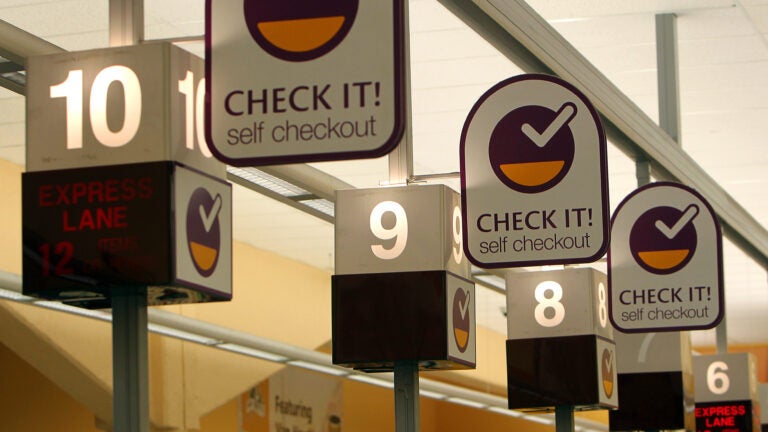
The blinking red light and error message at a grocery store self-checkout can be annoying for shoppers. But for longtime Stop & Shop employee Celine Blaisdell, it’s more than a nuisance — it can be dangerous.
“I understand that the self-checkouts are promoted as cost-saving measures, but they’ve also created a demanding and sometimes dangerous work environment for us grocery store workers,” said Blaisdell, who has worked at the Framingham store for 36 years.
Now, a Massachusetts lawmaker wants to change that. State Sen. Paul Feeney, who represents the Bristol and Norfolk districts, has introduced a bill limiting grocery stores to eight self-checkout stations and requiring a staffed lane for every two self-checkout machines open.
It would also require one dedicated employee to monitor every two self-checkout stations — no multitasking allowed.
The bill applies to grocery stores, most big box stores, and pharmacies that utilize self-checkout machines.
The proposal, “An Act Regulating Self-Checkouts in Grocery Establishments,” now sits before the Joint Committee on Consumer Protection and Professional Licensure.
Feeney said in a statement to Boston.com that the regulations would keep “workers employed and protect their safety and dignity while also reducing frustration for consumers, many of whom struggle with self-checkout yet find themselves stranded with no human worker in sight for assistance.”
However, not everyone agrees that self-checkout limitations are the way to go.
Ryan Kearney, general counsel for the Retailers Association of Massachusetts, said the proposed rules would burden staff, limit customer choice, and raise costs as stores hire more workers.
He noted that grocery stores already operate on slim margins — around 3% or less — so they would likely pass on any new expenses to shoppers.
“At the end of the day, it’s the consumer that suffers with longer checkout lines, less customer service and delays in e-commerce purchases,” Kearney said. “If they are forced to hire more labor, it will lead to higher prices for consumers.”
Brian Houghton, senior vice president of the Massachusetts Food Association, agreed, calling the proposal too restrictive. He said it would prevent stores from deploying staff to other essential tasks, such as stocking shelves, cleaning spills, or fulfilling online orders.
“It is not the responsibility of the state to determine how, when, and where a business deploys its staff,” Houghton wrote in a statement to Boston.com.
Houghton also noted that grocery stores are already struggling to fill jobs. A 2024 report by the Food Industry Association found that food retailers averaged nearly five full-time and nine part-time openings last year.
Blaisdell said her store could solve the problem by giving existing workers more hours.
Jack Kenslea, the political director of UFCW Local 1445, which represents grocery store workers in the region, said the union favors this bill.
After surveying its union members over the summer, Kenslea said, the most significant response was that self-checkout machines can often be overwhelming when a rush comes. Multiple alarm indicators can go off at once.
He said customers become frustrated when employees’ help takes a long time. Often, that frustration transfers to the union members.
Blaisdell said customers whose patience has run thin sometimes refer to whistling at her to get her attention, swearing, or even, in some cases, physical altercations. Once, she saw a coworker being thrown across the self-checkout console, busting a lip open.
“People expect to check in and out fast, but it doesn’t always go smoothly,” Blaisdell said.
Plus, there are random audits, where associates check to see if customers paid for their items. She said balancing theft with employee satisfaction can be tough.
Blaisdell said the machines themselves are finicky. Random items or a small child’s hand on the scale can trigger the alert system.
“They’re dealing with computers, but when it comes to the associate … they’re not a computer,” said Blaisdell. “They’re a human being.”

Get everything you need to know to start your day, delivered right to your inbox every morning.




To comment, please create a screen name in your profile
To comment, please verify your email address
Conversation
This discussion has ended. Please join elsewhere on Boston.com