
Sign up for the Today newsletter
Get everything you need to know to start your day, delivered right to your inbox every morning.
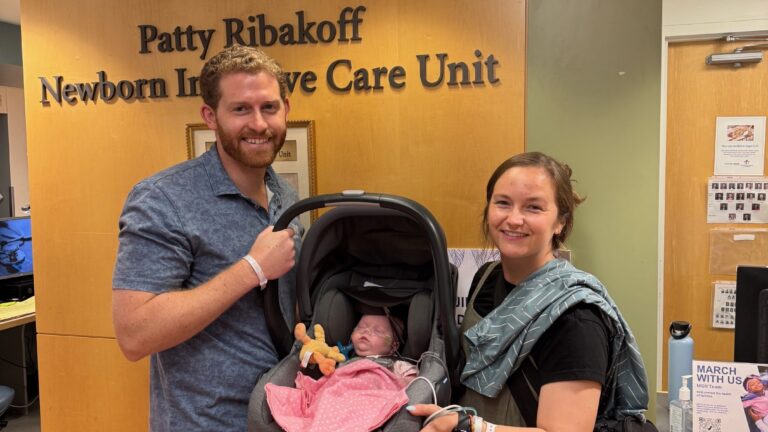
After five months in the NICU, the Thompson family finally brought their newborn, Eloise, home — a milestone made possible by the NTrainer, a device that helped her learn to feed independently.
Born weighing less than 1 pound, Eloise faced long odds, according to the hospital staff at Mass General Brigham for Children. With the support of the care team and the new technology, she is now 9 months old, weighs more than 13 pounds, and is thriving at home with her family.
“We’re very thankful. We’re very fortunate,” said Julia Thompson, Eloise’s mom, in a statement. “Mass General, they’re the reason why we are a family.”
Cardinal Health launched the Ntrainer 2.0 in August 2023 and has had similar technology for about a decade.
However, Eloise was the first patient at the hospital to take advantage of it.

“It’s easy to implement and easy to use, and at the same time, so helpful,” said Dr. Rodica Turcu, the medical director of the MGH NICU. “I think many babies will benefit from it.”
Turcu says NICU infants born before 34 weeks or with complications encounter oral feeding delays due to their premature condition.
Non-nutritive suck, or the basic act of sucking without receiving nutrients, is a key skill babies need to be successful at oral feeding.
Without the skill, premature babies receive nutrition through special IVs before eventually being introduced to milk through a tube that goes directly to their stomachs.
Turcu said coordinating “suck, swallow, breathe” without dropping oxygen or heart rate levels is a skill that typically comes together around 34 to 35 weeks of gestation. However, many of the babies coming to the NICU unit can be as young as 22 weeks.
“So, to wait for them to start learning this skill only at a later gestational age puts us a little bit behind the eight ball,” Turcu said.
That’s where the N-trainer steps in.

The device looks like a bottle with a pacifier attached to it. The baby will suck on it, and the device will record and graph the sucking pattern and strength. Specialists in the Pediatric Feeding Program or occupational therapists repeat the assessments to track progress.
Specialists use the same handpiece to deliver a series of six gentle pulsations followed by a two-second pause, mimicking mature sucking patterns to help the baby develop oral muscular memory.
The goal is for the babies to be able to suck and swallow milk from a breast or bottle, which will allow them to grow.
Many babies also need respiratory support from CPAP, and while doing so it is not safe to eat from a bottle. So, while the baby waits to get off CPAP, Turcu said they can use the device to get ready.
Eloise was on CPAP for a long time and trained on the Ntrainer.
“When she finally was ready to take a bottle, she was a superstar,” said Turcu.
Turcu also likes how the device can involve parents, who can handle it. It provides bonding similar to feeding a bottle, and “that is very valuable,” she said.
Studies show that the device, the only FDA-approved one, has shortened the time babies spend gaining those skills and shortened their hospital stays.
“That is the ultimate goal: to get babies home as soon as possible in the safest way possible,” said Turcu.

Get everything you need to know to start your day, delivered right to your inbox every morning.





To comment, please create a screen name in your profile
To comment, please verify your email address
Conversation
This discussion has ended. Please join elsewhere on Boston.com