
Sign up for the Today newsletter
Get everything you need to know to start your day, delivered right to your inbox every morning.
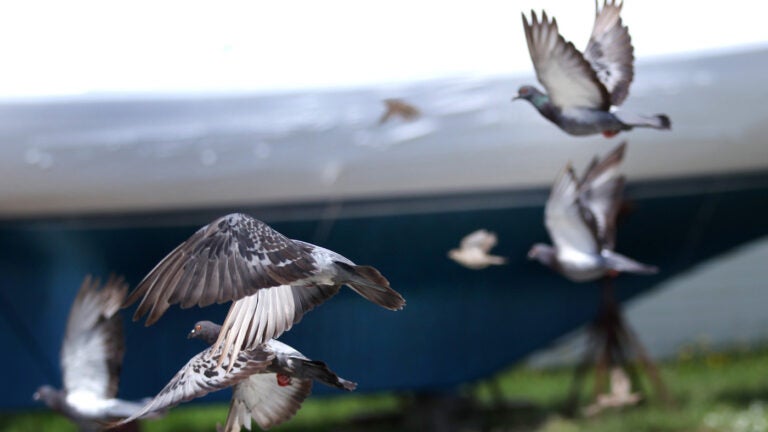
A video by a Reddit user at the MBTA’s JFK/UMass Red Line stop pans up and zooms in on the rafters. Multiple dead pigeon carcasses, many of which are hanging upside down with their heads sticking out, hang through the slats.
A commuter first raised the issue when she captured a video of a baby pigeon trapped in the rafters, squeaking for food.
Through word-of-mouth and the power of social media, the leaders behind the group Safe Hands Wildlife Rescue Network — which coordinates rehabilitation and adoption for pigeons in the area — swooped in.
Members dispatched to the station and coordinated with MBTA personnel in an attempt to help free the bird. But after days of delay, it was too late. The baby pigeon died.
“It might only be a pigeon, but that was disgusting,” says Stacie Delzingo, the founder of Safe Hands. “And it’s cruelty.”
Delzingo says that volunteers with her organization noticed that a hole in the station’s ceiling allowed pigeons to enter above the rafters, where they created nests.
Amanda Cowfer Chavez, the media liaison of Safe Hands, said a few of the fledgling birds fell out, which is normal. But instead of falling into a place where they could easily get back into the nest, they got stuck, upside down, with their heads poking out.
“That’s a rough way to go,” Delzingo said. “And, right out in the open.”
On Monday, an MBTA spokesperson said crews were working to clear out the area above the ceiling and would later seal the open spaces in the ceiling.
Delzingo said volunteers could tell the stuck pigeons were babies because they still had a few yellow chick feathers.
Cowfer Chavez said she suspects the pigeon’s parents were on the backside, trying to figure out how to reach the baby to feed it. Pigeons are known for feeding their young for a long time.
Delzingo started the organization about six years ago to coordinate pigeon rescues, rehabilitation, and adoption.
Members are slowly trying to flip the public narrative on pigeons.
“The public has such a bad rap on pigeons that they are disgusting and spread disease,” Delzingo said.
But in reality, she said, they don’t share diseases with humans and are only dirty because they have nowhere to go to clean.
Cowfer Chavez says pigeons are extraordinarily smart, have close family ties, and make great pets.
She said the pigeons seen in the wild in the U.S. descended from carrier pigeons.
“Just like we are responsible for the feral cats of the world, the same should be for pigeons,” Cower Chaves said. “We used them and abandoned them.”

Get everything you need to know to start your day, delivered right to your inbox every morning.





To comment, please create a screen name in your profile
To comment, please verify your email address
Conversation
This discussion has ended. Please join elsewhere on Boston.com