
Sign up for the Today newsletter
Get everything you need to know to start your day, delivered right to your inbox every morning.
For more than three centuries, King’s Chapel in downtown Boston has told its story with pride. The first Unitarian church in the United States, it holds a spot on the Freedom Trail, which millions walk each year.
However, beneath the church’s velvety pews lingers another history: slave owners and traders who once belonged to the congregation.
“We began to wrestle with that, because this is a church that has been very proud of our history,” Reverend Joy Fallon, a senior minister at the church, said.
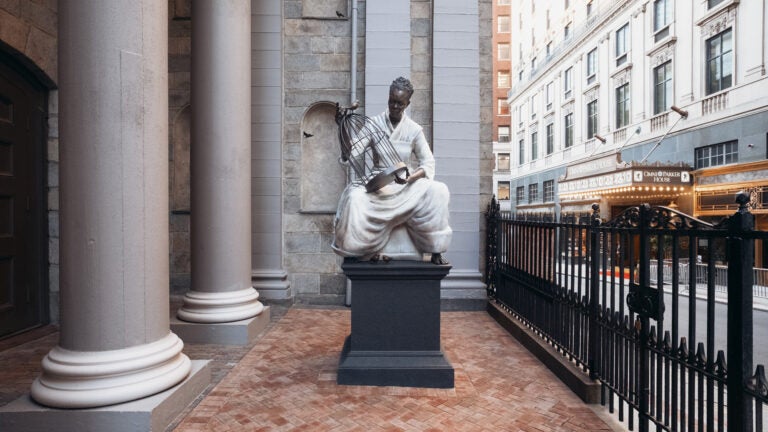
The Tremont Street church was founded in 1686. As a step toward reckoning with its past, it unveiled “Unbound,” a sculpture honoring the at least 219 men, women, and children who were enslaved by past ministers and parishioners, in September.
“We knew that it was our moral obligation to tell the truth, and that began this whole process for the church,” Fallon said.
The 14-foot sculpture sits in the church’s front courtyard and depicts a Black woman holding an open bird cage. Small bird figurines, representing liberty and empowerment, perch near her feet and at the top of the cage.

The church plans to list all 219 names of the identified enslaved people near the memorial and continue adding names as more are discovered.
“The real sad thing and injustice is that we only know the names of individuals who were sold, who were buried, were married in the church,” Roeshana Moore-Evans, strategic advisor for the memorial projects committee, said, “but there are millions of names we will never know.”
The project has been in development since 2016, and has a twofold objective: a physical memorial and a “living memorial” fund to support further endeavors to take accountability for the church’s history of slavery.
“[Slavery] was something that was alive and well in Massachusetts, and the more we uncovered, the more we decided that we really wanted to tell the whole truth about our history,” said Dean Denniston, chair of the church’s memorial projects committee.
Through extensive research, the church determined at least 55 members, including four ministers, were enslavers prior to the American Revolution. Slavery was abolished in Massachusetts in 1783. But, the church’s connection with slavery persisted into the early 1800s as it “relied on” wealthy members, some of whom were connected to slavery, for funding, as informational posters around the church explain.
Afro-Cuban artist Harmonica Rosales designed the statue in partnership with MASS Design Group, the organization behind the “Embrace” statue on Boston Common.
“As [Rosales] was sculpting this woman out of clay, her facial features changed, her dress changed, her hair and the radius represented changed over time, because these two were in a constant dialogue in her studio as she was coming to life,” said Jha D Amazi, principal at MASS Design Group.
The decision to place her at the forefront of the church was a purposeful effort to ingrain her in the city’s history, Moore-Evans said.
“I don’t want her to feel like an outsider. I don’t want her to be relegated to the balcony. I want her to be front and center,” Moore-Evans said. “I want people to see that she is important.”
Denniston said many of the names identified — traced through pew holders’ property and probate records — were not African names, and were instead names given by slave owners.
“If you are enslaved, your whole history, along with your culture, is just wiped away,” Denniston said. “Even though they weren’t their original names, it was important to identify folks, otherwise, they’re just erased, and we didn’t want that.”
Amazi hopes visitors strolling past the church on the Freedom Trail engage with the memorial.
“Even if it’s just a simple search from their cellphone and they move on, at least we’ve had an opportunity to invite people into a conversation about complicated histories and layers that they perhaps would not have thought to seek out on their own,” she said.
King’s Chapel plans to create an immersive ceiling mural in the church’s sanctuary, portraying Indigenous and Black people releasing birds into the sky.
“We can’t change the past, but we can move forward towards the future … We’ve called this project ‘the journey towards reconciliation,’ and it’s a lifetime journey,” Denniston said. “There’s a lot that needs to be done, and I think the church is willing.”
Get everything you need to know to start your day, delivered right to your inbox every morning.



To comment, please create a screen name in your profile
To comment, please verify your email address
Conversation
This discussion has ended. Please join elsewhere on Boston.com