
Sign up for the Today newsletter
Get everything you need to know to start your day, delivered right to your inbox every morning.

A new report from the Massachusetts Taxpayers Foundation warns that rising housing, energy, and health care costs and slow private sector growth are driving residents to lower-cost states even as the state’s talent, innovation, and quality of life remain strong.
“This year’s Index underscores the dual reality Massachusetts faces,” Doug Howgate, president of the Massachusetts Taxpayers Foundation, said in a statement. “Our state’s foundation in talent, innovation, and quality of life remains strong, but rising costs, especially in housing, energy, and health care, are stifling private sector growth and pushing residents away.”
The Massachusetts Taxpayers Foundation was founded in 1935 and is a public policy organization dealing with state and local fiscal, tax, and economic policies.
Key findings in the report show that Massachusetts remains in the top of national rankings for education. It is first nationally for the most significant percentage of its 25+-year-old population with a bachelor’s degree.
The state also ranks first in venture capital funding per $1 million in gross state product, signaling strength in innovation despite a significant year-over-year decline in funding.
The report also says that Massachusetts ranks second nationally in gross state product per capita at $110,023, reflecting high economic productivity and workforce efficiency.
However, the report also shows some challenges.
Private employment growth ranks 50th nationally, with a 0.6% decline in private jobs from 2023 to 2024.
The cost of living also remains high, with the state ranking 47th nationally for regional price parity. This index measures price level differences across the U.S., showing how expensive goods and services are compared to the national average.
Rising health care costs remain a top concern for employers and their workers. The state dropped from 36th to 48th in state rankings, and premiums grew close to 20%, or about $1,000 more per employee, to $7,494.
The state also has the highest infant child care costs in the nation, with median costs exceeding $23,000 annually.
In addition, residents in the state have the longest average commute time in New England, at around 30 minutes, which continues to worsen.
Massachusetts also ranks 45th nationally in domestic migration, showing a loss of residents to other states, especially among the 26-35 age group.
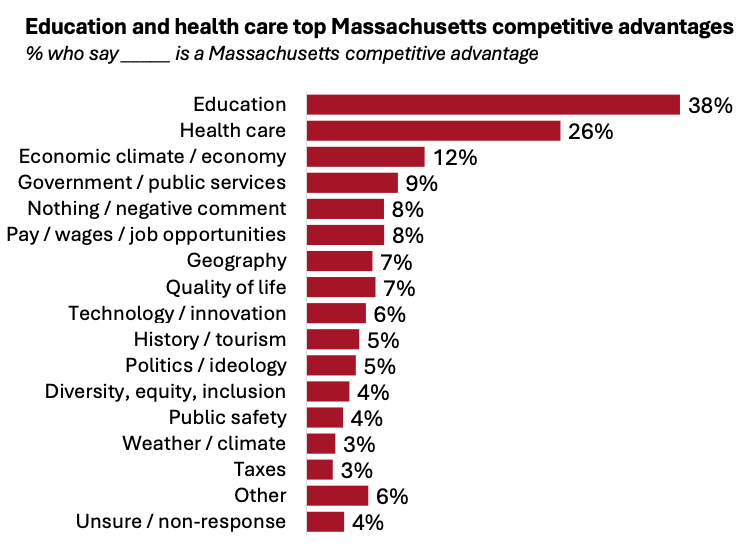
The Index added a companion poll conducted this July by the MassINC Polling Group. It showed that most respondents identified quality of education and health care as Massachusetts’ competitive strengths.
In contrast, 66% said housing availability and affordability were their primary concerns, 67% cited the cost of living, and 57% cited job opportunities elsewhere.
The survey found that 41% of residents aged 18-29 plan to move within five years, largely due to high living costs.
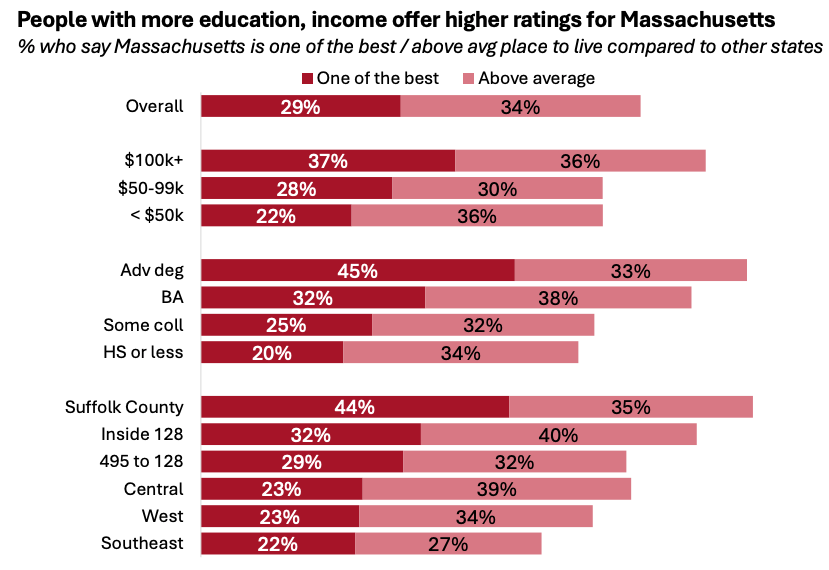
The poll showed that people with higher education and income levels were more likely to rank Massachusetts highly as a place to live. There were also regional differences, with those closer to Boston offering higher ratings.
“When people think about where they want to live and work, perception is reality, so state leaders need to pay attention to how residents think we stack up,” Steve Koczela, president of the MassINC Polling Group, said in a statement.

Get everything you need to know to start your day, delivered right to your inbox every morning.




To comment, please create a screen name in your profile
To comment, please verify your email address
Conversation
This discussion has ended. Please join elsewhere on Boston.com