
Sign up for the Today newsletter
Get everything you need to know to start your day, delivered right to your inbox every morning.
Massachusetts officials are asking members of the public to be on the lookout for the spotted lanternfly, as the invasive species starts to mature during the fall months.
The Massachusetts Department of Agricultural Resources confirmed last month that spotted lanternflies have been detected in more than 50 cities and towns and nine counties in the state.
The department keeps an interactive map updated online with locations where the insects have been found. This includes clusters of communities around Springfield, Worcester, and Boston, as well as a handful in southeastern Massachusetts near the Rhode Island border. Berkshire and Franklin counties have been spared so far, as has Cape Cod.

If residents see a spotted lanternfly, they should first check the map to see if one has already been reported in their community. For sightings in new cities and towns, residents can take a photo and report it to the state using an online form.
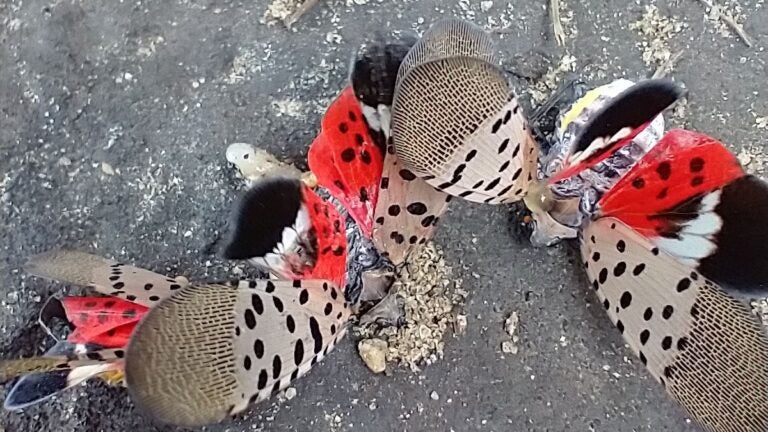
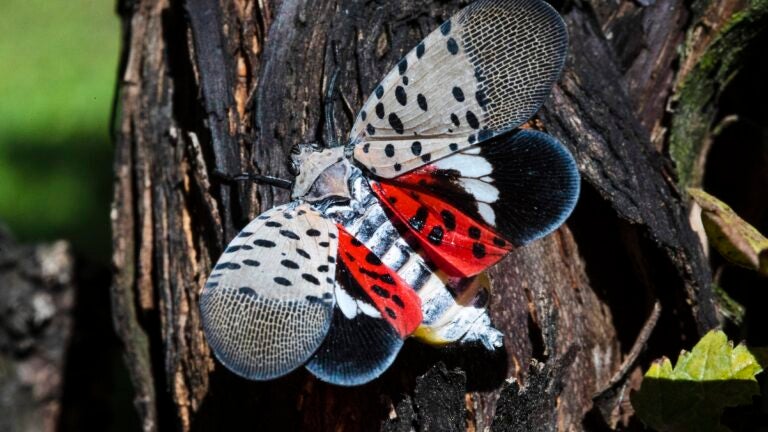
Adult spotted lanternflies are about an inch long, with grayish wings that have black spots on them and red hindwings underneath. They mature from August to December, before the weather kills off any adults. Typical New England winters are not cold enough to kill the egg masses, which then hatch the following spring.
The spotted lanternfly is native to southern China, Vietnam, and Taiwan. It first spread to South Korea and Japan in the early 2000s, and then accidentally to the U.S. in 2014 through a shipment to a business in Pennsylvania. Since then, it has spread to Massachusetts, Rhode Island, New York, New Jersey, and a range of other mid-Atlantic and midwestern states.
The insects do not sting, bite, or directly harm humans or pets. But they can cause a host of other problems. Lanternflies feed on the sap of more than 100 different plant species, and can kill grapevines and small tree saplings. Their primary host plant is the invasive tree-of-heaven, but the insects also love fruit trees and hops.
Adult spotted lanternflies produce a sticky substance called honeydew, which can accumulate over plants and anything else nearby an infestation. The honeydew is very hard to remove. It also attracts stinging insects and leads to the growth of sooty mold, which stunts plant growth. Other fungi and bacteria can lead to foul odors.
There are a range of ways to eliminate spotted lanternfly infestations. The state has published a management guide with detailed information on how to identify and exterminate the pests.
Last week, lawmakers in Congress introduced legislation that would direct federal officials to carry out a national campaign to increase awareness of spotted lanternflies and the damage they can do.
Get everything you need to know to start your day, delivered right to your inbox every morning.





To comment, please create a screen name in your profile
To comment, please verify your email address
Conversation
This discussion has ended. Please join elsewhere on Boston.com