
Sign up for the Today newsletter
Get everything you need to know to start your day, delivered right to your inbox every morning.
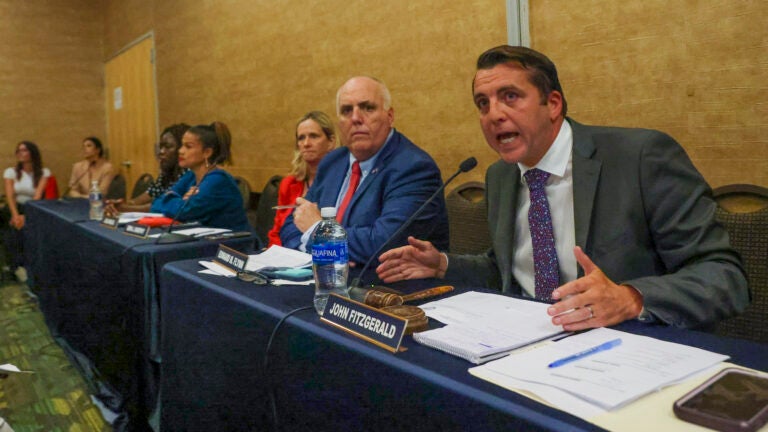
The majority of the Boston City Council expressed their support Wednesday for legislation that would allow for the establishment of safe injection sites in the city and around the state.
They did so by voting down a resolution that sought to declare the body’s opposition to pending legislation on Beacon Hill. The vote comes as Boston officials face continued outcry from residents who say that public drug use and the safety concerns that come with it are getting worse and spreading to new neighborhoods.
Councilor Ed Flynn introduced the resolution, with the backing of councilors Erin Murphy and John FitzGerald. The three councilors argued that the bill currently being debated by state lawmakers seriously risks making the public health crisis worse.
That bill, which was the subject of a hearing last week, provides a framework for cities and towns to establish designated areas where healthcare workers can supervise “persons who use pre-obtained substances.”
Safe injection sites, also known as overdose prevention centers, are touted by supporters as places where people who would be using drugs anyway can do so with a decreased risk of dying or spreading disease. They say that safe injection sites also save cities money and reduce litter without increasing drug use or crime.
City data shows that opioid-related overdose deaths dropped dramatically in Boston last year.
Councilors ultimately voted 8-3 against the resolution, with only Flynn, Murphy, and Fitzgerald casting votes in its favor.
In pushing the resolution, Flynn argued that the creation of safe injection sites would only incentivize drug use at a time when officials owe it to their constituents to take a firm stance against anything that could exacerbate the problems facing residents.
Flynn specifically mentioned a heated hearing the City Council held earlier this month near Mass. and Cass that hundreds of residents attended. Many complained about used needles, human waste, and other dangerous items being commonplace in their neighborhoods. One shared a story of how a homeless man had been using a stolen key to come and go from a home they recently bought.
“How can we go back to the community and say that safe injection sites are the right answer to address the crisis at Mass. and Cass? Residents don’t want us to enable additional harmful behavior to those battling addiction. They need recovery services, they need detox,” Flynn said.
Officials should instead focus on filling in the gaps within the existing continuum of care before considering safe injection sites, FitzGerald said. The emphasis should be on recovery, public safety, and judicial reform, he added.
Officials have been trying to decentralize the drug problem and promote a regional approach, FitzGerald said. In July, he pushed for other communities to “step up” and help establish an “intermunicipal fund” that would require communities to pool money that would go towards finding solutions at Mass. and Cass. FitzGerald asked his colleagues if they would support having a safe injection site in their districts, and said that the legislation would likely result in a site being set up in the South End, walking back progress.
Efforts to create safe injection sites could face stiff opposition from the federal administration. President Trump signed an executive order in July directing funds to be withheld from programs that support safe injection sites. In April, U.S. Attorney Leah Foley said that the sites are “categorically illegal and do nothing to help people overcome their addictions.”
But multiple City Council members spoke about the potential positives of safe injection sites. Councilor Gabriela Coletta Zapata cited research showing a number of benefits that the sites offer and pushed her colleagues to defer to public health experts and not to “politicize” the issue.
Councilor Liz Breadon offered her full-throated support for the legislation on Beacon Hill, responding to FitzGerald by arguing that safe injection sites could actually help take the burden off of Boston.
“We do know that people come to Boston for services and to access treatment. And also, we have an open drug market in the streets. But if there’s safe, supportive overdose prevention sites in other parts of the state, I feel that will take pressure off the city of Boston,” she said.
Councilor Sharon Durkan said that she has not taken a definitive stance on the topic, but took issue with how Flynn, Murphy, and FitzGerald were choosing to go about voicing their concerns. Those who are opposed to the legislation should testify in the State House under their personal capacity, she said, instead of introducing resolutions like this in the council chambers.
“I just don’t believe this resolution is a good faith representation of good public process,” she said.
Get everything you need to know to start your day, delivered right to your inbox every morning.





To comment, please create a screen name in your profile
To comment, please verify your email address
Conversation
This discussion has ended. Please join elsewhere on Boston.com