
Sign up for the Today newsletter
Get everything you need to know to start your day, delivered right to your inbox every morning.
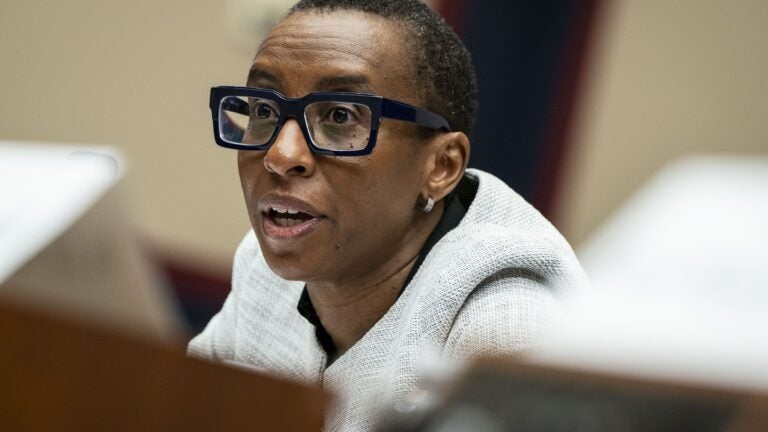
Claudine Gay, the former president of Harvard who resigned almost two years ago, delivered remarks earlier this month lamenting the power that donors have over universities and the possible “compliance” Harvard is showing toward the Trump administration.
Gay’s remarks, delivered at the Netherlands Institute for Advanced Study in Amsterdam, are some of the most extensive she has given in public since her resignation.
“Universities have come to rely on donors more desperately than ever, particularly as public support has diminished, and donors have come to expect more than just gratitude. They want influence. They want control. They want, in the language of our times, a seat at the table,” she said.
For much of this year, Gay’s successor, Alan Garber, has been engaged in negotiations with the Trump administration. After rejecting the administration’s sweeping demands in the spring, reports circulated last month that a potential deal could be coming where Harvard pays $500 million to end its dispute with the federal government. Harvard officials pushed back on that reporting, and a deal has yet to materialize.
In a Q&A session at the NIAS, Gay spoke candidly about that potential deal.
“The number of $500 million is completely arbitrary, and it will solve nothing,” Gay said, per The Harvard Crimson. “There is no justification.”
Coincidentally, Gay’s remarks came on the same day that a federal judge delivered a notable win for Harvard in its fight to restore more than $2.6 billion in funding research grants. Harvard sued the Trump administration, alleging it is waging a campaign of retaliation against the university for not agreeing to a series of demands made by a federal antisemitism task force in April.
On Friday, the federal government took another step to ratchet up pressure on Harvard, placing new restrictions on how it accesses federal funds for student aid.
While Garber’s initial rejection of the administration’s demands drew widespread praise, the university has also made some changes that mirror some of the White House’s demands, like closing diversity offices and making changes to the leadership of its Center for Middle Eastern Studies.
“The posture of the institution seems to be one of compliance,” Gay said, according to the Crimson. “This is distressing, not only for those of us who are on campus and facing the consequences directly, but also for all of those in higher ed who look to Harvard for leadership and guidance.”
Gay became the shortest-tenured president in Harvard history when she resigned in early 2024. Her leadership came under fire after a high-profile congressional hearing on campus antisemitism. Conservative activists later unearthed and amplified plagiarism allegations, intensifying the scrutiny Gay faced from the public.
When she resigned, Gay said that she was subject to “personal attacks and threats fueled by racial animus.”
Steven Levitsky, a Harvard professor of government, recently defended Gay in an interview with The Boston Globe. He said that she had been unfairly treated and praised her recent public comments.
“Good god — the woman is not even remotely antisemitic, and yet she was attacked relentlessly and few defended her, so I’m really glad she’s speaking up. More people should, if we want to maintain a free society,” he said.
Get everything you need to know to start your day, delivered right to your inbox every morning.





To comment, please create a screen name in your profile
To comment, please verify your email address
Conversation
This discussion has ended. Please join elsewhere on Boston.com