
Sign up for the Today newsletter
Get everything you need to know to start your day, delivered right to your inbox every morning.
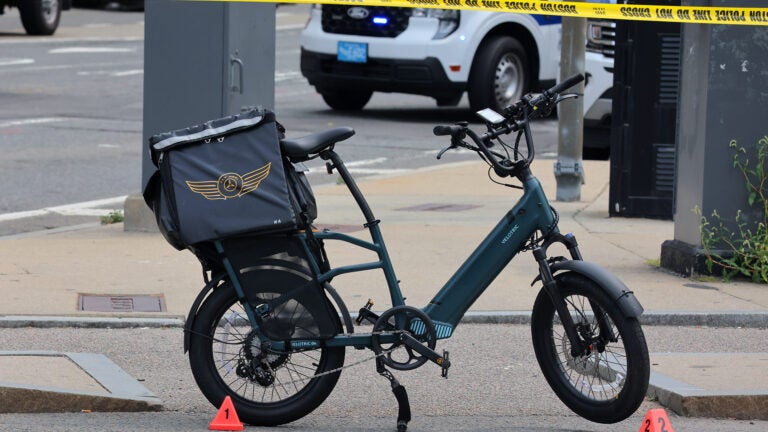
Members of the Boston City Council are beginning to debate the potential ban of mopeds, scooters and other similar vehicles from being used by third-party food delivery drivers. The conversation comes after continuous outcry from the public over the safety issues these drivers often pose.
But an all-out ban still appears very unlikely. The idea was introduced by Councilor Ed Flynn this week, but he faced stiff pushback from some colleagues. There was no vote taken on Flynn’s ordinance, and it was referred to the Committee on Government Operations where it will be the subject of future debate.
Flynn’s idea, which was supported only by Councilor Erin Murphy, proposes an amendment to an ordinance passed by City Council in April. Under that earlier ordinance, the city will soon begin requiring third-party restaurant delivery companies like Uber Eats, Grubhub, and DoorDash to obtain new permits in order to continue operating in Boston. It also requires the companies to share new safety data with the city and to provide liability insurance coverage for their drivers.
The April ordinance establishes important oversight, but the city does not have the “capability to provide consistent enforcement for hundreds of operators at the same time,” Flynn wrote in his ordinance.
Flynn references reports about these food delivery companies allegedly incentivizing their drivers to “prioritize speed over safety.” He also mentions reports about the city apparently pushing delivery companies to shift away from cars towards smaller vehicles in order to decrease congestion.
Speaking during Wednesday’s City Council meeting, Flynn drew attention to a recent incident where a person was fatally injured by an e-bike near Copley Square. He decried the “Wild West mentality” governing these vehicles at the moment.
“They don’t respect the rules of the road. Pedestrians are getting hit. Pedestrians are very scared crossing the street. I get calls all day long, and emails all day long,” Flynn said. “I just can’t accept the status quo.”
During the pandemic, Boston saw a significant spike in the number of food deliveries facilitated by app-based companies. Boston’s 311 database is full of complaints about mopeds, e-bikes, and scooters disobeying traffic laws and endangering others. Last summer, Police Commissioner Michael Cox and Chief of Streets Jascha Franklin-Hodge raised their concerns about “dangerous and unlawful” behavior directly to the companies. Cox directed officers to increase enforcement.
Councilor Henry Santana voiced his opposition to Flynn’s idea, saying that it would disproportionately jeopardize the livelihoods of low-income and immigrant workers who rely on these delivery jobs. He called for increased outreach to drivers and the delivery companies.
“The majority of these drivers are working, are trying to maintain their families and put food on the table and I think we need a different approach to this,” he said.
Councilor Enrique Pepén also disagreed with Flynn, saying that a full ban was not the appropriate way to solve the real problems Flynn identified. He said that the April ordinance is an important step that has yet to be implemented, and urged officials to increase coordination with the state about registering these vehicles. Pepén said that police need to increase their enforcement efforts as well.
Councilor Julia Mejia said that her colleagues should explore ways to put more pressure on the delivery companies instead of focusing on the drivers and their vehicles.
“We need to start thinking outside of this chamber, outside of just these individuals here, and thinking about the fat cats who are really the ones who tend to benefit from the work of these folks,” she said.
A spokesperson for Mayor Michelle Wu did not immediately respond to a request for comment Wednesday. Wu initiated the effort to require new permits and liability insurance earlier this year.
Spokespeople for Uber and GrubHub did not immediately return requests for comment.
DoorDash maintains that a ban on two-wheeled vehicles would cut into worker earnings, increase traffic congestion, and impede efforts to fight climate change.
“If enacted, this proposal would eliminate one-third of all Boston deliveries overnight — costing local businesses millions in sales and leaving thousands of workers without a reliable way to earn income. We couldn’t agree more with the push for safer, more responsible two-wheeled delivery, but an outright ban would have catastrophic consequences for the city’s local economy, and would force more deliveries back into cars — meaning more pollution and more congestion,” a DoorDash spokesperson said in a statement.
“As proven earlier this year, we remain a partner for the City as they explore meaningful solutions that will help keep Bostonians safe without damaging the city’s economy and sustainability efforts,” they wrote.
Get everything you need to know to start your day, delivered right to your inbox every morning.




To comment, please create a screen name in your profile
To comment, please verify your email address
Conversation
This discussion has ended. Please join elsewhere on Boston.com