
Sign up for the Today newsletter
Get everything you need to know to start your day, delivered right to your inbox every morning.
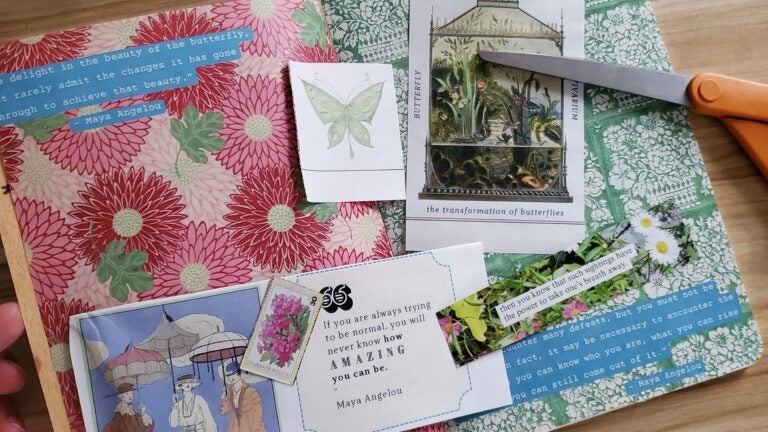
Opting for paper receipts and putting wrappers in tote bags instead of trash cans, young people are saving “junk” to collage in their journals.
Yes, scrapbooking and collaging found items, aptly known as “junk journaling,” is trending amongst younger generations.
While a journal is typically treated like a diary and full of writing, a junk journal is filled with cutouts of pamphlets, takeout bags, and museum tickets as physical representations of the journaler’s whereabouts.
A junk journal “fills in memories for you and you [don’t] necessarily have to write a whole page about your experience, but it still fulfills [the practice of] holding onto [a] special memory,” says Lauren Clark, the owner of Found and Flowered, a Greater Boston-based company that makes collage materials and hosts junk journaling events.
Last month, Olympian Ilona Maher discussed her and her sisters’ hobby of bullet, or junk, journaling with Malala Yousafzai on “The House of Maher” podcast, “We’ll get even a piece of paper or something from somewhere and we’ll put it in our journals and you can kind of remember it. … When we’re together, … we all get the same sticker and put it in.”
While it is trending online, junk journaling is getting people off social media to collect junk and then collage.
“We’re really hoping for a return to this, like, tangible, analog practice where you are using your hands again,” Clark said.
Junk journaling “means something different to everybody, but you could call it a revival of the scrapbooking trend,” in a way, she said.
Unlike scrapbooking, however, junk journaling does not typically involve photos. It is “a quicker, in-the-moment process. It’s about embracing imperfection and finding beauty in the discarded,” according to a January article on MarthaStewart.com.
While some junk journalers are purists who only utilize found items, other journalers, like the Maher sisters, buy items specifically for their junk journals — often using purchased items, such as stickers and collage kits, to supplement their repurposed items.
“Some people stick to really just receipts, tickets, pamphlets, really anything they haven’t purchased, but I think most people do a nice mix of both,” Clark said.
As a non-purist herself, Clark, through Found and Flowered, sells seasonal newspapers and monthly “snail mail” consisting of design pages meant to be cut out and serve as inspiration for junk journaling. After working at a handmade journal store over a decade ago, Clark was inspired to create the materials needed to put journals deemed “too pretty to use” to good use in 2018 and revamped the brand when she moved to Greater Boston in 2024.
Another non-purist, online junk journaler Martina Calvi, is releasing her second book, “A Year of Junk Journaling,” with 52 weekly collage prompts in October to pair with her first book, “The Art of Memory Collecting,” and the videos she shares with her 341,000 Instagram followers.

Clark said the clash with purists defies the first rule of junk journaling: There are no rules.
“A junk journal can really be anything” and requires no perfectionism or significant monetary investments, making it an approachable hobby, she said, adding, “It doesn’t really matter how you arrange it, just have fun playing with these materials.”
Beyond the practical reasons for junk journaling’s popularity, the hobby may have taken off because of its focus on getting offline.
“The benefits are proven, just for your mental health, to spend a half an hour doing anything [other] than being stuck on the phone,” Clark said.
Junk journaler Rosemarie Soma called junk journaling a “substitute for therapy” in one of her videos to her 54,000 Instagram followers.
Whether through posting collages online or attending workshops, junk journaling can be a community activity.
At Clark’s monthly workshops, attendees bind their own journal with upcycled book pages and paper and have the opportunity to fill its pages with collage materials or “emphera” as Clark calls it.
Then, the attendees participate in a show-and-tell of their journals. “The show-and-tell is so cool,” Clark said. “Everybody’s using the same materials, but then everybody has a different story about why they picked these pages” and what it reminded them of.
While most junk journalers online are Millennials or Gen Z, attendees at Clark’s workshops are ages 19 to 60 — most of them women.
While “junk journaling” is a new trend, the act of junk journaling has surfaced before.
Clark used to junk journal about a decade ago when it was known as “smashbooks” and noticed the trend reentering the media under its new name about two years ago.
Online, junk journaling took off right as 2025 started. According to Google Trends, searches about junk journaling peaked in late December and early January, and the search trends were on the rise at the end of August as well.
Get everything you need to know to start your day, delivered right to your inbox every morning.





To comment, please create a screen name in your profile
To comment, please verify your email address
Conversation
This discussion has ended. Please join elsewhere on Boston.com