
Sign up for the Today newsletter
Get everything you need to know to start your day, delivered right to your inbox every morning.
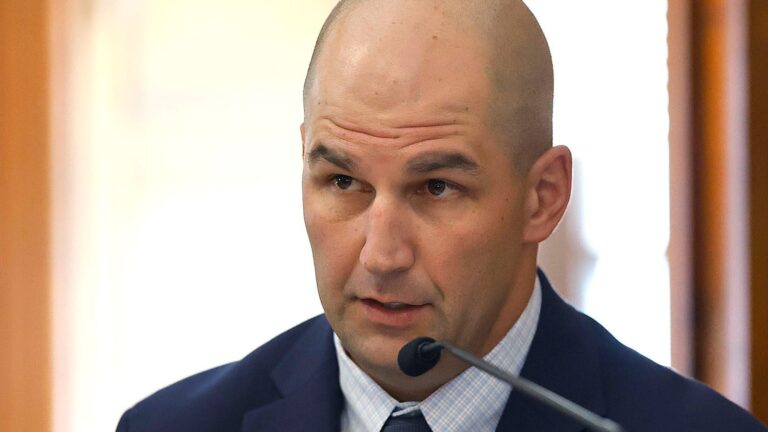
Continuing his quest to win Michael Proctor his job back, an attorney for the ex-trooper questioned Wednesday whether Proctor’s vulgar texts about Karen Read had any bearing on his investigation into Read’s murder case.
Proctor, a former Massachusetts State Police trooper, resumed his Civil Service Commission appeal Wednesday as he fights to reverse his firing. His lawyer previously argued he was an “exemplary trooper” who was “made to be a scapegoat” amid intense public scrutiny surrounding Read’s high-profile case.
State Police terminated Proctor in March following a lengthy suspension and internal affairs probe that delved into the now-infamous texts he sent friends, family, and coworkers about the case. In those texts, Proctor called Read a “wack job c**t” and “retarded,” made vulgar remarks about her health and appearance, joked about searching for nude photos on her cellphone, and said he hoped Read would kill herself.
Proctor has said his emotions “got the best of” him as he investigated the January 2022 death of Read’s boyfriend, Boston Police Officer John O’Keefe. However, State Police say the messages gave the impression Proctor was not impartial toward Read, the lead suspect at the time.
As the administrative hearing entered its second day, attorney Daniel Moynihan continued his cross-examination of Detective Lt. Kevin Dwyer, the sole State Police witness. Dwyer investigated Proctor’s alleged misconduct as part of an internal affairs investigation.
Proctor’s “personal cellphone messages had no relevance to his duties as a case officer, correct?” Moynihan asked.
Dwyer disagreed.
“I would agree that there was nothing shown that his duties were affected, but as a police officer, I think all of your behavior is relevant to your duties,” he replied.
Dwyer added: “While the text messages weren’t his duties, they affect everything that he does.”
Answering a subsequent question, Dwyer confirmed he found no evidence to suggest Proctor’s actions as an investigator were based on anything other than fact and reason.
In another line of questioning, Moynihan asked Dwyer whether he ever found Proctor untruthful. Dwyer said he hadn’t.
Moynihan probed the distinction between an assigned case officer and a lead investigator, likening Proctor to a “spoke in the wheel” versus an authority figure on Read’s case. He also asked Dwyer about the opinions investigators form about suspects when looking into a murder.
“It’s natural — it’s human nature, is it not — to form an opinion about someone you believe to be the suspect of a homicide?” he questioned.
“Yes, sir,” Dwyer replied.
“You don’t have warm, fuzzy feelings for somebody you think committed a homicide, correct?” Moynihan asked in a follow-up.
“I probably wouldn’t, no,” Dwyer conceded. “And I have not, yes.”
“And it’s entirely reasonable to express your personal opinions to family members and close friends, correct?” Moynihan pressed during the exchange.
“It is, but as a police officer there are certain things that you cannot share,” Dwyer replied.
In another line of questioning about expectations of privacy for personal phones, Dwyer testified, “as police officers, we have a different expectation.” When Moynihan asserted there’s no State Police policy governing personal conversations on a personal device, agency attorney Stephen Carley interjected.
“The rules governing the conduct of members apply at all times,” Carley told the Civil Service Commission hearing officer. “They do not differentiate between personal cellphones, work cellphones, or any cellphones. They simply apply at all times to all members.”
He added: “It doesn’t matter whether it occurs via email or smoke signal or personal cellphone.”
Elsewhere in his testimony, Dwyer maintained that nobody with the State Police urged him to “rush” his investigation into Proctor, though he acknowledged the case was a “priority.”
“Certain cases always take priority over other cases,” he explained. “It is no secret that there was heavy media attention on this case. Based on that, this would be a priority case in addition to the allegations that were made.”
At another point in his questioning, Moynihan pointed to a draft copy of Dwyer’s report, which referenced an interview with Proctor that hadn’t happened yet. Dwyer explained that he pre-wrote some “boilerplate” parts of the report, and that they were subject to change.
“Is it fair to say that Michael Proctor’s subject interview here was just a formality?” Moynihan pressed.
“That is not true,” Dwyer replied.
“Is it fair to say that Michael Proctor’s termination was just a predetermination?” Moynihan shot back.
“I can’t speak to that, sir,” Dwyer responded.
He also denied that anyone with the State Police had advised him of which charges he needed to find Proctor guilty.
“I think that it’s unfair to say that anyone tells an investigator what charges to find guilt on,” Dwyer testified. On redirect examination, he explained that none of his recommendations changed following the interview with Proctor.
“Nothing was learned in the interview that changed the facts as we already had them,” Dwyer said. “For the most part, Trooper Proctor had confirmed basically what he had testified to, and so the sustained charges were kept.”
Dwyer also said he didn’t receive “actionable information and details” about Proctor’s alleged text message misconduct until the ex-trooper testified during Read’s first trial in June 2024. Proctor’s texts initially came to light following a secretive federal probe into the state’s handling of Read’s case, and Dwyer testified about having to sign a non-disclosure agreement as part of his internal affairs investigation.
“As you understood the NDA, sir, you were not in a position to move forward with your investigation until you received Michael Proctor’s public testimony about his conduct?” Carley clarified.
“Correct,” Dwyer replied.
“And the department could not bring Michael Proctor forward to relieve him of duty … until it could provide the subject with documentation to support the accusation of misconduct?” Carley pressed.
“Yes,” Dwyer confirmed.
The hearing adjourned after Dwyer finished his testimony Wednesday afternoon. Proctor’s appeal will continue with another session Oct. 21.
Livestream via NBC10 Boston.

Get everything you need to know to start your day, delivered right to your inbox every morning.



To comment, please create a screen name in your profile
To comment, please verify your email address
Conversation
This discussion has ended. Please join elsewhere on Boston.com