
Sign up for the Today newsletter
Get everything you need to know to start your day, delivered right to your inbox every morning.
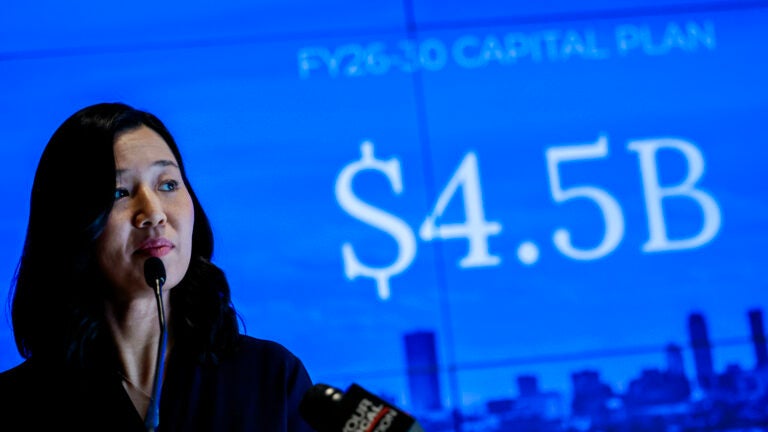
Boston is well positioned to withstand federal funding cuts that may be tied to the Trump administration’s crackdown on “sanctuary” cities, Mayor Michelle Wu said Wednesday.
The city has a firm legal basis to fight back, and this year’s budget was specifically crafted to account for potential financial unrest spurred by the federal government, she said. Wu’s comments come a day after she rebuked Attorney General Pam Bondi and refused to abandon the city’s immigration enforcement policies.
In a letter sent to Wu earlier this month, Bondi threatened to withhold federal funding until the city walks away from efforts to “thwart federal immigration enforcement.” Boston relies on about $300 million in federal funding every year to support a variety of city services. But Wu said that most of these dollars are not at risk, despite Bondi’s threats.
“We do not believe that the vulnerability for the city of Boston is in the range of hundreds of millions of dollars,” she said during an appearance on the “Java with Jimmy” show.
When Wu unveiled her budget proposal in April, she said that the priority was to prepare for worst-case scenarios. Wu signed a $4.8 billion budget for fiscal year 2026 in June that represents a 4.4% increase over the previous budget. City officials have said that they want to prioritize core city services but cannot add new positions or invest in major new programs.
“We really tightened the belt on the city this year,” Wu said Wednesday.
Wu believes Boston is not at serious risk of losing significant amounts of federal funding because most of those dollars have been approved by Congress and cannot be rescinded through an executive order from President Donald Trump.
In May, the Trump administration attempted to cancel $3.6 billion in housing and homelessness prevention grants unless Boston and other cities complied with a number of conditions laid out by the White House. Boston joined a lawsuit challenging this move, arguing that the Trump administration was adding “unlawful and arbitrary” conditions to the funding.
That lawsuit was successful, and the city currently has access to the funds, Wu said this week.
She also spoke about grants that could prompt a future legal fight. For years, Boston has applied for counterterrorism grants through the Urban Area Security Initiative (UASI) program. Under the new federal administration, those grants now require 10% of the allocated funding be used for “border crisis response and enforcement,” such as promoting collaboration between ICE and local law enforcement.
Both state law and a local ordinance known as the Boston Trust Act limit how local police can cooperate with federal immigration enforcement officers. But some information can still be shared through the Boston Regional Intelligence Center (BRIC), which has prompted some to call for a strengthening of the Trust Act, as reported by The Flipside.
Wu told that outlet earlier this month that Boston would apply for the UASI grants again because nothing in the grant stipulations can compel the city to violate its own laws or state laws.
She reiterated this message Wednesday, saying that 10% of the funds are already being used for purposes in line with border security, such as harbor patrols.
“We will not and cannot, by our laws, cooperate with ICE in the way that they’re trying to force us to do so because of the Boston Trust Act,” she said. “So we’re going to apply for the funds as we always have. If we get rejected then we will go to court again and sue.”
Wu spoke about the Trump administration’s attempts to portray cities like Boston as crime-ridden places where local leaders use sanctuary policies to keep hardened criminals out of custody. The Boston Trust Act does allow cooperation between local police and federal officers on matters of significant public safety importance, like cases of child exploitation and human trafficking. Wu says that policies like this one actually improve public safety by reassuring residents that they can report crimes without fear of deportation themselves.
Wu made these arguments in a letter she sent to Bondi Tuesday. In that letter, she denounced the federal government’s “unconstitutional threats and unlawful coercion,” while blaming the Trump administration for seeking to “divide, isolate, and intimidate” residents.
Read Wu’s full response to Bondi below:
Wu response to Bondi by Ross Cristantiello
Get everything you need to know to start your day, delivered right to your inbox every morning.





To comment, please create a screen name in your profile
To comment, please verify your email address
Conversation
This discussion has ended. Please join elsewhere on Boston.com