
Sign up for the Today newsletter
Get everything you need to know to start your day, delivered right to your inbox every morning.
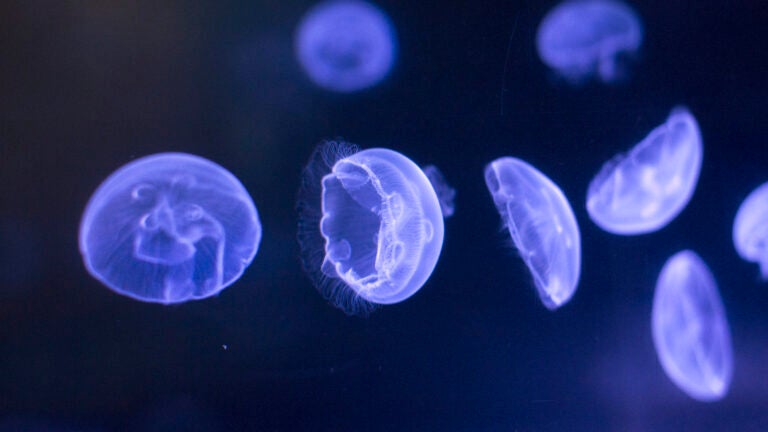
A jellyfish species not known for stinging humans has been doing just that on Cape Cod, and researchers aren’t quite sure why.
The moon jellyfish is “typically harmless,” but in the last two decades, the moon jellyfish on Cape Cod have been stinging people and have grown to a large size, said Nicole Corbett, director and president of the Popponesset Water Stewardship Alliance.
The mucous coating from the jellyfish left in the water is also stinging people who haven’t even come into contact with the jellyfish itself, NBC10 reported.
When Corbett sampled jellyfish recently, some of the moon jellies she pulled out of the Nantucket Sound were up to 14 inches across. The size of a moon jelly usually tops out at 12 inches, according to the National Aquarium.
Also, during the last ten years, the moon jellyfish have been staying on Cape Cod from July to October, compared to the species’ typical linger period of a few weeks, Corbett said.
After crowdfunding to genetically test these moon jellies in 2021, Corbett said, “They were considered to be a moon jelly, but the DNA didn’t match known species of moon jellyfish.”
The lack of a genetic match is “a clue,” Corbett said.
The two main possibilities could be that the Cape Cod moon jellies mutated to have this size and stinging adaptation, or this species of moon jellies had not yet been genetically tested and originated from somewhere else.
“It was like the tip of the iceberg getting some of the genetic testing … and now we’re really trying to delve more into this mystery,” Corbett added.
Eighteen research institutions from Maine to Texas are collaborating with the University of California Merced to determine if the moon jellies mutated or moved in from elsewhere.
What to do if you get stung in the meantime? In 2020, Corbett piloted a program of jellyfish sting relief kits, including a vinegar, lab-grade urea-based spray, a copper sulfate-based cream, and a heat pack to kill remaining stinging cells and break down venom.
The kits are funded by donations and can be found on 18 beaches across the coasts of Sudbury and Mashpee and in Barnstable.
Get everything you need to know to start your day, delivered right to your inbox every morning.




To comment, please create a screen name in your profile
To comment, please verify your email address
Conversation
This discussion has ended. Please join elsewhere on Boston.com