
Sign up for the Today newsletter
Get everything you need to know to start your day, delivered right to your inbox every morning.
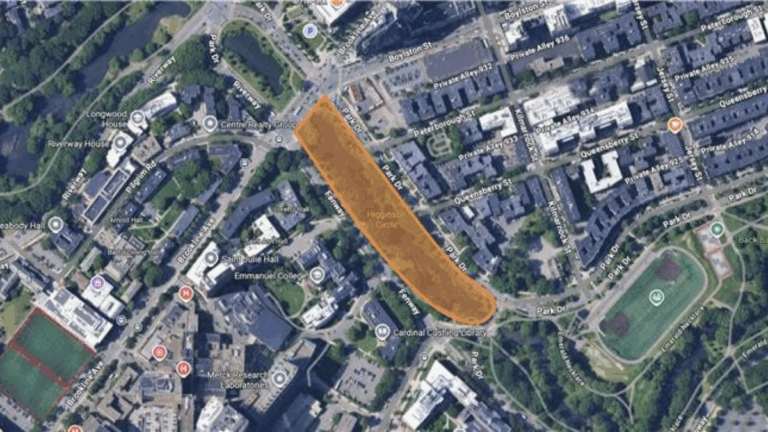
The Boston Public Health Commission is warning residents to avoid contact with water and algae around the Muddy River in Fenway.
The area, between Brookline Avenue and Avenue Louis Pasteur, has a cyanobacteria algae bloom, which has toxins that can harm people and pets, the BPHC said.
The levels of cyanobacteria cells in the Muddy River exceeded the guidelines of the Massachusetts Department of Public Health, according to DPH staff.
The blue-green algae can form harmful blooms in bodies of water that make the water appear murky or paint-like. The blooms can produce toxins that are harmful to people and animals, according to the BPHC.
Residents are instructed to avoid direct contact with the river’s water and the shoreline, and refrain from water activities and fishing.
The primary concern for humans is ingesting the contaminated water, which can cause gastrointestinal symptoms like vomiting and diarrhea.
For young children, ingestion of toxic algae can impact the functioning of their liver, kidneys, and neurological systems. In severe cases, the toxins ingested by humans can result in death, the BPHC said.
Direct skin contact with the algae may cause skin and eye irritation. If someone comes into contact with the water or algae, the BPHC advises residents to rinse themselves off immediately.
The BPHC also warned residents to not allow their dogs to drink or swim in the Muddy River’s water. For dogs, a primary concern is them ingesting the contaminated water and them getting “scum that has washed ashore” on their skin or fur.
For dogs, symptoms of ingesting an algae bloom are shown soon after exposure, and can cause vomiting, staggering, drooling, or convulsions. Residents are encouraged to call a veterinarian immediately if their dog has been around an algae bloom and shows symptoms.
Dangerous algae blooms are most common in summer when warm conditions advance algae growth, and can dissipate quickly or last for weeks, the BPHC said.
Multiple other algae blooms were discovered this summer, including elsewhere in Boston and in Brookline.
The BPHC said Aug. 1 that a cyanobacteria algae bloom was found in the Charles River near Massachusetts Avenue and the Harvard Bridge.
🚨WATER ALERT Charles River downstream of Mass Ave/Harvard Bridge CLOSED due to cyanobacteria. Includes Broad Canal, Lechmere Canal, North Point Park, Lederman Park, Community Boating & Storrow Lagoon
— City of Cambridge (@CambMA) August 1, 2025
⚠️NO swimming, fishing, boating
⚠️Avoid visible algaehttps://t.co/KCpPj9GyW3 pic.twitter.com/ph73EmFWon
The areas affected temporarily closed their water activities.
Similarly, the Brookline Reservoir advised residents to avoid the park due to presence of the blue-green algae.
Though swimming in the reservoir is already prohibited, Brookline reiterated the danger of swimming in the water with algae present and warned residents to keep their dogs away.
A harmful blue-green algae bloom has been confirmed at the Brookline Reservoir. These blooms can produce toxins that may make people & pets sick. While swimming is already prohibited, ingesting this algae can be toxic & cause serious illness. Keep safe & stay away from the algae! pic.twitter.com/1jNh5fujFE
— Town of Brookline (@TownofBrookline) August 5, 2025
The DPH is continuing to monitor the algae levels in Muddy River and conduct sampling for laboratory analysis.
Residents can find an updated list of all bodies of water containing algae blooms here.
Get everything you need to know to start your day, delivered right to your inbox every morning.





To comment, please create a screen name in your profile
To comment, please verify your email address
Conversation
This discussion has ended. Please join elsewhere on Boston.com