
Sign up for the Today newsletter
Get everything you need to know to start your day, delivered right to your inbox every morning.
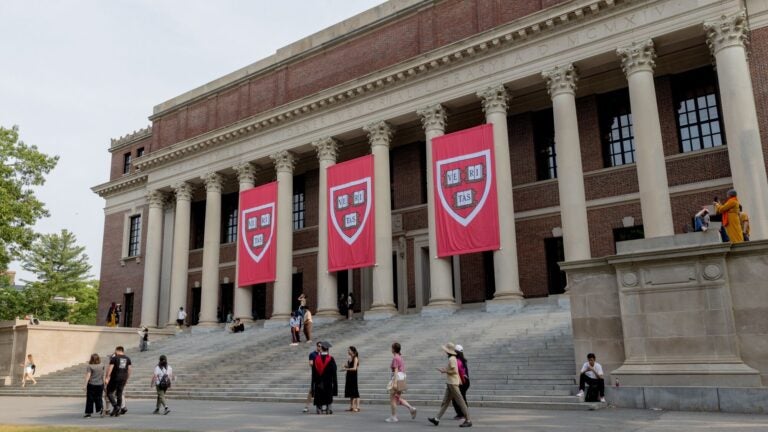
A federal judge on Monday temporarily blocked a presidential order barring international students from studying at Harvard, allowing the university to continue hosting them as the legal battle unfolds.
But the uncertainty of the outcome is still leaving faculty and students scrambling to plan for the next academic year, especially since international students make up a significant portion of many of the graduate programs.
Walter Willett, a professor of epidemiology at the Harvard T.H. Chan School of Public Health, says the recent actions by the Trump administration have been “simply un-American.”
And, Willett said, there doesn’t seem to be an end in sight.
“Even if all of a sudden these policies were reversed, it will take years before people would trust coming to this country again,” he said.
The judge, Allison Burroughs, first blocked the proclamation by President Donald Trump that banned international students from entering the U.S. to attend Harvard on June 6.
Harvard immediately filed a legal challenge against the administration, claiming it was an illegal retaliation for the school’s rejection of the White House’s demands.
A preliminary injunction provided by Burroughs on Monday provides longer-term relief to Harvard.
The attempted ban on international students is only the latest in the recent battle between the president and Harvard. The Trump administration has also froze over $2 billion in federal research grants, launching its own battle in the courts. The administration is also trying to strip the school of its tax-exempt status and had previously revoked visas of multiple students, which a court overruled.
In the meantime, Harvard, which has close to 7,000 international students attending the university each year, is waiting to see how the current legal battle will impact them.
Previously, President Alan Garber condemned the actions of the Trump administration as unlawful and unwarranted, and said it was “yet another illegal step taken by the administration to retaliate against Harvard.”
Garber stated in a press release earlier this month that the schools are working “to ensure that our international students and scholars will be able to pursue their academic work fully.”
| International Enrollment | Total Enrollment | Percentage of international students | |
|---|---|---|---|
| College | 1048 | 6980 | 15.0% |
| GSAS | 1735 | 4661 | 37.2% |
| Business | 690 | 1875 | 36.8% |
| Dental | 63 | 252 | 25.0% |
| Design | 494 | 899 | 54.9% |
| Divinity | 75 | 328 | 22.9% |
| Education | 348 | 925 | 37.6% |
| Government | 587 | 1040 | 56.4% |
| Law | 349 | 2009 | 17.4% |
| Medical | 331 | 1389 | 23.8% |
| Public Health | 413 | 986 | 41.9% |
| Extension | 660 | 3630 | 18.2% |
| Total | 6,793 | 24,519 | 27.7% |
Some schools at the university will be affected more severely than others. The Harvard Kennedy School of Government student body, for instance, is comprised of 56% international students.
It is also the first school at Harvard to set up a contingency plan in case the block falls through.
This week, the school announced that if international students are unable to come to the U.S. due to visa or entry restrictions they will launch two options for them.
The first is online coursework with three in-person meetings for new and returning students, and the second is in-person classes for returning students at the Munk School of Global Affairs and Public Policy at the University of Toronto.
The Graduate School of Design is also made up of over 50% international students.
“Without its international students, Harvard is not Harvard, and the GSD is not the GSD,” a statement from the school said.
In a note to the Graduate School of Design community, Dean Sarah Whiting noted that GSD is one of the “most international schools at Harvard.”
“It is part of our DNA—our student body, our faculty, our staff, and the discipline and practice of design all thrive on this internationalism,” she wrote. “The extraordinary breadth of experience and perspectives that the international members of our community provide is essential to who we are.”
Additionally, international students comprise approximately two-fifths of both the business school and the School of Public Health.
“We have selectively been able to get the very best,” Willett said. “We’re the beneficiaries of that.”
“But that’s changing,” he added.
Willett said students are questioning coming to the United States for graduate education when they could lose their visa, be picked up off the street by ICE, and be incarcerated.
“It’s a horrendous situation,” he said. “We are the losers.”
Additionally, Willett said, it has been a terrible experience for foreign students who are already here, impacting their studies and research.
“Even if you decided you weren’t going to admit foreign students, why terrorize people and make them fearful?” he said. “Getting deported, snapped up, being imprisoned without legal recourse — it’s just simply inhumane.”

Get everything you need to know to start your day, delivered right to your inbox every morning.





To comment, please create a screen name in your profile
To comment, please verify your email address
Conversation
This discussion has ended. Please join elsewhere on Boston.com