
Sign up for the Today newsletter
Get everything you need to know to start your day, delivered right to your inbox every morning.
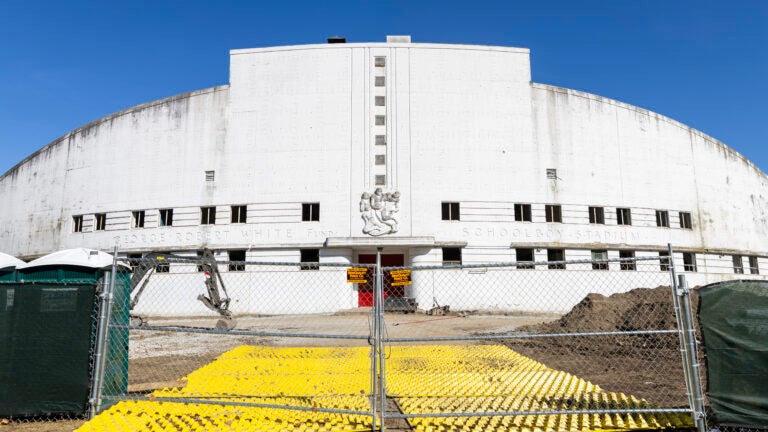
As Boston Mayor Michelle Wu seeks reelection, the cost of one of her signature projects is taking on a major role in the race against Josh Kraft. The two continued to clash over the White Stadium redevelopment project this week, with Kraft accusing Wu of “catastrophic” mismanagement. The mayor, in turn, refuted cost estimates shared by the Kraft campaign and maintained her complete commitment to the project.
Wu is pursuing an ambitious plan to remake White Stadium, the dilapidated field where many of the city’s student-athletes play. The stadium, built in 1949, has been in a state of disrepair for years. It does not meet current safety codes or accessibility requirements, and student-athletes do not have space for modern amenities. It was last renovated in the ’80s, and a fire seriously damaged it in the ’90s. Even Wu’s opponents agree that something should be done to improve conditions there.
The mayor’s solution is a public-private partnership with Boston Legacy FC, a new professional women’s soccer team that will share the field with Boston students. The team is financing half of the project.
There has been considerable opposition from local groups, who argue that the project would negatively impact traffic, change the historic character of Franklin Park, and shortchange the city’s student-athletes. Some of these issues took center stage in a legal battle that played out earlier this year. A judge ruled in favor of the Wu administration, clearing the way for construction to continue.
But despite that legal victory, many residents are still concerned about the project’s rising costs. Officials within the Wu administration initially estimated that the city would spend about $50 million, only for the estimate to rise to $91 million. Wu has been adamant that the city is not offering a “blank check,” despite saying earlier that it would pay for half the stadium “no matter what it costs.”
The final cost for taxpayers is still unclear. Demolition and construction work is underway, but the road ahead is long. The Legacy initially hoped to play in a fully renovated White Stadium beginning in March 2026. But the club recently announced plans to play its inaugural season in Gillette Stadium, since the White Stadium project will not be done in time.
Josh Kraft, Wu’s major opponent in this year’s mayoral race, has sought to capitalize on the discontent surrounding the project. He rallied with those opposing the project earlier this year and called for demolition work to be stopped.
On Monday, Kraft convened a press conference to publicize new “internal city estimates not shared with the public.” The Wu administration, he said, now estimates that the city will have to spend roughly $170 million to complete the renovation.
“Mayor Wu regularly takes to the stump to criticize those who ‘hand the keys over to billionaires’ when deciding public policy. Some think she’s talking about me,” Kraft said in a statement. “But when it comes to White Stadium and the wealthy owners of Boston Unity Partners, she’s not only handing the keys to billionaires – she’s giving them the whole car. And she’s sticking us with the bill.”
On Tuesday, Wu used her monthly appearance on GBH’s “Boston Public Radio” to refute the cost estimate shared by Kraft.
Wu said that, after Kraft’s press conference Monday, she asked her staff to look into where the $170 million figure came from. She confirmed that it did come from an internal city document, but one that represented an “absolute worst-case scenario” that is “highly unlikely” to unfold.
“That is not a real number, that is not the real cost,” she said. “It’s harmful, it’s disrespectful, it’s offensive to the hardworking professional teams who do this in the city.”
Wu admitted that she does expect costs to rise somewhat, citing President Donald Trump’s chaotic tariff policy as having increased the price of steel “significantly.”
When pressed about what the current cost estimate actually is, Wu declined to offer a specific figure. Specific construction documents will be put out for bidding later this summer, and more concrete estimates will become clear at that time, she added.
Get everything you need to know to start your day, delivered right to your inbox every morning.





To comment, please create a screen name in your profile
To comment, please verify your email address
Conversation
This discussion has ended. Please join elsewhere on Boston.com