
Sign up for the Today newsletter
Get everything you need to know to start your day, delivered right to your inbox every morning.
The Trump administration increased its public pressure campaign against so-called “sanctuary” jurisdictions this week. The Department of Homeland Security published a list of places nationwide that are allegedly “deliberately obstructing the enforcement of federal immigration laws” and threatened further action if local officials do not change their policies.
The list of sanctuary jurisdictions includes all of Massachusetts, but federal officials also singled out a number of municipalities such as Boston, Cambridge, Somerville, Springfield, and Chelsea. (See full list below.)
DHS officials say they are purposefully “exposing” these “lawless jurisdictions” to the public in order to increase public awareness and force policy changes.
“These sanctuary city politicians are endangering Americans and our law enforcement in order to protect violent criminal illegal aliens,” DHS Secretary Kristi Noem said in a statement. “We are exposing these sanctuary politicians who harbor criminal illegal aliens and defy federal law. President Trump and I will always put the safety of the American people first. Sanctuary politicians are on notice: comply with federal law.”
While there is no single set definition of what it means to be a sanctuary jurisdiction, the term generally refers to places where local authorities are limited in how they can cooperate with federal immigration enforcement. According to the Trump administration, these are places that “protect dangerous criminal illegal aliens from facing consequences.”
The actual specifics are more complicated and vary from place to place, but sanctuary jurisdictions do not shield immigrants from deportation and they can still be prosecuted for criminal activity. Judges have repeatedly ruled that the Tenth Amendment actually prohibits the federal government from forcing local officials to participate in immigration enforcement.
In April, Trump signed an executive order threatening to cut off funding from sanctuary jurisdictions and other actions. A judge then barred the government from withholding funds for now, ruling that portions of the order were unconstitutional.
The executive order also directed officials to publish a list of jurisdictions that apparently obstruct federal immigration enforcement. The list was compiled using “factors like compliance with federal law enforcement, information restrictions, and legal protections for illegal aliens,” according to DHS officials. It will be updated regularly.
Individual jurisdictions will receive formal notification of their noncompliance, according to DHS. The agency is demanding that local leaders review and revise their policies to align with federal priorities.
| COUNTIES: |
| Barnstable County |
| Berkshire County |
| Bristol County |
| Dukes County |
| Essex County |
| Franklin County |
| Hampshire County |
| Middlesex County |
| Nantucket County |
| Norfolk County |
| Plymouth County |
| Suffolk County |
| Worcester County |
| CITIES: |
| Amherst |
| Boston |
| Cambridge |
| Chelsea |
| Concord |
| Holyoke |
| Lawrence |
| Newton |
| Northampton |
| Orleans |
| Somerville |
| Springfield |
It is unclear if those formal notifications have been received yet. Spokespeople for leaders including Gov. Maura Healey did not respond to requests for comment Friday morning.
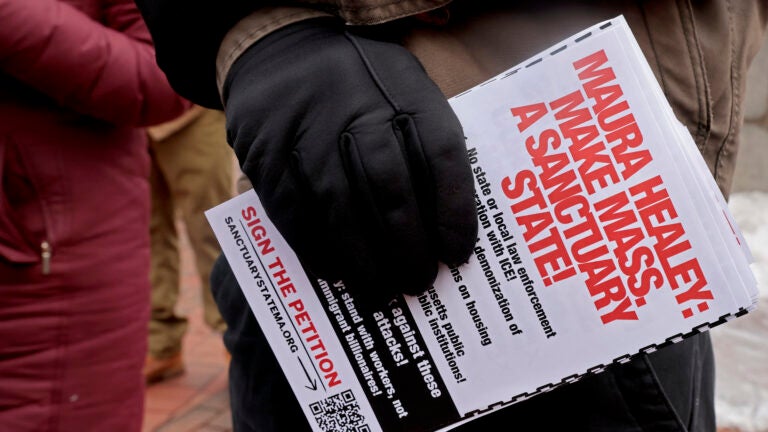
Much of Healey’s time in office has been spent responding to a surge in migration and the subsequent shelter crisis. She frequently calls for lawmakers in Washington to pass comprehensive immigration reform, and has been adamant that Massachusetts should not be considered a sanctuary state.
A Massachusetts Supreme Judicial Court ruling from 2017 makes clear that local law enforcement cannot arrest someone solely because federal authorities believe they are subject to deportation. Some groups that support increased immigration enforcement use this decision as evidence that Massachusetts is a sanctuary state, while other experts argue that the state is not a true sanctuary jurisdiction.
Many individual municipalities have their own laws on the books as well. The Boston Trust Act, for example, orders the city’s police department to only collaborate with ICE on issues of significant public safety importance, like cases of child exploitation and human trafficking. It was originally enacted in 2014 and recently reaffirmed by the City Council.
Boston Mayor Michelle Wu is a vocal advocate for the law, arguing that it increases public safety by strengthening trust between residents and police. If people do not fear the BPD will deport them, they are more likely to report crimes and engage with their communities, the argument goes. GOP lawmakers convened a high-profile Congressional hearing in March to grill Wu and the leaders of other cities with similar laws on the books. Some Republicans said they would refer Wu and the other mayors to the Department of Justice for a criminal investigation.
Trump’s “border czar” Tom Homan and Wu have engaged in a war of words for months, and Homan has taken a particular interest in immigration enforcement in Boston. He vowed to “bring hell” to the city and ICE followed that up by engaging in a heavily publicized operation earlier this spring.
When asked about the recent developments during an unrelated event Friday, Wu told reporters that she was called to testify in Washington under the “false pretense” that Boston was violating federal law.
“We’ve been in this back and forth for some time now,” she said.
Wu stressed that Boston authorities are constantly collaborating with state and federal agencies to enforce cases involving drug trafficking, cybercrimes and more.
“In this particular case, when it’s around mass deportation and going after immigrants who do not have a criminal warrant attached to them, that is not the job of city officials to do what the federal government is doing,” Wu said. “We follow the law here in Boston.”
Somerville Mayor Katjana Ballantyne echoed a similar sentiment, saying that the city abides by all federal laws and should not see federal action if the Trump administration “sticks to the law and the Constitution.”
However, Ballantyne added that her administration is preparing for “possible assaults on the rule of law that may be directed at Somerville for no good reason.”
“For now, Sanctuary cities and universities may be among the first targets, but we’d all do well to recognize that when we trade the rule of the law for the rule of one man, anyone can be next,” Ballantyne said in a statement Friday.
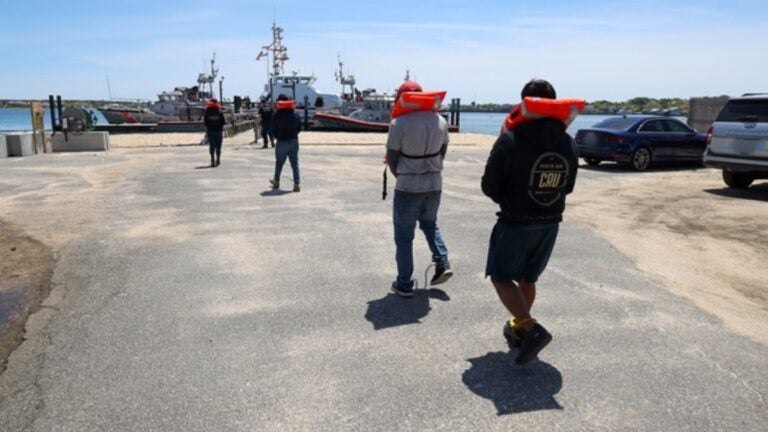
Amid reports that White House officials are pressuring immigration enforcement agents to meet daily arrest quotas, ICE activity appears to be increasing around the state. Earlier this week, agents on Martha’s Vineyard and Nantucket arrested around 40 “alien offenders.”
In response, Healey demanded more information from the federal government.
“We have zero information,” she said. “Local police chiefs have zero information about what’s happening in their communities. We at the state level have zero information about what’s happening in communities, and that needs to change. We need to get answers. We need to get clarification from ICE.”
Get everything you need to know to start your day, delivered right to your inbox every morning.





To comment, please create a screen name in your profile
To comment, please verify your email address
Conversation
This discussion has ended. Please join elsewhere on Boston.com